
Reported characteristic quirks in Cat Breeds
Compare breeds by reported characteristic quirks. The ordering follows the characteristic itself rather than the alphabet whenever a meaningful order exists.
Discuss Reported characteristic quirks in the forum
| # | Breed | Reported characteristic quirks |
|---|---|---|
| 1 | Adult coloration can take about two years to develop The misted coat can continue developing for roughly two years before reaching its full adult coloration. | |
| 2 | Calm “four feet on the floor” temperament A British Longhair often chooses a place beside its person rather than climbing onto a lap or seeking acrobatic heights. | |
| 3 | Coat type can change over time A Peterbald born with hair may change coat type as it matures, and the breed spans everything from bald skin to an ordinary coat. | |
| 4 | Distinctive conversational repertoire and strong fetch/agility tendencies. Japanese Bobtails are often highly interactive and can learn retrieval games; many use a broad range of chirps and trills, giving rise to the familiar impression of a cat that 'sings' to its people. | |
| 5 | Every pom-pom tail is structurally individual The short pom-pom tail is a defining feature, and its exact shape and structure vary from cat to cat. | |
| 6 | Exceptional climber; often seeks cabinet-top height Powerful hind legs make high places especially attractive, and cabinet tops are ordinary destinations. | |
| 7 | Frequently uses paws/touch to initiate interaction with people. Havana Browns often investigate objects by touching them with a paw and may repeatedly reach toward a person or new item before moving closer, giving their curiosity a particularly tactile quality. | |
| 8 | High-place seeking and unusually persistent involvement in household activity are characteristic Abyssinian quirks. Abyssinians are famous for seeking high vantage points and involving themselves in whatever their people are doing. | |
| 9 | Highly acrobatic and prone to inventing its own entertainment Devon Rex are clever, mischievous cats; if left bored for too long they readily invent their own games. | |
| 10 | Highly interactive; may sleep under the covers with people Orientals often seek intense involvement with their people and may sleep under the covers or pile together with companions. | |
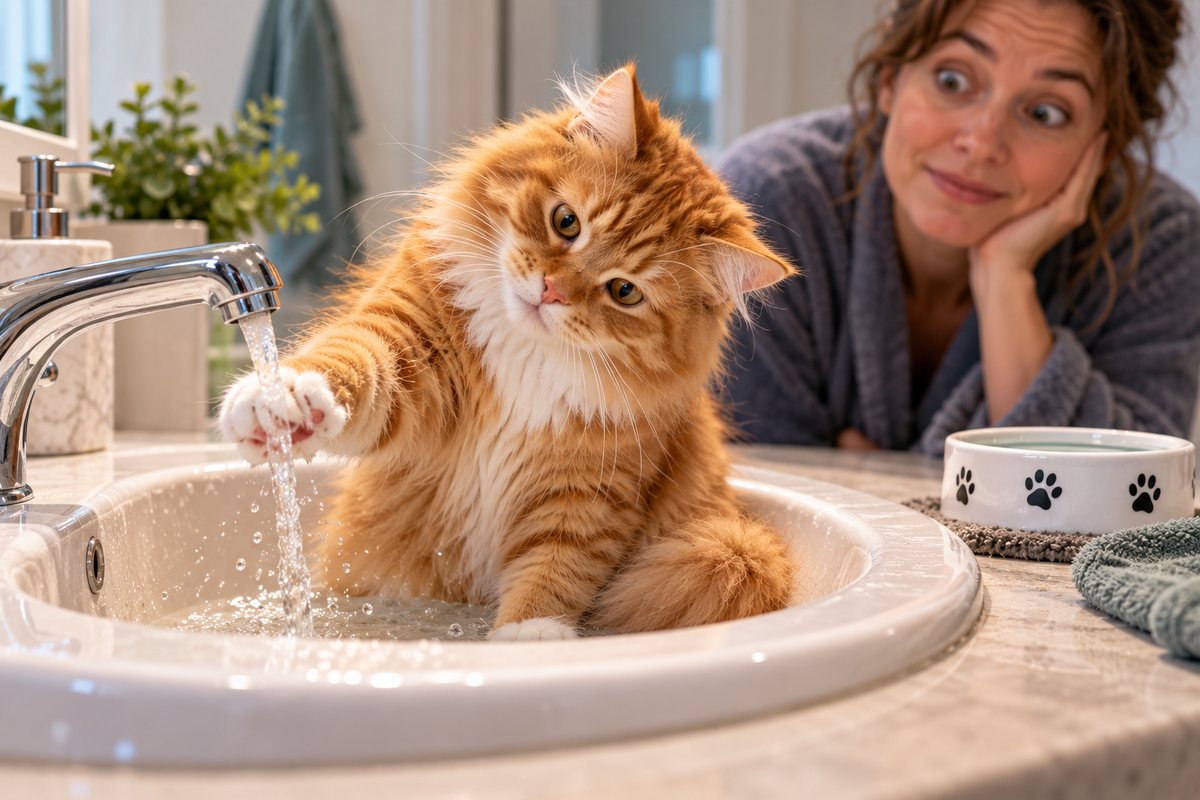
| 11 | Individual quirks often center on play and exploration Aegeans often show a strong fascination with water and fishing-like play, pawing at dripping taps or watching water closely—an apt quirk for a breed rooted in the Greek islands. | |
| 12 | Individual quirks often center on play and exploration American Ringtails characteristically carry the tail curled over the back when relaxed or interested, yet can straighten it. Owners may notice the tail becoming an unusually expressive part of greeting and exploration. | |
| 13 | Individual quirks often center on play and exploration American Wirehairs often combine a calm manner with bursts of practical hunting play; some become intensely interested in insects, window watching and small moving objects despite otherwise undemanding behavior. | |
| 14 | Individual quirks often center on play and exploration Aphrodite Giants are often surprisingly agile for their size, with a fondness for climbing and surveying rooms from elevated positions rather than behaving like sedentary giant cats. | |
| 15 | Individual quirks often center on play and exploration Arabian Maus commonly retain a strong evening activity rhythm and may patrol the home, investigate windows and demand vigorous play when quieter companion cats are settling down. | |
| 16 | Individual quirks often center on play and exploration Asian cats often make themselves part of household routines, following people between rooms and investigating bags, cupboards or whatever is being handled. Their curiosity can make privacy scarce. | |
| 17 | Individual quirks often center on play and exploration Tiffanies often combine the Asian group's people-following curiosity with a softer longhaired presentation; some develop persistent greeting rituals and supervise household tasks from very close range. | |
| 18 | Individual quirks often center on play and exploration Bambinos can look physically unusual yet behave like determined little climbers, using furniture in stages and seeking warm laps, blankets and sunny spots with notable persistence. | |
| 19 | Individual quirks often center on play and exploration Bombays are well known for warmth-seeking and may burrow under blankets, occupy freshly vacated warm seats or press closely against people while also insisting on joining household activity. | |
| 20 | Individual quirks often center on play and exploration Brazilian Shorthairs often retain alert, opportunistic habits: watching doors and windows, investigating new objects quickly and turning ordinary household movement into hunting-style play. | |
| 21 | Individual quirks often center on play and exploration California Spangled cats were selected to look wild while remaining domestic; accounts emphasized athletic climbing and an inclination to perch at eye level or above. | |
| 22 | Individual quirks often center on play and exploration Chantilly-Tiffany accounts often describe a soft conversational voice rather than constant loud calling, with some cats using small chirps or trills while following a favored person. | |
| 23 | Individual quirks often center on play and exploration Cherubim are developing as highly companion-oriented cats, and owners can encounter persistent shadowing from room to room, alternating relaxed lounging with sudden playful engagement. | |
| 24 | Individual quirks often center on play and exploration Colorpoint Shorthairs often turn vocal communication into a two-way routine, answering people, commenting on closed doors or delayed meals and persisting until they receive a response. | |
| 25 | Individual quirks often center on play and exploration Cymrics often pair their rounded, tailless appearance with powerful hindquarter play, including rapid acceleration and climbing; some also retrieve toys or carry favorite objects. | |
| 26 | Individual quirks often center on play and exploration Cyprus cats often show strong climbing and observation habits, using shelves, trees or high furniture readily. Individuals with outdoor backgrounds may remain particularly attentive to birds, insects and window movement. | |
| 27 | Individual quirks often center on play and exploration Dragon Li cats are often portrayed as observant hunters that form routines around watching territory, studying activity first and then joining on their own terms. | |
| 28 | Individual quirks often center on play and exploration Dwelfs often combine intense warmth-seeking with determined exploration: blankets, clothing and laps become favored heat sources, while short legs do not stop them devising staged routes onto furniture. | |
| 29 | Individual quirks often center on play and exploration European Burmese frequently turn companionship into participation, following people, investigating whatever is being handled and using persistent vocal or physical prompts when excluded. | |
| 30 | Individual quirks often center on play and exploration European Shorthairs often retain strong practical hunting behavior; indoor cats may develop elaborate stalking routines around flies, toy mice or window wildlife. | |
| 31 | Individual quirks often center on play and exploration Foldex cats often combine quiet companion behavior with playful Scottish-family curiosity. Some use conspicuous upright or sprawled resting postures, although posture should never be used to dismiss stiffness or pain. | |
| 32 | Individual quirks often center on play and exploration German Longhairs often act as calm observers, choosing a strategic place near family activity and then switching quickly from composed lounging to energetic play when invited. | |
| 33 | Individual quirks often center on play and exploration German Rex cats often seek body warmth and close contact, sometimes burrowing into bedding, while their playful Rex temperament can make small household objects irresistible targets for batting and carrying. | |
| 34 | Individual quirks often center on play and exploration Kanaani cats can be notably vertical and exploratory, often preferring high shelves, tall cat trees and active patrol routes through the home. | |
| 35 | Individual quirks often center on play and exploration Khao Manees are often intensely interactive and curious, with some using chirps, trills and close face-to-face inspection when greeting people or investigating something new. | |
| 36 | Individual quirks often center on play and exploration Kinkalows can be surprisingly inventive about vertical movement despite short legs, using intermediate surfaces as steps while approaching play with persistent kitten-like enthusiasm. | |
| 37 | Individual quirks often center on play and exploration Korean Bobtails are associated with expressive short tails whose movement can be conspicuous during greeting or excitement. The population is too sparsely documented to assign a more specific universal behavioral hallmark. | |
| 38 | Individual quirks often center on play and exploration Korn Ja cats are traditionally regarded as auspicious Thai cats, making their strongest distinctive quirk cultural rather than behavioral: stories attach good fortune to their dark coloration. | |
| 39 | Individual quirks often center on play and exploration Lambkins can combine a teddy-bear appearance with determined play, often finding low or staged routes onto furniture rather than abandoning climbing. | |
| 40 | Individual quirks often center on play and exploration LaPerms are often unusually tactile with people, using paws, head rubs and close face contact; some readily ride on shoulders or settle around the neck. | |
| 41 | Individual quirks often center on play and exploration Mekong Bobtails are often described as dog-like, with some retrieving toys, following people closely or greeting at the door. Their short kinked tail can also be highly expressive. | |
| 42 | Individual quirks often center on play and exploration Minskins often seek warm skin-to-skin contact, blankets and heated resting places, yet remain curious and playful. Their short legs can encourage staged routes through chairs and low furniture. | |
| 43 | Individual quirks often center on play and exploration Minuets often retain kitten-like floor-level play and may follow people from room to room. Many solve height by using intermediate furniture rather than abandoning the attempt to climb. | |
| 44 | Individual quirks often center on play and exploration Neva Masquerades often show the Siberian family's fascination with water, pawing at bowls or investigating taps, while their heavy coat can hide a surprisingly acrobatic playful streak. | |
| 45 | Individual quirks often center on play and exploration Ocicats commonly learn to retrieve, walk on a harness or respond to simple cues, and many recruit people into games by carrying or presenting toys. | |
| 46 | Individual quirks often center on play and exploration No distinctive behavior is securely tied to the Ojos Azules eye-color mutation. Its genuine oddity was visual—deep blue eyes occurring without the usual white or colorpoint explanation—so individual behavioral anecdotes should not be generalized. | |
| 47 | Individual quirks often center on play and exploration Historical Oregon Rex accounts center more on the unusual curly coat than on a unique behavior. A modern claim of an 'Oregon Rex personality' would be anachronistic because the distinct breeding population is extinct. | |
| 48 | Individual quirks often center on play and exploration Oriental Bicolors often behave like other Orientals: highly conversational, investigative and inclined to follow people closely, sometimes developing elaborate vocal routines around doors, meals or bedtime. | |
| 49 | Individual quirks often center on play and exploration Oriental Longhairs often turn household life into a shared project, following people, climbing to shoulder or eye level and answering speech with persistent vocalizations. | |
| 50 | Individual quirks often center on play and exploration Pixie-bobs are often described as dog-like, with reports of retrieving toys, learning leash routines and following family members. Some use chirps and chatters more than ordinary meows. | |
| 51 | Individual quirks often center on play and exploration Raas cats are surrounded by local stories, but the population is too sparsely documented for a dependable behavioral hallmark. Alert, athletic environmental exploration is the most defensible recurring tendency. | |
| 52 | Individual quirks often center on play and exploration Russian Blues often develop precise household routines and may appear at the same place for meals, play or bedtime each day, then reveal a playful private side once the home is quiet. | |
| 53 | Individual quirks often center on play and exploration Sam Sawet is more culturally distinctive than behaviorally documented: Thai tradition attaches auspicious meaning to the type, while evidence is too thin to claim a particular trick as breed-wide. | |
| 54 | Individual quirks often center on play and exploration Scottish Straights often show quiet, observant companion habits, including unusual lounging postures and following people without constant vocalizing. Persistent odd posture with stiffness should be treated as a health sign, not a cute quirk. | |
| 55 | Individual quirks often center on play and exploration Selkirk Rex cats are sometimes nicknamed for a tousled 'bad hair day' appearance, and many pair that comic coat with a patient habit of staying near household activity. | |
| 56 | Individual quirks often center on play and exploration The Serrade Petit is too sparsely documented for a defensible signature trick. Individual exploratory and play routines should carry more weight than folklore attached to the rare breed label. | |
| 57 | Individual quirks often center on play and exploration Siberians are often fascinated by water and may paw at bowls or taps, while their powerful build does not stop ambitious jumps to high perches. Some also retrieve toys persistently. | |
| 58 | Individual quirks often center on play and exploration Sokokes are often described as intensely active climbers that use vertical space as readily as floor space. Some accounts also note interest in water and a habit of accompanying people through household activity. | |
| 59 | Individual quirks often center on play and exploration Suffolks inherit the Oriental-family tendency to converse and supervise: a cat may follow its person, investigate every new object and produce a running vocal commentary when routines change. | |
| 60 | Individual quirks often center on play and exploration Suphalaks carry strong Thai cultural lore associated with value and good fortune. Reliable breed-wide behavioral quirks are much less documented, so those stories should not be converted into claims about every cat. | |
| 61 | Individual quirks often center on play and exploration Tennessee Rex cats are memorable for a curly coat that can appear to shimmer with a satin-like sheen as it moves. Behavioral documentation is limited, making this visual effect a firmer breed quirk than any claimed universal trick. | |
| 62 | Individual quirks often center on play and exploration Thai cats often conduct extended conversations with familiar people, following them through the home and varying vocal sounds in response to attention. Many also turn interactive games into daily rituals. | |
| 63 | Individual quirks often center on play and exploration These Thai color varieties share the breed's vocal, interactive household routines; unusual lilac or blue-point coloring changes appearance, not the tendency toward conversational following and close supervision. | |
| 64 | Individual quirks often center on play and exploration Tonkinese often combine Burmese persistence with Siamese sociability: many retrieve toys, ride on shoulders, open lightweight doors or cabinets and insist on participating in household activity. | |
| 65 | Individual quirks often center on play and exploration The Transylvanian is still too new for a stable folklore of behavior. Early selection emphasizes companion temperament, but any claimed signature trick should remain provisional until reports accumulate across unrelated lines. | |
| 66 | Individual quirks often center on play and exploration Turkish Vankedisi can share the Turkish-cat fascination with moving water and high observation points. In all-white individuals, apparently ignoring a sound should not be labeled quirky independence before hearing status is known. | |
| 67 | Individual quirks often center on play and exploration Ukrainian Levkoys often seek warmth under blankets or against people because of sparse coat coverage. Warmth-seeking is a more defensible recurring quirk than any supposed breed-specific trick. | |
| 68 | Individual quirks often center on play and exploration Historical York Chocolate descriptions emphasized affectionate, people-following cats that could be interested in water. With the breed effectively unavailable, these are best treated as historical tendencies. | |
| 69 | Individual quirks often center on social routines Himalayans often develop quiet companionship rituals—occupying the same nearby chair, appearing for grooming or settling beside a familiar person—rather than the intrusive supervision seen in highly active breeds. | |
| 70 | Individual quirks often center on social routines Persians often turn comfort into a routine, selecting favored resting stations and appearing at predictable times for grooming or attention. Their placid reputation does not exclude occasional short, comic bursts of play. | |
| 71 | Individual quirks often center on social routines RagaMuffins often greet familiar people and then settle very close, sometimes going conspicuously limp and relaxed when comfortably held. That relaxed handling style is a tendency rather than a guarantee. | |
| 72 | Known for upright “prairie-dog” and human-like sitting postures Scottish Folds are known for unusual sitting positions, including sitting upright to inspect a sound and the so-called Buddha sit. | |
| 73 | Likes shoulders, drawers, closets and high places A Singapura may ride on a shoulder, investigate drawers and closets, or seek the highest available shelf. | |
| 74 | Many are fascinated by water and may swim Snowshoes are unusually interested in water; some will splash, join a bath or even swim. | |
| 75 | Many relax or go limp when comfortably held The breed name reflects the tendency of many Ragdolls to relax heavily in the arms when they feel secure. | |
| 76 | May empty cupboards and needs child-proofing Chausie curiosity can be remarkably practical: some learn to open cupboards and remove the contents, leading owners to fit child-proof latches. | |
| 77 | May open doors, operate faucets and play in water Their intelligence and curiosity can show up as opening doors, turning on faucets, flushing toilets or playing in water. | |
| 78 | May ride on a person’s shoulder Some Balinese enjoy leaping onto a familiar person’s shoulder and riding there. | |
| 79 | May sit upright on hind legs and often reaches high places through staged smaller jumps. Munchkins are often reported to sit upright on their hindquarters to survey a room, a posture made conspicuous by short legs. Some also cache small toys or shiny objects, although neither habit occurs in every cat. | |
| 80 | Naturally tiny but not delicate The Toybob combines an unusually small body with a sturdy, muscular feel and a naturally kinked bobtail. | |
| 81 | Not every Manx is tailless Although taillessness is iconic, Manx kittens can be born with no tail, a short tail or even a full-length tail. | |
| 82 | Notably quiet voice relative to body size; often communicates without frequent meowing. Chartreux are famously quiet for such substantial cats; many use small chirps or trills rather than frequent meowing and can follow household activity with an understated, watchful presence. | |
| 83 | Often fascinated by water and may learn to operate faucets Maus are notably clever and some teach themselves to open doors or drawers and even turn on a faucet. | |
| 84 | Often follows people from room to room A Birman commonly follows its people through the home and likes to remain physically close. | |
| 85 | Often joins children’s games and household activities Burmese commonly insert themselves into family activities and may tolerate surprisingly involved play with children. | |
| 86 | Often learns leash walking, fetch and agility Toygers are unusually trainable for a cat and many take readily to leash walking, fetch, agility or an exercise wheel. | |
| 87 | Often observes from high places before joining in A Nebelung may retreat upward and quietly study a situation before deciding to participate. | |
| 88 | Often remains kitten-like into adulthood Burmillas commonly retain a playful, mischievous, kitten-like quality well into adult life. | |
| 89 | Often remains playful into old age American Shorthairs commonly retain a playful streak well into later life. | |
| 90 | Often seeks high vantage points; vocal style varies widely Korats often seek high perches to supervise their surroundings. Some are exceptionally quiet while others have much more to say. | |
| 91 | Often uses chirps/trills despite relatively low overall vocalization; many show unusual fascination with water. Maine Coons are well known for chirps and trills that can sound surprisingly delicate from such a large cat. Many also show unusual interest in water, pawing at bowls or investigating sinks and showers. | |
| 92 | Often watches dripping water and quietly studies puzzles Exotics can be fascinated by simple things such as dripping water and may patiently study how to retrieve an inaccessible toy. | |
| 93 | Opens doors and cabinets · retains kittenlike playfulness American Curls are noted for retaining kitten-like playfulness into adulthood, and some become adept at opening doors and cabinets. | |
| 94 | Prefers four feet on the floor; occasional kitten-like bursts British Shorthairs are notably grounded cats: usually calm and deliberate, punctuated by occasional bursts of kitten-like play. | |
| 95 | Registry material repeatedly notes unusual travel adaptability. American Bobtails are frequently described as dog-like: some retrieve toys, adapt readily to harness travel and greet people at the door. Their flexible shortened tail can become especially animated during greeting routines. | |
| 96 | Reported 'werewolf' appearance combines with unusually explicit stalking/search play behavior. Lykois can undergo striking seasonal coat changes, sometimes losing much of their sparse coat and later regrowing it. That visual transformation can be more dramatic than ordinary shedding. | |
| 97 | Retrieves toys · follows people · uses paws like hands Cornish Rex are known for following their people, retrieving favourite toys and using their long-toed paws with unusual dexterity. | |
| 98 | Seeks close physical warmth/contact and is unusually people-centered. Sphynx cats are persistent heat-seekers and may burrow under blankets, climb inside clothing or monopolize warm electronics and laps. Their lack of coat makes close skin contact especially common. | |
| 99 | Seeks the highest available viewpoints Somalis are famous for exploring upward and may appear on refrigerators, doors and bookcases to supervise the room. | |
| 100 | Some kittens lose their coat progressively A Donskoy may be born with hair and gradually lose much of it, making coat development unusually dynamic. | |
| 101 | Strong conversational relationship with people Siamese often turn vocal communication into an ongoing conversation with their people. | |
| 102 | Strongly associated with unusual interest in water; affectionate but often prefers contact on its own terms. Turkish Vans have a longstanding reputation for fascination with water; some paw in bowls, investigate taps or voluntarily play in shallow water. The 'swimming cat' label does not mean every individual enjoys being put into water. | |
| 103 | Tail wags · clownish antics The expressive short tail may wag with excitement, and the breed is known for clownish, attention-seeking antics. | |
| 104 | Unusual affinity for water; some swim Many Turkish Angoras are fascinated by water, and some will enter baths, showers or pools and swim. | |
| 105 | Water interest, object manipulation and high-place exploration are repeatedly reported together. Bengals are notorious for turning water and household mechanisms into entertainment: many paw in sinks or showers, drop toys into water, investigate taps and learn to open simple doors or cupboards. | |
| 106 | “Velcro” attachment after acclimation After an initially cautious period, some Serengetis become remarkably persistent followers of their people. |





































































































Breed comparisons describe tendencies, not guarantees about an individual cat. Approximate entries are kept separate from the canonical research record and can be refined as better evidence arrives.
 English