
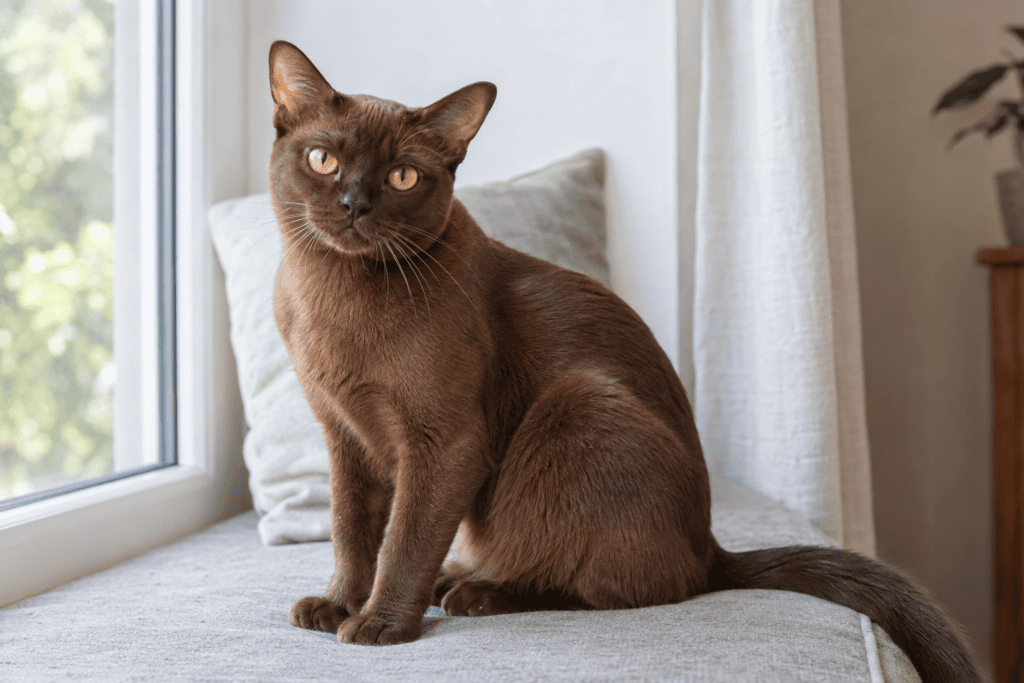
The European Burmese is a sociable, physically moderate cat that often wants to be involved in household life. It can be an excellent companion for someone who enjoys interactive play, conversation and a cat that follows the rhythm of the home. The same social intensity can be difficult for a household seeking a quiet, highly independent pet.
Quick Facts
| Feature | Practical description |
|---|---|
| Build | Medium-sized, muscular and moderate rather than extremely compact or angular |
| Head | Short blunt wedge, broad cheekbones, strong chin and lower jaw |
| Ears and eyes | Medium, fairly wide-set ears and large, wide-set eyes |
| Coat | Short, fine, glossy, close-lying and usually sparse in undercoat |
| Classification | Registry-dependent; confirm the pedigree and applicable color standard |
There is also a practical complication before temperament or appearance: “European Burmese” is not used identically by every cat registry. A prospective caregiver should confirm the pedigree, named registry and breeder’s terminology rather than assuming that European Burmese, Burmese and British or European Burmese are interchangeable labels.
Identity, recognition and history
The European Burmese developed from the same Burmese ancestry associated with Wong Mau, but breeding programs on opposite sides of the Atlantic followed different ideals. The European type remained moderate and gently rounded, while the American Burmese developed along a more compact, rounded path in some lines. These are related cats, not simply two coat names for one universally defined standard.
Registry language determines how that distinction appears on paper. The Cat Fanciers’ Association recognizes European Burmese as a separate championship breed, with championship status dating from 2002, and publishes a dedicated European Burmese standard. The World Cat Federation also publishes a European Burmese standard. FIFe, TICA and GCCF public breed materials generally use Burmese rather than consistently presenting European Burmese as a separate breed.
That difference matters when buying a kitten, importing a cat or planning to show. Ask which registry issued or will issue the pedigree, what breed name appears on it, and whether the breeder’s “European” terminology refers to a recognized breed, a breeding line or a regional type. A pedigree is more informative than a visual impression because the same-looking cat may be classified differently under different systems.
What the European Burmese looks like
The European Burmese is a medium-sized, muscular shorthaired cat with a moderate outline rather than an extremely cobby or strongly oriental one. Its head is a short, blunt wedge, with broad cheekbones, a strong chin and lower jaw. The ears are medium in size and set fairly wide apart, while the eyes are large and also widely spaced.
The coat is fine, glossy, short and close to the body, with little or almost no undercoat. It tends to feel silky and light in the hand, but that does not mean the home will be hair-free or that the cat is hypoallergenic. No reliable breed-specific shedding rate or seasonal pattern establishes either expectation.
Color terminology depends on the registry. Under the CFA system, recognized colors include brown, blue, chocolate, lilac, red, cream and four tortoiseshell-based colors. The WCF standard uses broader categories that include solid, tortoiseshell, tabby, silver and smoke. Eye expectations also vary with the applicable standard and coat category; CFA permits shades from yellow-gold through amber. Buyers should therefore ask to see the standard used for the particular pedigree rather than treating one list as universal.
There is no established European-Burmese-specific target weight or fixed maturation timetable. A healthy body condition, good muscle tone and regular veterinary assessment are more useful than trying to make an individual cat fit an assumed number.
Temperament and everyday companionship
Curiosity, playfulness and a strong interest in people are central to the breed’s appeal. Many European Burmese want to know what their caregiver is doing, investigate changes in the home and participate in routines rather than remaining decorative observers. Affection may appear as following someone from room to room, greeting at the door, sleeping beside a person or seeking a vocal exchange.
This involvement creates a different responsibility from simply providing food and a comfortable bed. A European Burmese generally benefits from daily interactive play, scratching options, climbing surfaces, safe places to retreat and opportunities to investigate its surroundings. Puzzle feeders, rotating toys and short training sessions can give an active cat useful work, while vertical space helps an apartment feel larger and more interesting.
A single kitten that actively seeks company may be a poor match for a home where everyone is routinely absent for long periods. There is no defensible breed-wide rule defining how many hours a European Burmese can be left alone. A compatible feline companion may help some individuals, but it does not replace human attention, play or veterinary care. The right question is whether the household can provide dependable social contact and enrichment, not whether it can meet an invented hourly threshold.
Energy can remain substantial beyond kittenhood. One caregiver described two cats whose demanding play continued at age three, while also finding that the pair was easier to leave for a day than a single kitten with appropriate care. That experience should not be treated as a universal formula, but it illustrates why prospective owners should plan for an active adult rather than assuming the difficult stage ends at one year.
Affection and handling tolerance are separate traits. A cat may sleep close, talk frequently and seek attention while objecting to being picked up. Vocal intensity, lap preference, response to strangers and willingness to tolerate restraint vary between individuals. Meeting an adult, or watching a kitten respond to handling and recover from a change, gives more useful information about these qualities than the breed label alone.
Home life, children and other animals
An enriched apartment can suit a European Burmese. Floor area by itself does not determine welfare; secure windows, shelves or cat trees, hiding places, scratching surfaces and predictable food, water and litter resources matter more than calling the breed suitable only for houses. A secure catio or supervised outdoor activity can add variety without requiring the cat to roam.
Free roaming is not a requirement of the breed. Indoor living or controlled outdoor access avoids exposing a confident, sociable cat to traffic, disease, poisoning, predation and territorial conflict. Sociability can make a cat more willing to approach unfamiliar people or animals, which is not the same as being able to assess danger safely.
Introductions to dogs and other cats should be gradual, supervised and supported by escape routes and separate resources. Positive experiences with a dog or another cat show what may be possible with a suitable introduction and compatible individuals; they do not guarantee universal friendship. Small pets require secure physical separation because hunting safety has not been established simply by observing a cat living peacefully with a dog.
Children should be taught to let the cat approach, stop when it signals discomfort and avoid carrying or restraining it without cooperation. A European Burmese that enjoys conversation and play may still dislike rough handling. Adult supervision protects both the cat and the child while their relationship develops.
Grooming and routine care
The short, close coat usually makes grooming straightforward. A soft brush or grooming mitt can remove loose hair and provide a brief routine, with frequency adjusted to what the individual sheds and whether the coat tangles or collects debris. A light-feeling coat can still leave hair on furniture, clothing and floors, so grooming should be viewed as maintenance rather than a promise of a hairless home.
Routine care also includes nail checks, dental care, parasite prevention where appropriate and regular veterinary examinations. Introduce handling gradually, especially around paws, ears and the mouth. A cat that learns early that restraint is predictable and brief is easier to examine, but individual tolerance still matters.
Body condition deserves particular attention because no breed-specific weight range is available. Muscle, waist definition, rib coverage and changes over time are more meaningful than comparing the cat with a supposed European Burmese average. Food portions should reflect age, activity, reproductive status and veterinary advice.
Health, testing and lifespan
Burmese-derived lines have documented inherited concerns that should be discussed before purchase. Recessive Burmese hypokalemia can cause episodes of muscle weakness. A Burmese GM2 gangliosidosis variant is also included in testing guidance relevant to European Burmese. The University of California, Davis Veterinary Genetics Laboratory provides information on Burmese hypokalemia testing and Burmese GM2 testing.
Ask the breeder for the parents’ results, not merely an assurance that testing has occurred. Ask what “clear,” “carrier,” “affected” or “untested” means in that breeding program, and how the results affect pairing decisions. A DNA test addresses the specified variant; it does not certify that a kitten is free from every illness or predict its entire adult health.
Diabetes has been discussed in Burmese populations, but a complete European-Burmese-specific prevalence profile is not established. That is a reason to discuss family health openly and maintain ordinary preventive care, not a basis for declaring the breed either free of risk or inevitably prone to the disease.
No validated population longevity estimate is available specifically for European Burmese. Caregivers have reported individuals living to approximately 18, 19, 20 and 21 years. Those ages are encouraging examples of long lives, but they do not establish an expected average or a reliable lifespan range for the breed. Genetics, early care, nutrition, veterinary attention, environment and chance all influence an individual cat’s lifespan.
Finding and buying a European Burmese
Availability is locally variable. Some caregivers describe wait lists or importing from Europe, while breeders in some areas may have planned litters but no immediate kittens. The CFA breed page includes a breeder-finding route, but a listing should be treated as a starting point rather than an endorsement. One US breeder reported all kittens reserved in July 2026, illustrating how quickly availability can change rather than proving a global rarity ranking.
A dated 2026 US price source gives approximately USD 2,500–3,000 for show-quality or European-line Burmese kittens. This is an asking-price example for a mixed European-line/Burmese category, not a verified completed-sale range for CFA European Burmese. Confirm the current price, currency, deposit, registration, vaccination, microchipping, transport and return terms directly with the breeder. Adoption fees and recurring ownership costs are set by the individual rescue or organization and should not be merged with breeder pricing.
Before committing, request the named registry and pedigree, the parents’ relevant hypokalemia and GM2 results, vaccination and veterinary records, family-health information and the breeder’s policy if a kitten develops a serious problem. Ask which colors are accepted under the pedigree’s registry and whether the kitten is sold as a show, breeding or companion animal. A careful breeder should be able to explain both the paperwork and the limitations of the health information.
Is the European Burmese a good fit?
The European Burmese is a strong fit for a household that wants an engaged companion and can offer regular play, conversation, environmental interest and patient relationship-building. Its moderate appearance and relatively simple coat may suit someone who wants an athletic shorthaired cat without extensive grooming, provided they do not mistake easy coat care for low overall involvement.
It may be a poor fit for someone who is away most of the day, wants a reliably quiet and solitary cat, needs a pet that accepts frequent carrying or expects affection to mean constant lap sitting. Those are not automatic disqualifications, because individuals differ, but they are important friction points to investigate before choosing a kitten.
The most useful preparation is to describe the life the household can actually provide. Can someone play every day? Are there safe climbing and retreat areas? Would a compatible second cat be realistic? Can introductions be gradual? Is the caregiver comfortable with a cat that may follow, vocalize or demand participation? Meeting an adult from the intended line can help reveal social style, while observing a kitten’s recovery from handling and unfamiliar situations can provide clues without pretending to predict its entire personality.
What owners and caregivers say
Owners and caregivers describe rewarding relationships built around presence rather than passive companionship. European Burmese may greet people at the door, sleep beside them, trail them through the home or answer when spoken to. One caregiver described a cat that joined dog walks, approached unfamiliar dogs, perched on shoulders and delivered a long vocal complaint when the caregiver returned. That is a vivid example of outgoing sociability, not a promise that every European Burmese will be vocal or dog-friendly.
Other experiences show why “affectionate” needs interpretation. Some caregivers describe cats that seek conversation and closeness but resist being picked up. For one household, the ideal cat may be a shoulder companion; for another, it may be a cat that settles nearby and chooses contact on its own terms. Meeting the actual adult is the best way to explore that distinction.
Moving house can temporarily hide the social cat that appears in a breeder’s description. Caregivers have reported kittens hiding for several days and an adult remaining under a sofa for about four weeks before settling suddenly. A quiet safe room, familiar-smelling bedding, nearby food and water, and gradual access to the rest of the home are sensible responses. Initial caution does not necessarily contradict a later confident personality.
The most important recurring lesson is that companionship is a management need as well as a pleasant trait. A European Burmese can be wonderfully involved when its people enjoy that involvement, but the same need for play and contact can become stressful when the household expects independence. The breed label offers a useful starting point; the individual cat, its pedigree, its health information and the home’s daily routine determine whether the relationship will work.
 English