
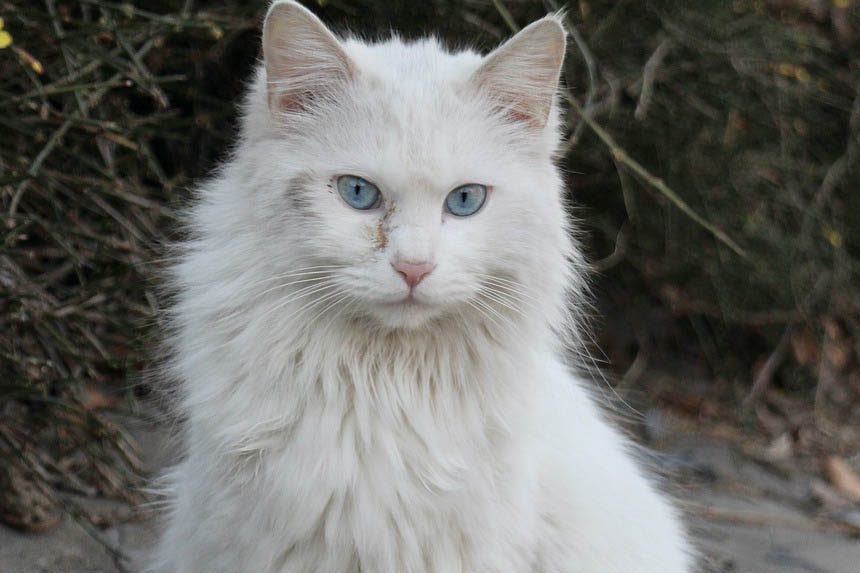
The Turkish Angora is an elegant, athletic cat whose appeal goes well beyond a white coat and unusual eyes. Life with one is often shaped by movement, curiosity and social involvement: this is a cat that may supervise household activity, invent games, climb for a better view and seek interaction on its own terms. The most useful questions for a prospective caregiver are therefore not simply “Do I like the look?” but “Can I provide enough engagement, and will I respect the kind of affection this particular cat offers?”
Quick Facts
| Breed | Turkish Angora |
|---|---|
| Adult orientation | About 5–10 lb (2.3–4.5 kg) in commonly published breed profiles; males are often larger |
| Build | Medium-sized, long and fine-boned but firmly muscled |
| Coat | Fine, silky, semi-longhaired or intermediate coat with little undercoat |
| Typical life estimate | Approximately 13–20 years in published breed profiles; an estimate, not a promise |
| Best home feature | Daily interaction, vertical territory, play and respectful handling |
Identity and recognition
The Turkish Angora is a recognized pedigreed breed associated with Ankara, formerly called Angora. It is recognized by CFA, TICA and FIFe, although those organizations use their own standards, color rules and registration terminology. A cat’s appearance does not prove its ancestry: for example, CFA registration requires a three-generation pedigree. A white, longhaired or odd-eyed cat may resemble a Turkish Angora without being a documented member of the breed.
That distinction matters when comparing a pedigreed kitten with an adopted cat or shelter “Angora.” A look-alike can still be a wonderful companion, but the caregiver should not assume that visual resemblance guarantees breed-typical behavior, health history or registration eligibility. If documented ancestry is important, ask to see a verifiable pedigree and understand which registry’s requirements apply.
The breed’s history connects Turkish Angoras with cats preserved in Turkish zoological programs and with later breeding work in North America. Historical relationships with Persian breeding are part of the broader story, but they should not be reduced to the claim that every modern Turkish Angora descends directly from one particular program. The Turkish Angora is also distinct from the Turkish Van, a separate and generally more substantial breed whose characteristic color pattern is concentrated on the head and tail.
Appearance, coat and eye color
The Turkish Angora has a long, graceful outline without looking fragile. Long legs, a modified wedge-shaped head, large tufted ears and a long, plumed tail create the breed’s distinctive silhouette. The body is fine-boned, but it should also be athletic and well muscled. The commonly published weight range is an orientation rather than a target: a healthy individual may fall outside it, and body condition matters more than a number on the scale.
The coat feels fine and silky, with little undercoat. Registry descriptions differ in whether they call it semi-longhaired, intermediate or effectively single-coated, but the practical point is similar: it may be easier to comb than a dense, heavily undercoated longhair. That does not make it hair-free or maintenance-free. Seasonal fullness can add a ruff, britches and a fuller tail, and the adult coat may continue developing until the cat is two or three years old.
Weekly combing is a sensible starting routine. Increase attention when loose hair, seasonal fullness or small tangles collect around the ruff, hind legs or tail. A silky coat can still leave hair on clothing and furniture, so anyone choosing the breed partly because the coat looks light should spend time with an individual cat before assuming it will suit their household.
White is historically prominent but not exclusive. Depending on the registry, accepted colors and patterns can include solid colors, smoke, tabby, tortoiseshell, calico and bi-color cats. Rules differ, and some registries exclude pointed patterns, shorthair cats or particular color classes. White cats may have blue, amber, green, green-gold or odd-colored eyes under applicable standards.
Coat texture should not be used as an allergy guarantee. No evidence establishes Turkish Angoras as hypoallergenic. A low undercoat may change the amount of visible hair or the effort needed to comb the cat, but it does not establish lower exposure to the allergens that cause reactions. If allergies are relevant, test your response around the individual cat rather than relying on its appearance.
Temperament and daily life
Activity is one of the breed’s central practical characteristics. Turkish Angoras are commonly described as athletic, curious, playful into adulthood and responsive to interactive games or reward-based training. They may enjoy chasing toys, climbing, investigating high shelves and participating in household routines. A home that provides only food, a bed and open floor space may leave an energetic cat searching for its own entertainment.
Indoor enrichment should be built vertically as well as horizontally. Tall scratching posts, cat trees, secure shelves, window perches, puzzle feeders and rotating toys give the cat different ways to climb, observe, solve problems and expend energy. Short daily play sessions are usually more useful than leaving a large collection of toys untouched. An apartment can work well when it offers safe vertical territory and regular social interaction; square footage alone does not determine suitability.
Social interest does not necessarily mean lap preference. One cat may follow a caregiver from room to room, vocalize and retrieve toys while rarely sitting still. Another may remain close to the household and welcome conversation but move away from hugs or restraint. “Affectionate” can therefore mean proximity, supervision and participation rather than being carried or held.
Handling should be taught through gradual, voluntary cooperation wherever possible. Grooming, nail care, transport and veterinary examinations become easier when a kitten or adult learns that brief handling is predictable and rewarded. Older, cat-literate children are generally a more defensible match than very young children who expect a cat to tolerate grabbing. The same principle applies to dogs and other cats: careful introductions and observation are more reliable than assuming that a social breed will accept every companion.
The breed may suit someone who wants an engaged relationship with a clever, active cat. It is a weaker match for a caregiver seeking a reliably sedentary animal, a cat that will always enjoy being held or a companion that can be left without daily play and interaction. Meeting an adult, or obtaining detailed observations from a foster home or breeder, is particularly valuable for assessing vocalization, visitor response, lap preference and handling tolerance.
Care and health planning
Routine care is relatively straightforward but still needs consistency. Comb the coat at least weekly as a starting point, inspect the ears and nails, provide scratching surfaces and maintain regular dental and veterinary care. Adjust grooming to the individual: a cat with a fuller seasonal coat or a tendency to collect tangles needs more attention than one whose coat stays smooth with little effort.
Nutrition does not require a Turkish Angora-specific formula. Feed a complete food appropriate to the cat’s life stage, monitor body condition and adjust portions with a veterinarian if weight changes. No distinctive grain-free requirement or universally mandated breed-specific testing panel is established for this breed. Claims about hypertrophic cardiomyopathy, ataxia, obesity or allergies should not be transferred from other breeds simply because the cats look similar.
White pigmentation creates one specific question for some kittens. In cats generally, white coat color—particularly when combined with one or two blue eyes—is associated with congenital deafness. White fur or odd eyes do not diagnose deafness, and a cat may have one-sided hearing loss that is easy to miss in ordinary household observation. BAER testing is the more definitive assessment.
When considering a white kitten, especially one with blue or odd eyes, ask whether hearing has been assessed and whether the assessment was behavioral or BAER-based. Request the veterinary examination, vaccination and microchip records, available family health information and a verifiable pedigree when ancestry is being represented as pedigreed. A pedigree documents lineage; it is not a guarantee of health.
Hearing status also affects safe management. A deaf cat can thrive, but outdoor roaming is especially hazardous because the cat may not detect vehicles, approaching animals or other environmental sounds. Secure windows, enclosed outdoor areas and supervised access are safer choices for any cat, and particularly important when hearing loss is present.
Published longevity estimates range from approximately 13–17 years to 15–20 years. These figures are breed-profile estimates rather than verified population life-expectancy studies, so they describe a possible span rather than a promise for an individual cat. Preventive veterinary care, genetics, nutrition, environment and ordinary individual variation all matter.
Buying, adopting and finding one
Availability in the United States appears limited compared with that of common domestic cats. A prospective buyer may find only a small number of breeders, encounter a waiting list or need to travel. Rescue placements occur occasionally, but a rescue cat described as an Angora may be a mix or a longhaired look-alike rather than a cat with registry documentation.
United States purchase examples checked in 2026 range from about US$1,000–2,000 or more for a purebred breeder kitten in an Adopt-a-Pet cost guide to US$400–3,000 in a marketplace review dated August 17, 2026. These are guide-based or asking-price examples, not a standardized completed-sale range. Region, age, pedigree, registration, breeding rights, show prospects and the breeder’s veterinary preparation can all change the comparison. A buyer should clarify what is included rather than treating the lowest figure as the normal price.
United States adoption examples checked in 2026 include approximately US$100–300 in an Adopt-a-Pet guide and a minimum fee of US$150 from a Turkish Angora rescue organization. Adoption fees generally cover some combination of veterinary care, sterilization, vaccination or transport, but policies vary. Rescue labels should be treated as descriptions of appearance or reported history unless pedigree documentation supports a formal breed claim.
The safest purchase process separates identity from suitability. For a documented pedigreed cat, review the pedigree, registration terms, contract, health records and family information. For an adopted adult, focus on the cat in front of you: ask about activity, handling, vocalization, compatibility with other animals, hearing, transition history and the kind of home the cat has previously managed well.
Is the Turkish Angora right for you?
A Turkish Angora is a promising choice for a caregiver who wants an involved, playful and athletic companion and can provide climbing space, interactive play, respectful handling and regular combing. The breed’s fine coat may simplify grooming compared with some dense longhaired cats, but it still sheds. Its social nature may bring conversation and companionship, but it does not guarantee a lap cat.
The strongest decision usually comes from combining documentation with direct observation. Verify ancestry if pedigree matters, ask precise hearing questions for white kittens, and meet the individual whenever possible. A caregiver who wants a quiet, predictable and highly handleable cat may be disappointed by an energetic or touch-sensitive Turkish Angora. Someone prepared to let the cat choose how to participate may find the breed’s intelligence, movement and companionship especially rewarding.
What owners and caregivers say
Owners describe a wide range of social styles within the breed and among cats identified as Angoras. One adopter described a vocal, sweet cat that followed people and retrieved toys, illustrating the energetic, people-oriented companion some caregivers hope for. Another caregiver described a cat that stayed socially involved and followed them around but was not especially cuddly. The difference is useful: following a person and wanting a lap are separate traits.
Handling preferences vary just as much. An adopter described an attentive, engaged cat that disliked hugs. That experience supports a practical rule for prospective caregivers: assess sociability and tolerance of restraint separately. A cat may want to be near its people while still objecting to being picked up, held tightly or groomed for too long.
Adult rehoming can require patience. A caregiver seeking advice about a nine-year-old Angora focused on the cat’s stress while adjusting to a new owner and environment. A quiet room, predictable routines, gradual access to the home and low-pressure interaction can be more helpful than trying to force immediate sociability. The cat’s age and previous experiences may matter as much as its breed label.
Rescue descriptions show further variation: a deaf adult, a shy cat better suited to an only-cat home and a quiet cat content to rest on a bed or in the sun all represent plausible individual needs. These examples do not establish a single temperament for the breed. They do show why the right question is not simply whether Turkish Angoras are “friendly,” but what this cat does with attention, handling, noise, other animals and change.
Caregivers also question whether informal paperwork, shelter labels or appearance truly establish Turkish Angora ancestry. Their uncertainty reinforces the value of treating visual resemblance and pedigree as different claims. Whether a cat is a documented Turkish Angora or a beautiful domestic longhair, the most dependable match comes from understanding that individual’s behavior, needs and history.
Selected sources
Recognition and breed standards: CFA Turkish Angora, TICA Turkish Angora and FIFe Turkish Angora.
Hearing information: Merck Veterinary Manual on deafness in cats and UC Davis Veterinary Genetics Laboratory.
Longevity and price examples: VCA breed profile, Adopt-a-Pet cost guide and Turkish Angora rescue listings.
 English