
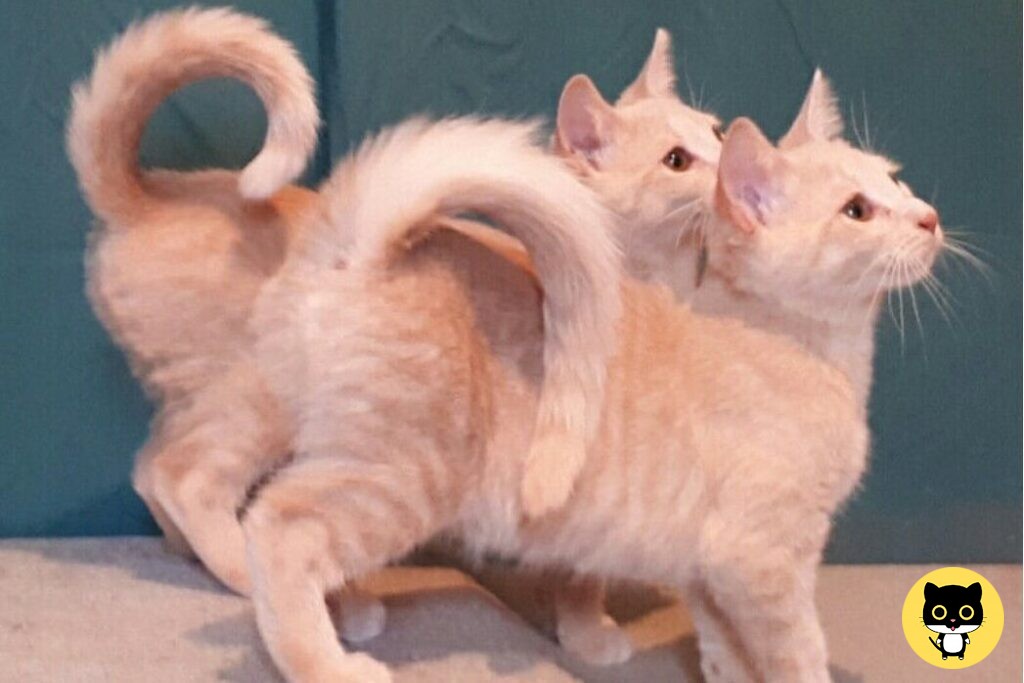
The American Ringtail is a developing domestic-cat breed identity built around an unmistakable tail: full length, flexible and capable of curving upward over the back. That feature makes the cat memorable, but it also creates the most important question for a prospective caregiver: does the cat have documented American Ringtail ancestry, or does it simply have a naturally curled or kinked tail? The shape alone cannot answer that question.
Quick Facts
| Quick fact | What to know |
|---|---|
| Breed status | A developing breed identity with historical experimental recognition; current recognition should be confirmed with the issuing organization. |
| Size | Generally described as medium-sized, athletic and muscular; no dependable breed-specific adult weight range is established. |
| Coat | Shorthaired and longhaired forms are reported, with broad variation in colors and patterns. |
| Activity | Often described as playful, curious, climbing-oriented and interactive. |
| Lifespan estimate | One veterinary breed profile gives 13–17 years; this is a planning estimate, not a measured breed-wide survival range. |
| Typical price | No reliable, dated and region-specific breeder price or completed-sale example supports a universal figure. |
Identity, history and recognition
The modern American Ringtail project is associated with a rescued California cat called Solomon and breeder Susan Manley in the late 1990s. The project developed around cats showing the characteristic tail, but the precise foundation crosses remain unsettled. It is therefore more accurate to describe the American Ringtail as a developing breed identity than to attach an unverified named-breed ancestry to every cat with a curled tail.
Recognition has also changed or remained unclear over time. Historical TICA material listed Experimental American Ringtail and Experimental American Ringtail Longhair. The current TICA records checked do not clearly show an active listing, and the current CFA and FIFe breed lists checked do not include American Ringtail. A buyer should ask which organization issued a pedigree and check that organization’s current rules rather than relying on an old webpage, a marketplace label or a breeder’s informal description. Historical recognition and current registration availability are not necessarily the same thing.
A pedigree is especially important because curled tails occur outside this breed project. A domestic cat may inherit a tail that bends or curls, and an old injury or congenital variation can produce a similar appearance. Even community accounts of curled-tailed cats include uncertainty about whether the shape reflected ancestry, development or a previous injury. The useful dividing line is provenance: a documented pedigree can support a breed claim, while an unusual tail can only describe the individual cat.
The tail: defining feature and welfare boundary
The characteristic tail is full length rather than shortened, and is described as flexible enough to curl upward over the back. Some caregivers report that a curl became more pronounced as a cat matured, while other curled-tailed cats have reportedly shown a curl that sometimes straightened. Those observations do not establish a fixed maturation schedule, but they do give a practical reason to avoid judging a kitten’s eventual tail posture too confidently.
A comfortable, flexible tail is a different situation from a sudden change. New pain, swelling, rigidity, poor movement or obvious loss of function warrants veterinary assessment. The same is true when a tail change occurs with weakness or altered urination or defecation. A caregiver should never force the tail straight or manipulate it to test its flexibility. Children should be taught not to pull, bend or handle it as a novelty.
The tail can be admired without becoming the sole measure of the cat. A graceful curl does not prove pedigree, and a less dramatic curl does not by itself determine temperament or quality. For an adopted cat, veterinary evaluation and a secure relationship matter more than assigning an uncertain label. For a purchase, the responsible sequence is documentation first, physical examination second and appearance only as one part of the picture.
Appearance and coat
The American Ringtail is generally described as medium-sized, balanced, athletic and muscular. These descriptions suggest a capable, active domestic cat rather than a breed defined by extreme body proportions. No dependable breed-specific adult weight range or precise height standard is established, so a seller’s unusually exact size promise should be treated cautiously.
Both shorthaired and longhaired forms have been reported. Colors and patterns appear broadly variable, but there is no clearly established current authoritative list that would allow a caregiver to treat one eye color, pattern or coat texture as the definitive American Ringtail look. In practical terms, the tail and documented provenance carry more identity value than a particular color.
Coat length should shape the grooming plan. A shorthaired cat may be comfortable with occasional combing, while a longhaired individual may need more frequent attention to prevent tangles around the tail, legs and collar. The tail’s curl can make visual inspection worthwhile, particularly if hair mats hide skin irritation or debris. A silky or light-feeling coat can still leave hair around the home, and there is no sound basis for calling the American Ringtail hypoallergenic.
Temperament and life with an American Ringtail
The typical picture is an active, curious and socially engaged cat. Breed profiles describe play, climbing, jumping, exploration, communication and interest in people. That combination may suit a household that enjoys interactive companionship rather than a cat expected to remain decorative or self-entertaining all day.
Sociability does not guarantee a lap cat. A friendly American Ringtail may prefer sitting nearby, following a caregiver from room to room, vocalizing, playing or choosing brief periods of contact instead of prolonged restraint. Individual accounts of curled-tailed cats range from affectionate and playful to quiet and independent, and many of those cats do not have verified pedigrees. These differences are not a contradiction: age, early socialization, previous handling and individual temperament can matter more to daily life than the tail.
Meeting an adult cat remains the best way to assess its preferences. A prospective caregiver can observe whether the cat seeks contact, tolerates being picked up, retreats from noise, enjoys play and recovers readily from unfamiliar situations. A breed description can suggest possibilities, but it cannot promise a particular level of lap contact, vocality, independence or tolerance of handling.
Other animals require the same individual assessment. Handling tolerance, dog compatibility, stress sensitivity and safety around small pets are not established breed-level guarantees. Slow introductions, separate food and toileting resources, hiding places and escape routes give the cat choices while relationships develop. A rescue placement may describe one cat as high-energy and happiest with another young cat, but that is useful information about that cat’s needs—not a rule for every American Ringtail.
Home setup and daily care
An enriched indoor home is likely to be the most comfortable setting for an active American Ringtail. Tall, stable climbing furniture, scratching surfaces, hiding places and interactive toys can turn the cat’s interest in height and movement into safe activity. Rotating toys helps prevent the environment from becoming predictable, while short play sessions allow a caregiver to meet the cat’s need for pursuit and exploration without expecting the cat to invent all its own exercise.
Vertical space should be secure rather than merely available. A cat that jumps and climbs needs shelves, trees and perches that do not wobble, as well as clear routes away from dogs, children or busy household traffic. Window access can provide enrichment, but screens must be secure. Indoor living also makes it easier to observe changes in the tail, appetite, mobility, grooming or toileting.
Routine care is ordinary cat care rather than a special Ringtail regimen. Feed a complete diet suited to the cat’s life stage, monitor body condition, provide preventive veterinary care and keep parasite control current. Dental care deserves a place in the routine, as it does for other cats. No breed-specific diet or target weight has been established, so feeding should follow the individual’s condition and veterinary guidance rather than a supposed Ringtail formula.
Health and choosing a cat
No definitive American Ringtail-specific disease predisposition or conformation-related welfare defect has been established. That should not be converted into a claim of exceptional health. It means that a caregiver should use sensible preventive care and evaluate the individual cat rather than assuming either unusual fragility or unusual invulnerability.
A pre-purchase veterinary examination is particularly valuable when the tail is central to the cat’s identity. The examination can assess the tail, general movement, body condition, eyes, mouth and overall health. Ask for kitten and parent veterinary records, relevant family history and verifiable pedigree or registry documentation. No validated mandatory American Ringtail DNA panel was identified, so a commercial genetic test should not be presented as a substitute for provenance or a veterinary examination.
One veterinary breed profile reports a lifespan of 13–17 years. That range can help a household plan for a long commitment, but it is an estimate from one profile, not a demonstrated population survival range for American Ringtails. Nutrition, preventive care, genetics, environment and ordinary individual variation will all influence how long a particular cat lives.
Availability and price
Availability appears limited and region-dependent. Some listings may use “American Ringtail” for a cat whose appearance resembles the breed without providing a pedigree. That does not make the cat less deserving of a home, but it does matter if a buyer is being asked to pay a breed premium or wants to participate in a recognized breeding program.
No sufficiently documented, dated breeder asking price, completed sale or adoption-fee example supports a general American Ringtail price claim. A responsible future price comparison would need to state the region, currency, date, age of the cat and whether the figure was an asking price, completed sale or adoption fee. Without those details, a universal number would create false precision.
Before paying, ask who registered the cat, whether the paperwork is verifiable, what the parents’ records show and what support the breeder provides after the sale. For a rescue or marketplace cat, treat the breed name as a description to investigate rather than proof of ancestry. A caregiver can choose the cat because of its personality and needs without accepting an unsupported rarity premium.
Who is the American Ringtail best suited to?
The American Ringtail may suit an active caregiver who wants an interactive indoor cat and is prepared to provide climbing opportunities, play, grooming appropriate to coat length and respectful social contact. It can be a rewarding choice for someone fascinated by the tail but willing to see the whole animal rather than demand a particular performance from that feature.
It is less suitable for a household seeking guaranteed quietness, automatic lap-seeking, effortless dog compatibility or a cat that needs little environmental stimulation. Families with children can make the arrangement work when adults supervise interactions and teach children to let the cat approach, stop handling when the cat signals discomfort and leave the tail alone. Meeting the individual cat is more informative than relying on the breed label for these decisions.
What owners and caregivers say
Owners and caregivers describe curled-tailed cats as unusually individual. Some report friendly, social, playful or affectionate companions; others describe quieter cats whose most distinctive quality is simply the tail. Those experiences fit the broader practical picture: the American Ringtail may be interactive and people-oriented, but its label cannot guarantee a lap preference, a talkative nature or prolonged tolerance of restraint.
An owner describing a curled-tail cat observed that the curl became more pronounced as the cat matured. That experience is a useful reminder that a kitten’s appearance may change, but it is not evidence of a predictable breed-wide timetable. Other caregivers have described tails that sometimes straighten. Because many of these cats have uncertain or non-pedigreed ancestry, their stories illuminate variation in curled-tailed domestic cats rather than establish American Ringtail standards.
Caregivers of rescued curled-tailed cats have also wondered whether the shape reflected breed ancestry, a congenital variation or an old injury. That uncertainty points to the most useful lesson for adopters: enjoy the unusual appearance, but seek provenance and veterinary assessment before drawing conclusions. A rescue cat does not need a confirmed breed identity to be a wonderful companion.
One rescue placement described an American Ringtail individual as high-energy and in need of another young cat for play. That may be important evidence for the household considering that particular cat, yet it should not be turned into a universal compatibility rule. The strongest expectations come from observing the actual cat: how it plays, rests, responds to handling, meets other animals and uses the environment provided for it.
 English