
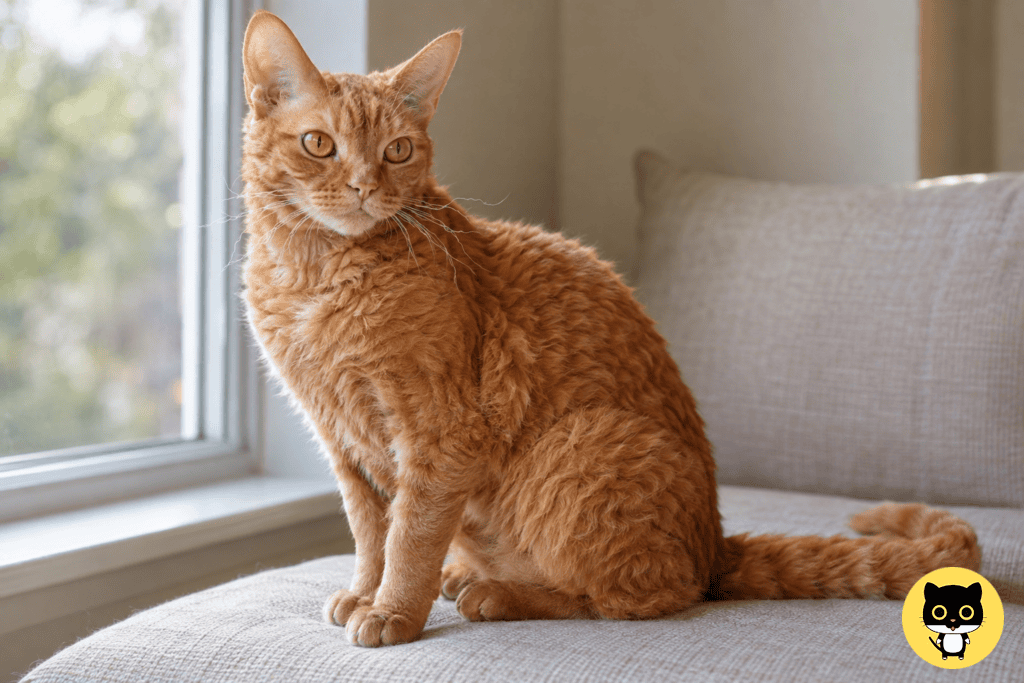
The Tennessee Rex is a distinctive Rex-type cat for a household that values interaction as much as appearance. Its defining combination is a wavy or curly coat with a satin-like reflective sheen, but the breed is more than an unusual texture: the intended cat is medium to large, athletic, substantial and human-oriented. It may suit a caregiver who wants an involved companion and is comfortable making decisions around individual variation rather than relying on guarantees.
Quick Facts
| Quick fact | Tennessee Rex |
|---|---|
| Coat | Wavy to curly, with a satin-like sheen; shorthair and longhair forms |
| Colors and patterns | All colors and patterns are permitted under the TICA standard |
| Build | Medium to large, rectangular, muscular and athletic |
| Temperament | Outgoing, friendly, gentle, curious, playful and people-oriented |
| Recognition | Recognized in TICA’s championship system from May 1, 2024; recognition is not universal among registries |
| Lifespan | No verified Tennessee-Rex-specific numerical estimate is established |
Identity, recognition and developing history
The Tennessee Rex is a developing breed with a clear visual identity but a relatively limited public evidence base for everyday outcomes. Its name refers to its Rex-type coat, while its most characteristic feature is the combination of curl and shine. TICA recognizes both shorthair and longhair Tennessee Rex cats and permits all colors and patterns under its breed standard.
Recognition depends on the organization. TICA places the Tennessee Rex in its championship system, with championship status effective May 1, 2024. The breed did not appear in the CFA or FIFe directories reviewed, so TICA recognition should not be interpreted as universal recognition by every registry.
The breed’s development also makes pedigree details worth taking seriously. Permitted domestic outcrosses and generation history can affect how a breeder describes an individual cat, its coat development and its available documentation. A prospective buyer should ask which generation the kitten belongs to, what outcrosses appear in the pedigree, and which registration and pedigree papers will be supplied.
Appearance and coat development
The adult Tennessee Rex is intended to be a rectangular, firm-muscled cat with medium boning, medium-length legs, rounded paws and a full-length tail that is broad at the base. Males are generally larger and more heavily boned than females, but there is no dependable sex-specific weight table to use as a purchasing or care target. A sound adult should therefore be assessed by overall proportion, condition and musculature rather than by an assumed number on the scale.
The coat provides the breed’s visual signature. Shorthairs have a medium-short coat, while longhairs have a medium-long coat and a plumed tail. Curl and shine can differ across the body and may be affected by color, age and coat length. Hair on the back or torso may be straighter than hair elsewhere, so a Tennessee Rex need not display an even, tight curl over every part of its body to fit the breed’s general description.
A kitten’s coat is not necessarily a preview of its finished appearance. Young cats may be woolly or relatively straight, molt, and lose and regain curl during development. Curl can continue to redevelop through young adulthood, potentially as late as 24 months; that timing describes coat development rather than a proven age for complete physical or behavioral maturity. Someone choosing a kitten for a particular curl pattern should ask the breeder for photographs of parents, older relatives and the kitten at different ages, while accepting that the adult coat may still differ.
The satin effect is attractive but should not be confused with a promise of effortless ownership. Breed descriptions characterize the coat as easy to groom and not prone to matting, yet individual reports mention fragile-feeling or greasy hair in some cats. A light-feeling or glossy coat can still shed onto furniture and clothing, and shedding has not been reliably quantified for this breed. The Tennessee Rex should not be presented as hypoallergenic or as a dependable low-hair cat.
Temperament and household life
The intended temperament is outgoing, friendly, gentle, curious, playful and oriented toward people. In practical terms, this is a cat likely to benefit from daily conversation, interactive play and regular participation in household life rather than long periods of social isolation. Provide scratching surfaces, comfortable resting places and opportunities to explore; stable vertical space can be useful if the individual cat enjoys height, but no fixed exercise or enrichment quota has been established.
Human sociability is not the same as universal compatibility. A cat may actively seek people yet dislike being restrained, traveling, sharing territory with another cat or tolerating rough handling. Breed descriptions do not establish a safe number of hours to leave a Tennessee Rex alone, nor do they guarantee a lap cat, reliable dog companion or easy relationship with children.
Families should make introductions gradually and give the cat a retreat where it can avoid unwanted attention. Children need instruction in lifting, chasing, petting and recognizing withdrawal signals. If another cat or dog already lives in the home, ask about the specific cat’s history with animals and plan controlled scent exchanges, barriers and short supervised meetings rather than treating friendliness toward people as evidence of inter-animal tolerance.
Meeting an adult Tennessee Rex is particularly valuable. If that is not possible, request videos showing the cat being brushed, picked up, approached by an unfamiliar person, placed in a carrier and handled around the face and paws. Those examples answer more useful suitability questions than a general description such as “affectionate” or “family-friendly.”
Grooming and everyday care
A Tennessee Rex may have a manageable grooming routine, but the routine should follow the actual coat. Use gentle combing and inspect the plumed tail, britches, underarms, groin and areas behind the ears. These locations can collect loose hair or develop tangles even when the rest of the coat feels easy to maintain. Increase grooming only when the cat’s coat, seasonal changes or household hair make it necessary.
Longhair cats may need more frequent inspection simply because their coat provides more opportunity for knots. A short-haired cat may need less combing, but short hair does not eliminate shedding or skin and coat observation. Watch for sudden changes in texture, excessive oiliness, bald areas, persistent scratching or discomfort, and involve a veterinarian when the change is unexplained.
Routine care should include claw checks, dental care, veterinary examinations and gradual comfort with handling. Coat changes during kittenhood are expected within the breed’s development, but persistent eye discharge, skin problems or discomfort should not be dismissed as a Rex trait. One breeder’s adult listings describe individual cats needing eye cleaning every few days or having a chronic eye problem; those examples support asking direct questions about the particular cat, not assuming that eye disease is a standard breed feature.
Health, testing and longevity
The Tennessee-Rex-specific health profile is still limited, so transparent records matter. TICA material reports Factor XII deficiency in 43.7% of a tested sample and an Abyssinian progressive-retinal-atrophy variant in 1.4% of that sample. These figures are findings from the cats tested, not breed-wide disease rates and not a prediction that a particular kitten will be affected.
Factor XII deficiency was described as generally asymptomatic apart from prolonged bleeding times. A breeder’s test results should therefore be shared with the cat’s veterinarian, especially before surgery or another invasive procedure. Ask whether the parents and kitten have relevant DNA results, what the results mean, and whether the breeder will provide the laboratory documentation rather than only a verbal summary.
There is no verified Tennessee-Rex-specific numerical lifespan estimate. That absence does not mean the breed has a known short lifespan; it means a precise number would imply more breed-specific evidence than is currently available. A caregiver should focus on preventive veterinary care, body condition, dental health, inherited-risk documentation and the individual cat’s medical history instead of treating a generalized lifespan promise as a planning tool.
Finding and buying a Tennessee Rex
Availability is limited and region-dependent. Documented breeders are found in the United States, Canada and Europe, and TICA maintains a Tennessee Rex category within its breeder listings. Depending on location, a buyer may need to make contact well in advance, travel to collect the cat or wait for a suitable litter.
Rarity can make an attractive kitten feel difficult to question, but careful documentation is more important when the gene pool and health evidence are still developing. Request registration and pedigree documents, generation and outcross history, vaccination and veterinary records, the family health history, and relevant DNA results. Ask what happens if a kitten’s coat develops differently from expectation, and whether the breeder provides support after the cat moves home.
No reliable universal purchase-price range is established for the Tennessee Rex. A breeder-operated adult-adoption page describes some adult cats as available for the cost of altering plus transportation, but gives no fixed currency amount; this is a breeder-specific rehoming policy, not a market price or a dependable estimate for kittens. Any quotation should be evaluated with its currency, region, date, age of the cat and whether it is an asking price, completed sale or breeder policy clearly stated.
Travel and waiting costs may matter as much as the advertised price. Before committing, confirm what is included, whether transport is arranged safely, which vaccines and procedures have been completed, and whether registration transfer is part of the agreement. A lower adult-adoption cost may be appropriate for a particular rehoming situation, but it should not be used to infer the value or normal price of the breed as a whole.
Is the Tennessee Rex a good fit?
The Tennessee Rex may be a strong match for someone who wants an interactive, playful cat with an unusual coat and who is willing to learn the preferences of one individual. Its people-oriented reputation, athletic build and curiosity point toward a companion that benefits from attention, play and a socially involved home.
It is a weaker match for someone seeking guaranteed allergy safety, a completely shed-free home, a fixed low-grooming burden or predictable compatibility with other animals. It may also frustrate a buyer who expects a kitten’s first coat to remain unchanged or who wants a defensible breed-specific lifespan and price promise. The sensible commitment is to the cat’s documented history and observed behavior, not only to the breed label.
What owners and caregivers say
Caregivers commonly describe Tennessee Rex cats as quick to seek human attention, soft-voiced, purring and interested in household activity. One breed-community account portrays children as part of that interest, and TICA has recorded families successfully involving Tennessee Rex cats in children’s junior showmanship and using two cats as emotional-support animals. These examples make close human involvement plausible, but they do not establish that every cat will enjoy children, showing, handling or an emotionally demanding role.
Adult listings show why sociability needs to be described more precisely. Some cats are characterized as sweet, people-oriented or suitable for a family, while named individuals have disliked showing, needed frequent eye cleaning, carried a chronic eye problem or become overweight. Another Tennessee Rex was described as very fond of people and good with the breeder’s grandchildren but as bullying other cats. Human friendliness and multi-cat compatibility are therefore separate questions.
Coat experiences also vary. Curl and shine may change through kittenhood and adulthood, and some individual coats may feel fragile or greasy. That variation does not undermine the breed’s satin-rexed identity; it explains why a prospective caregiver should inspect the actual cat, ask how its coat has changed over time, and plan gentle grooming without assuming that glossy means maintenance-free.
Taken together, these experiences suggest a cat that can become a deeply involved companion when its caregiver welcomes interaction and individual assessment. The best preparation is neither to expect a perfect show coat and effortless sociability nor to dismiss the breed because its evidence base is still developing. Meet the cat, verify the records, ask behavior-specific questions and make room for the particular Tennessee Rex that comes home.
 English