
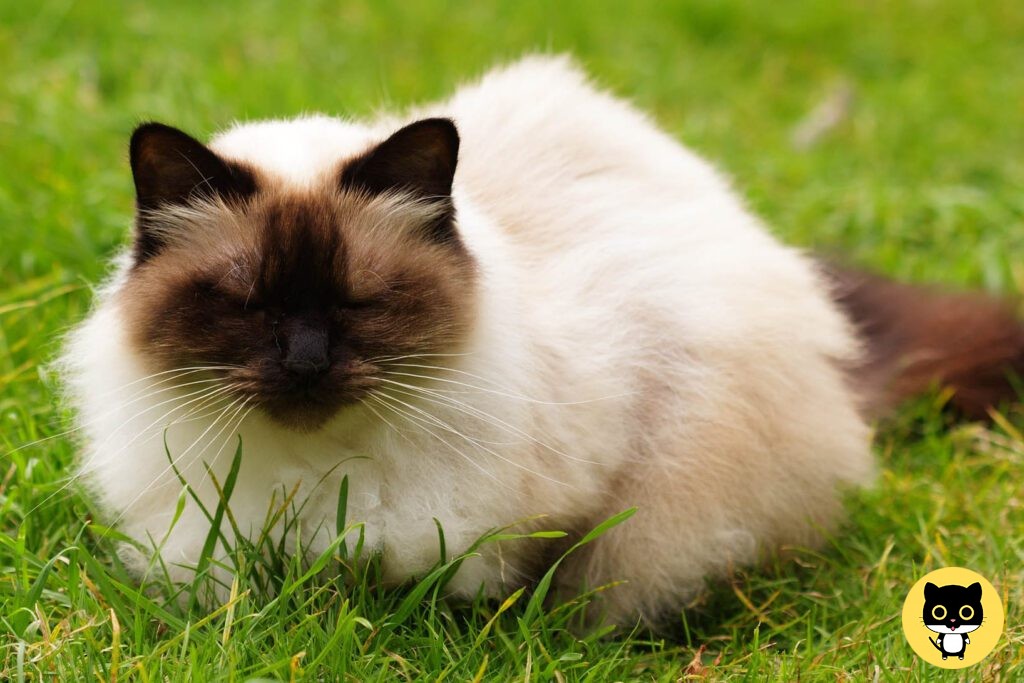
The Himalayan is a long-haired, blue-eyed colorpoint cat whose appeal comes with a practical commitment: the household must be prepared to maintain the coat and pay attention to facial comfort. Its quiet, companionable reputation can make it seem easy to live with, but the more useful question is whether a caregiver can make grooming, eye checks, enrichment and veterinary observation part of ordinary life.
Quick Facts
| Feature | What to expect |
|---|---|
| Type | Long-haired, colorpoint Persian-family cat |
| Typical appearance | Compact body, broad head, blue eyes and dark points on a lighter coat |
| Activity | Usually low to moderate, with individual differences in playfulness |
| Coat care | Frequent, often daily, combing when the dense undercoat tangles easily |
| Published lifespan estimate | 8–11 years; an estimate rather than a verified population statistic |
What “Himalayan” means
The name does not have one identical technical meaning everywhere. TICA places the Himalayan in the Persian Breed Group, while CFA treats it as a division of the Persian. FIFe’s current breed structure does not list a separate Himalayan entity. These are classification differences, not different instructions for living with the cat, but they matter when someone is buying a pedigreed animal or trying to interpret registration papers.
A pointed long-haired cat is not necessarily a pedigreed Himalayan. Rescue organizations, classified listings and casual sellers may use the name to describe appearance, while a breeder should be able to explain the pedigree and registration status. If identity matters to the adopter, ask for records rather than relying on blue eyes, dark points or a Persian-like face alone. The relevant registry positions can be checked through the Himalayan breed description, the Persian standard and the current FIFe breed list.
The Himalayan’s relationship with the Persian is also important for health and care questions. It is reasonable to ask about Persian-family records and conformation without treating every Himalayan-looking cat as genetically identical or assuming that a registry label predicts an individual cat’s future. The cat’s actual pedigree, facial structure, veterinary history and behavior provide more useful information than the name alone.
Appearance, color and facial structure
The typical Himalayan is medium-sized, compact and heavily boned. A broad, rounded head, small widely spaced ears, large blue eyes, a short thick tail and a long flowing coat create the familiar silhouette. The coat adds considerable visual volume, so the cat may look larger than its underlying body size.
The coat is colorpoint: the body is lighter, while the face, ears, legs, feet and tail carry deeper color. Recognized point categories include seal, blue, chocolate, lilac, flame, cream, tortie, blue-cream and lynx-related colors, although the way these colors are grouped or registered differs between organizations. Point color can deepen with age and may be influenced by temperature. A kitten’s coloring therefore need not remain exactly the same as it matures.
The face deserves individual attention rather than a simple “flat-faced” or “not flat-faced” description. Some Himalayans have a less extreme profile, while others have more Persian-type brachycephaly. Greater facial shortening can be associated with more exposed eyes, narrower nasal airways and displaced or crowded teeth. When meeting a cat, look beyond the photograph: observe quiet breathing, eye comfort, chewing, dental alignment and how the cat copes with warmth. These observations do not diagnose a problem, but they identify sensible questions for a breeder, foster caregiver or veterinarian.
Temperament and everyday companionship
A Himalayan often suits a household looking for a composed indoor companion rather than a constantly busy, highly athletic cat. The breed is commonly described as gentle and companionable, with low-to-moderate activity and periods of play. “Calm” does not mean that the cat needs nothing to do. Scratching surfaces, interactive toys, elevated resting places, safe exploration and quiet retreat spaces help an indoor cat remain comfortable and engaged.
Affection may be expressed through proximity rather than prolonged lap sitting. A cat may follow a caregiver, share a room, climb toward a person, bunt with its head or communicate with occasional mews without wanting to be held continuously. Another adult may be much quieter and show little interest in play. These possibilities fit within a broad companion-cat temperament; they are not reliable promises about every Himalayan.
Children, dogs and other cats can live successfully with a Himalayan when the individuals and introductions are managed well. Give the cat escape routes and elevated safe places, supervise interactions with children, and introduce animals gradually rather than testing them together immediately. A breed description cannot guarantee that a particular cat will enjoy rough handling, canine attention or a busy household. Meeting the adult—or obtaining detailed foster or breeder observations—is more informative than choosing on appearance or a general reputation for gentleness.
Himalayans should not be described as hypoallergenic. All cats produce allergens, and coat length or visible shedding does not reliably predict the amount of allergen in a home. Someone with allergies should consult an allergist and spend meaningful time with the specific cat before committing, recognizing that a trial visit may not reproduce every household reaction.
Grooming is the central daily responsibility
The dense undercoat can turn a beautiful coat into a painful problem surprisingly quickly. A silky or light-feeling coat may still leave substantial hair around the home and require frequent work beneath the visible topcoat. For a cat that mats readily, thorough combing may be needed every day, especially around the ruff, behind the ears, under the forelegs, across the belly, on the hindquarters and beneath the tail.
Short, calm sessions are often more sustainable than waiting until the coat is severely tangled. Pair handling with food, breaks and a predictable routine, and stop before the cat becomes frightened or defensive. The goal is not merely a neat appearance. Regular grooming allows the caregiver to notice skin changes, soreness, weight change and new resistance to handling.
Individual tolerance can vary dramatically. One rescued Himalayan gradually accepted brief brushing and eventually presented its belly for grooming, while continuing to object to paw handling. Other caregivers have encountered deep mats, strong resistance and the need for professional grooming or a lion cut. These experiences show why grooming ability should be assessed before adoption. A cat that cannot safely tolerate combing may need a cat-experienced groomer, and severe mats may require veterinary help rather than forceful home removal.
Eye-area care may also become part of the routine. Tear discharge can collect on the long facial hair, so gentle cleaning with an appropriate method may be needed. Persistent, thick or foul-smelling discharge, squinting, redness, pain or rubbing should not be dismissed as a normal feature of the breed; those signs warrant veterinary assessment. Eye care is easier when the cat has been taught from an early age that brief facial handling is safe, but an adult’s established preferences still matter.
Health questions to raise before adoption or purchase
The most useful health discussion is individual rather than alarmist. Persian-family cats are associated with questions about polycystic kidney disease, entropion, dental crowding or malocclusion and breathing comfort. Persian-group screening discussions may also include progressive retinal atrophy and hypertrophic cardiomyopathy. These are reasons to request records and family information, not diagnoses to assign from the breed name.
Ask a breeder for the parents’ health history, documented PKD testing where relevant, veterinary records and an explanation of any screening performed. For an adopted cat, ask what the shelter, rescue or previous caregiver knows about breathing, eyes, teeth, kidney findings and previous treatment. A responsible answer may include uncertainty, particularly for a rescued adult; uncertainty is preferable to an unsupported assurance that the cat has no inherited risk.
Facial conformation changes what should be watched. A cat with a more shortened face may need closer observation of eye exposure, tear irritation, dental function, breathing and heat tolerance. Seek veterinary advice if breathing is labored, the cat cannot settle comfortably in warm conditions, the eyes appear painful or the mouth interferes with eating. These checks are especially important because coat density can make overheating harder to notice.
Indoor living is generally compatible with the Himalayan’s needs, provided it is not reduced to a bare room and a food bowl. Secure windows, climbing options, scratching posts, play and resting areas support physical and mental well-being. A secure enclosure or supervised outdoor access is safer than unrestricted roaming, particularly for a cat whose long coat can collect debris and whose calm behavior may not protect it from traffic or other animals.
Cost, availability and longevity
No responsible universal purchase price or adoption-fee range can be given here. A meaningful price example would need to identify the region, currency, date, cat’s age, intended purpose and whether the figure was an asking price, completed sale or adoption fee. Those details can change substantially between a pedigreed kitten, an adult retirement cat, a rescue placement and a cat sold only by appearance.
When evaluating an offer, compare more than the headline price. Ask whether registration papers, vaccinations, microchipping, sterilization, health examinations and documented testing are included. Confirm the seller’s identity and the cat’s living conditions, and be cautious when a pointed long-haired cat is advertised as a Himalayan without pedigree evidence or clear health information. Availability is similarly regional and variable; a shelter label may describe appearance rather than established ancestry.
TICA publishes an expected lifespan of 8–11 years for the Himalayan. That figure is a breed-site estimate, not a verified population life-expectancy statistic, and it should not be used as a promise for an individual cat. Preventive veterinary care, inherited traits, facial structure, body condition, dental health and living conditions can all influence a particular cat’s life.
Is a Himalayan a good match for you?
A Himalayan may be a strong match for someone who values a visually distinctive, generally composed companion and is willing to make grooming cooperative and routine. The household should be comfortable checking the eyes, monitoring breathing and dental comfort, arranging professional help when necessary and providing enrichment even for a quiet adult.
The breed is less suitable for someone seeking a low-maintenance coat, a guaranteed lap cat, a reliably silent pet or a cat that can be left to manage itself in a busy home. The decisive issue is not whether the caregiver likes the long coat and blue eyes; it is whether the caregiver can sustain the work that keeps that appearance comfortable. Before committing, watch the individual cat being handled, ask how it responds to combing and facial care, and assess its body language around people and other animals.
What owners and caregivers say
Owners and caregivers describe rewarding relationships, but their cats do not all express companionship in the same way. An adopter of a four-year-old Himalayan/Persian described a very calm adult with little interest in play who still showed affection through bunting and mewing. Handling the belly, eyes and hindquarters was difficult, and eye cleaning initially required two people. That experience suggests a practical distinction: a cat may be gentle in ordinary company while still needing careful planning for necessary care.
Grooming stories show a similarly wide range. One caregiver’s rescued Himalayan initially resisted brushing, then gradually accepted short, patient sessions and eventually offered its belly for grooming, although paw handling remained unwelcome. Other caregivers faced severe mats and strong resistance that led to professional grooming or a lion cut. These accounts do not establish how common difficult grooming is, but they make one point clear: coat maintenance is not automatically easy because an individual cat appears quiet or affectionate.
An adopter bringing home a first Himalayan described frequent eye cleaning and unexpectedly difficult mat management. The lesson is not that every Himalayan will create the same workload. It is that the practical demands may become clearer only after adoption, especially when a cat arrives with an unknown grooming history. A foster report, veterinary examination and observed handling session can reduce that uncertainty.
Caregivers also describe cats that seek human proximity or climb toward people, alongside quieter adults with limited play interest. Affection, therefore, may mean sharing space, approaching for attention or communicating with a small sound rather than consistently choosing a lap. The best match comes from reading the individual cat’s preferences and tolerance, not from expecting a breed-wide personality script.
 English