
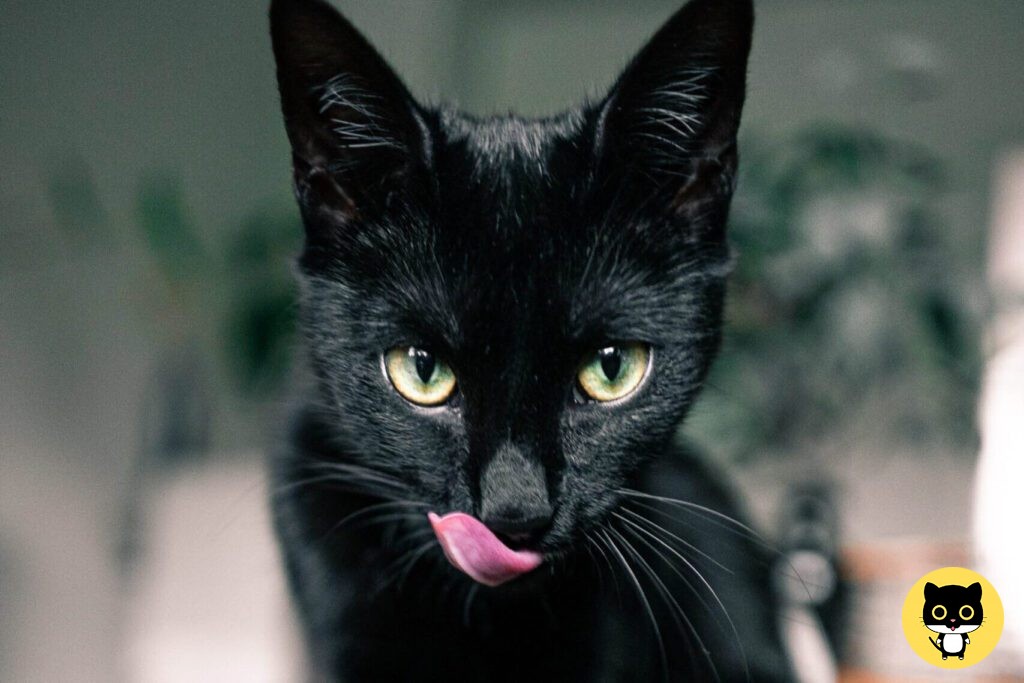
Korn Ja is a cat whose name carries more cultural meaning than predictive certainty. Also written Konja or Koneja, it belongs to a traditional Thai black-cat identity associated with the Tamra Maew, the old Thai cat manuscripts. Cultural descriptions emphasize a solid black coat, yellow to yellow-green eyes, a long or slender tail, and a dignified bearing. Those features explain why the cat is distinctive and culturally important, but they do not by themselves prove that an individual cat belongs to a particular breeding line.
Quick Facts
| Other names | Konja and Koneja |
|---|---|
| Traditional appearance | Solid black coat, yellow, golden or yellow-green eyes, and a long or slender tail |
| Coat | Usually described as short, sleek and fine-lying; individual variation and conflicting commercial descriptions make inspection important |
| Recognition | A culturally recognized Thai type and a population included in a 2024 genetics study; not listed as a conventional breed under the name Korn Ja or Konja by CFA, TICA or FIFe directories checked |
| Health profile | No Korn Ja-specific inherited disease profile, screening panel or longevity study has been established |
| Best selection method | Evaluate the individual cat, its history, records, parents and living conditions rather than relying on the name alone |
For a prospective caregiver, that distinction matters. Korn Ja can describe a traditional type, a Thai domestic-cat population, a preservation project, or a seller’s interpretation of the name. Before paying for a kitten or importing a cat, ask which meaning is intended and what records support it. A black cat with golden eyes may resemble the traditional image without having documented Korn Ja ancestry.
Identity, history and recognition
Korn Ja’s identity begins in Thailand’s cultural history rather than in a modern, universally enforced breed standard. Traditional accounts treat black cats as meaningful and fortunate, and the Korn Ja image is one of several Thai cat identities preserved through cultural writing and public heritage efforts. The traditional description is therefore valuable even when a contemporary cat cannot be traced to a closed pedigree.
Modern population research gives the name another layer of legitimacy without resolving every question about individual ancestry. Konja appeared among five Thai domestic-cat populations examined in a 2024 genetics study. That inclusion shows that researchers can identify a population of interest; it does not create a universal studbook, establish fixed pedigree boundaries, or provide a diagnostic test that can confirm every cat sold as Korn Ja.
Registry recognition is a separate matter. The breed directories of the Cat Fanciers’ Association, The International Cat Association and Fédération Internationale Féline checked do not list Korn Ja or Konja as a conventional recognized breed under that name. Separate material about Thai cats or Maew Boran should not automatically be treated as Korn Ja recognition. In practical terms, a seller’s use of the name may refer to tradition, preservation, ancestry or appearance, and the buyer needs to find out which.
A useful question is not simply, “Is this a real breed?” but, “What identity is being offered with this cat?” Ask for the names and identities of the parents, the organization or program issuing any pedigree, veterinary records, breeding or placement terms, and an explanation of how the line is defined. Those details are more useful than a confident label unsupported by documentation.
Appearance and coat
The traditional Korn Ja is immediately striking: black fur set against yellow, golden or yellow-green eyes. A long or slender tail and an upright, dignified posture are also part of the familiar image. These characteristics can help a reader understand why a cat is called Korn Ja, but they are identifying clues rather than exclusive markers. Ordinary black domestic cats, Bombay-like cats and other Thai-associated cats can share the same visual combination.
The coat is most usefully approached as an observation rather than a guaranteed specification. A short, sleek, fine-lying coat is the strongest practical description, while some commercial pages use terms such as medium or half-long. Look at the actual cat, its parents and the documented line. A seller’s coat label is less informative than seeing whether the fur lies close to the body, gathers loose hair, tangles behind the legs or changes noticeably with the seasons.
No dependable Korn Ja target has been established for adult weight, sex-specific size, maturation speed, shedding or matting. That does not make the cat impossible to assess. A healthy adult should be judged by body condition, muscle, movement, coat and general development rather than by comparison with an invented breed number. A kitten’s eventual size is likewise better estimated from its parents and growth pattern than from the name Korn Ja.
Temperament and household suitability
Korn Ja does not currently offer a reliable temperament shortcut. Commercial descriptions call these cats loyal, affectionate, intelligent, playful or social, but those statements are promotional descriptions rather than a dependable body of long-term owner experience. There is no established Korn Ja profile that predicts whether an individual will be a lap cat, an active climber, a frequent talker, a cautious observer or a cat that prefers affection on its own terms.
That uncertainty is an invitation to observe, not a reason to expect a difficult companion. Meet the actual cat whenever possible, preferably more than once, and notice how it responds to unfamiliar people, touch, play, restraint and changes in the environment. An adult’s established preferences are especially informative. With a kitten, ask the breeder or foster caregiver about its behavior over time rather than treating one lively visit as a complete personality assessment.
Children, dogs, other cats and small pets should be considered through the individual cat’s history. A cat that has lived calmly with respectful children may be a better match for a family than one with an attractive pedigree but no relevant experience. Any introduction should be gradual, with escape routes and elevated resting places for the cat. Small or vulnerable animals need secure separation rather than relying on a cat’s supposed breed temperament.
An indoor home can suit a Korn Ja well when it is organized around feline needs. Provide dependable food, water and toileting resources, scratching surfaces, hiding places, daily interactive play and safe vertical space. These provisions support many cats, but they should not be presented as proof of a Korn Ja-specific activity level or intelligence. A quieter cat may use them for security; a more energetic one may need more play and climbing opportunities.
Daily care
A genuinely short, sleek coat will often be straightforward to maintain. Occasional gentle combing is a sensible starting point, with the frequency adjusted to the amount of loose hair, any tangling, skin condition and the cat’s tolerance. A light or silky-feeling coat can still leave hair on furniture and clothing, so “low maintenance” should not be confused with “non-shedding.”
Routine bathing is not established as a Korn Ja requirement. Most cats can manage ordinary coat cleanliness without regular baths, while a veterinary reason, contamination or a specific skin problem may call for different care. Introduce combing gradually and stop before handling becomes a struggle; preserving trust is usually more useful than forcing a grooming schedule.
Daily care should also include opportunities to scratch, play and retreat. Rotate toys if the cat loses interest, use food puzzles where appropriate, and make high resting areas safe rather than allowing access to unstable furniture or hazardous windows. The right level of activity will emerge from the cat’s behavior. Watch for boredom, excessive hiding, destructive scratching or repeated nighttime agitation, then adjust the environment before assuming the cat has a fixed breed trait.
Health and longevity
No Korn Ja-specific inherited disease predisposition, clinical prevalence estimate, reproductive problem, validated screening panel or survival study has been established. The genetics work involving Konja examined population structure, not disease rates or lifespan. The sensible conclusion is balanced: there is no basis for promising unusual hardiness, but there is also no evidence here for declaring the type medically high-risk.
Routine preventive care is therefore especially important. Feed a complete, balanced diet suited to the cat’s life stage, monitor body condition, arrange veterinary examinations and attend to dental health. Vaccination and parasite control should reflect local veterinary guidance, lifestyle and regional risks. Keep records of weight, appetite, toileting, skin and coat changes, dental condition and behavior so that gradual problems are easier to recognize.
When buying from a breeder or preservation program, request veterinary records and the health history of parents and close relatives. Ask what conditions have occurred in the line and what, if any, testing was performed. Do not assume that tests developed for a related Thai breed automatically apply to Korn Ja; a responsible answer should explain the reason for each test and the limits of what it can show.
Reported figures such as 13 to 16 years should not be presented as a Korn Ja lifespan estimate. No documented Korn Ja cohort supports that range. An individual cat’s longevity will depend on genetics, preventive care, diet, environment, injury risk and treatment of illness, so a caregiver should plan for a normal long-term feline commitment without attaching a precise promise to the breed name.
Availability and purchase price
Korn Ja availability appears uneven, and the available listings do not establish a worldwide market, standard waiting time or universal rarity. Thai Cat House listed two Konja boys in Saint Charles, Missouri, with parentage information but no public price. A French preservation program described limited births, which may mean that a documented kitten requires patience, travel or direct contact with a small program.
A Maison RĀTĀNA program page in France listed a Konja companion kitten at €1,800, accessed October 2, 2026. This is a France-specific asking price for one companion kitten, not a completed sale and not a typical international price range. Travel, import documentation, veterinary certification and transport could materially change the final cost.
Before sending a deposit, establish what the payment covers and who is responsible for transport, registration, vaccinations, microchipping, export paperwork and any health guarantee. Confirm the seller’s identity and inspect the contract. If importation is involved, check current government requirements rather than relying on an old listing or a breeder’s general assurance.
Is a Korn Ja the right cat for you?
A Korn Ja may suit someone who values Thai cultural history, enjoys an unusual black-and-gold appearance and is willing to investigate identity carefully. It may also suit a household that is comfortable choosing a cat through direct observation rather than expecting a breed label to predict sociability, noise level or handling preferences.
It is a less straightforward choice for someone who needs highly predictable traits, a clearly bounded pedigree, a published health-screening framework or a reliable adult size and lifespan estimate. That does not make the cat a poor companion. It means the decision should rest on the specific cat’s behavior, records, parentage and care history.
The strongest buying standard is simple: choose documentation and a good match over an attractive story. Meet the cat, ask to see where it is raised, speak clearly about its previous social experience, verify veterinary information and make sure the seller can explain the meaning of Korn Ja in that particular line. When the name is treated as a starting point rather than a guarantee, its cultural significance and the practical realities of caregiving can both be respected.
What owners and caregivers say
The traceable material around Korn Ja contains more placement information and marketing language than detailed, long-term accounts from adopters. That limits what can honestly be said about everyday companionship. Listings from Thai Cat House and a Pelican Parts poster record Konja kittens, parentage claims and availability, but they do not provide follow-up descriptions of how those kittens behaved as they matured or lived in a household.
The parentage described in those listings also illustrates why records need interpretation. One offer described black Konja kittens as having a Thailand Burmese male and Thailand Suphalak female in their reported ancestry. Another listing supplied parentage for two Konja boys, including a Suphalak female and Burmese male. Such claims may be useful leads for tracing a line, but they are not substitutes for independently understandable pedigree records or evidence about the kittens’ adult temperament.
Commercial pages often portray Korn Ja cats as affectionate, loyal, playful, intelligent or social. Those qualities may describe particular cats, but they should not be converted into owner consensus. There is not enough attributable long-term experience to promise that a Korn Ja will enjoy being held, follow people from room to room, welcome strangers, live peacefully with dogs or prefer an independent routine.
For a caregiver, the practical lesson is to ask better individual questions: Does this cat seek contact or merely tolerate it? How does it recover after a startling event? Has it lived with children or other animals? What does it do when left alone? Does it use scratching posts and litter areas reliably? An answer grounded in the cat’s actual history is more valuable than a generalized claim about Korn Ja temperament.
Selected sources
Background on the Thai black-cat tradition appears in the Thailand Foundation’s account of lucky Thai cats and Thailand’s cultural heritage material on five Thai cats. The 2024 genetics study is available through PMC.
For current recognition and registration questions, consult the CFA breed directory, TICA breed directory and FIFe breed list directly, since breed policies and listings can change.
The dated price example comes from the Maison RĀTĀNA Konja program page; the Missouri listing is available through Thai Cat House.
 English