
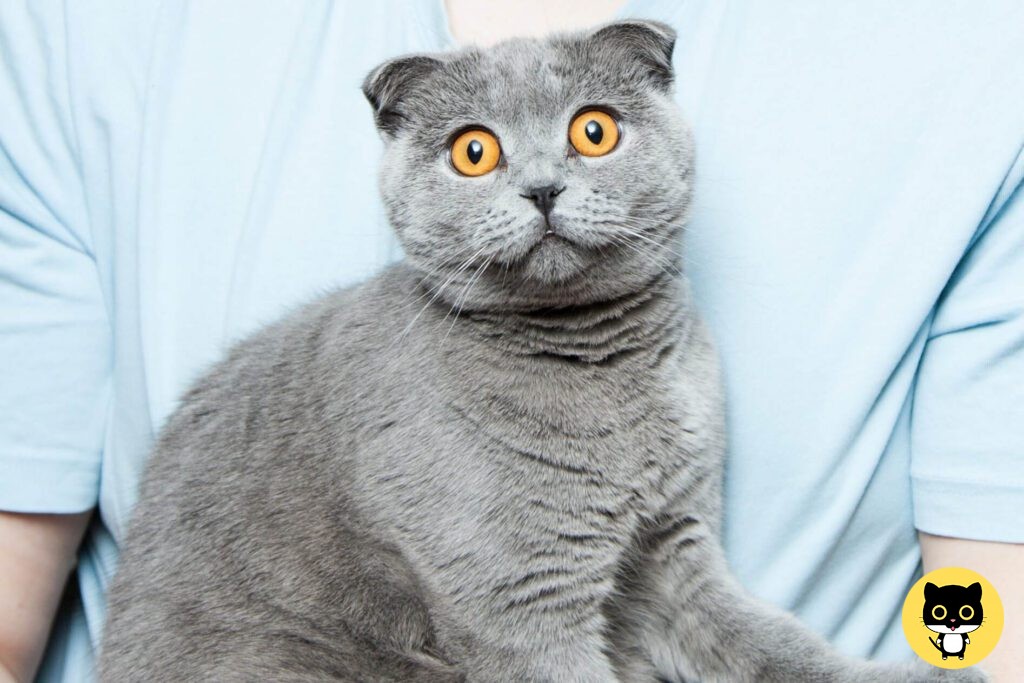
The Foldex is a compact, round-faced cat whose appeal often begins with its ears but should not end there. Developed from Scottish Fold and Exotic ancestry, it is intended to combine a folded or straight ear set with a sturdy body, plush coat and expressive, rounded features. For a prospective caregiver, the important question is not simply whether the appearance is attractive. It is whether the breeder’s documentation, the individual cat’s movement and the household’s ability to provide attentive care make the choice responsible.
Quick Facts
| Origin and identity | A hybrid developed from Scottish Fold and Exotic ancestry |
|---|---|
| Body | Medium-sized, compact and muscular, with medium-to-heavy bone |
| Coat varieties | Shorthair and Longhair |
| Ear types | Folded and straight; registration treatment depends on the cat’s records and registry rules |
| Colors and patterns | All colors, patterns and combinations are accepted under the current CCA standard, subject to its color rules |
| Lifespan | No dependable Foldex-specific estimate is established |
| Typical price | No verified, dated, region-specific price or adoption-fee range was available |
Identity and recognition
Recognition depends on the registry rather than on a single universal definition. The Canadian Cat Association currently provides Foldex standards for both Shorthair and Longhair cats and treats Foldex as its own breed category. Its standard describes a cat developed from Scottish Fold and Exotic ancestry, so names such as “Exotic Fold” should not automatically be treated as interchangeable registry identities.
The breed’s status is not identical everywhere. A TICA rules document dated December 23, 2021 listed Experimental Foldex and Experimental Foldex Longhair, which is a date-specific classification rather than evidence of current recognition. Foldex does not appear on the CFA breed list or the FIFe recognized-breeds page reviewed. Anyone buying a supposedly registered kitten should therefore ask which registry issued the papers and confirm that the cat is recorded under the name and category being advertised. The current CCA breed entry and breed standard are useful places to check the terminology.
Folded and straight ears are part of the registration conversation, not merely a cosmetic distinction. Straight-eared offspring may be registered as Foldex Straights under the CCA standard. A kitten whose ears fold and later straighten may still remain registered as carrying the fold gene. This makes a pedigree and registration record more informative than an advertisement’s casual label.
Appearance: a substantial cat with two coat varieties
The Foldex has a broad, rounded outline that can make it look softer and smaller than its structure really is. The standard describes a medium-sized, compact and muscular cat with a broad chest, short strong legs, rounded paws and medium-to-heavy bone. Its head is broad and round, with prominent cheeks, a short muzzle and large, round eyes. The tail is medium in length, thick and flexible.
The Shorthair has a short, plush, soft and dense coat. The Longhair has a medium-to-long, soft, glossy and dense coat, with a full plume on the tail. Both varieties can be visually appealing in different ways: the Shorthair emphasizes the cat’s compact outline, while the Longhair adds fullness around the body and tail.
Color choice is broad. The current CCA standard accepts all colors, patterns and combinations subject to its color standards. Eye color should correspond with the coat color, and pointed Foldex cats must have blue eyes under that standard. These are conformation requirements, not predictions about personality or health.
A dense or silky coat should not be mistaken for a low-shedding or hypoallergenic coat. Even a coat that feels light under the hand can leave hair on furniture and clothing. The Longhair’s density and tail plume make tangles and loose hair more noticeable possibilities than they may be with a Shorthair, but there is no reliable breed-wide grooming schedule or shedding category. Let the cat’s actual coat, seasonal shedding and tendency to mat determine how often it needs combing.
The health question behind the ears
The folded ear is the feature that requires the most careful interpretation. A show-standard head and an attractive ear set establish appearance; they do not establish healthy cartilage, joints or movement. The Scottish Fold-associated TRPV4 mutation is the central documented welfare concern relevant to Foldex breeding. UC Davis reports that one copy can affect cartilage development and may be associated with misshapen toes, thickened or inflexible tails and progressive osteoarthritis. Two copies are associated with more severe bone, cartilage and joint problems. The UC Davis veterinary genetics information explains why testing matters, while not supplying a Foldex-specific disease rate or prognosis.
This changes what a responsible purchase conversation should focus on. A breeder’s assurance that a straight-eared kitten is automatically safe, or that a folded ear is purely cosmetic, is not enough. Ask for the kitten’s and both parents’ TRPV4 test results, the pedigree, registration records, laboratory documentation and veterinary history. Ask directly whether any parent or kitten has shown a stiff or painful tail, abnormal gait, reluctance to jump or difficulty moving.
Genotype is only one part of the assessment. Observe whether the kitten walks, runs, climbs and turns comfortably. A flexible tail, normal posture and willingness to move are more useful welfare observations than ear shape alone. The CCA standard withholds awards for tails lacking flexibility because of fused vertebrae and for certain leg or foot abnormalities associated with calcium deposits. That judging requirement has a practical home equivalent: mobility deserves attention throughout the cat’s life.
A change in gait, activity, jumping, posture, tail movement, grooming or litter-box behavior should lead to veterinary assessment rather than being explained away as a quiet or easygoing temperament. These signs are monitoring tools, not a diagnosis. Conversely, the presence of a folded ear does not prove that an individual cat will develop severe disease. Foldex-specific prevalence and long-term prognosis are not established, so the honest position is neither reassurance nor inevitability.
Temperament and life with a Foldex
Informal descriptions portray some Foldex cats as active, playful, curious, intelligent, affectionate and willing to approach strangers. Those are useful possibilities, but not dependable breed promises. There is no sufficient basis for describing every Foldex as calm, vocal, cuddly, quiet, child-friendly or easy to handle.
An individual cat’s social history may matter as much as its breed label. Meeting an adult Foldex, when possible, lets a prospective caregiver assess how that cat responds to handling, visitors, play and ordinary household activity. With a kitten, ask how it has been raised and whether it has experienced gentle handling, household sounds and appropriate social contact. A charming temperament is valuable, but it should be evaluated in the actual cat rather than assumed from the folded ears or round face.
A Foldex can live successfully indoors when its environment is arranged around ordinary feline needs: stable food, water and litter resources; scratching surfaces; play; elevated or resting places; and quiet retreats. Equipment and access should be adjusted to the individual cat’s mobility. Low-entry litter boxes, easy-to-reach resources and steps or ramps may become sensible if jumping becomes uncomfortable.
There is no supported Foldex-specific verdict that an apartment is better or worse than a house. Space matters less than whether the cat can move safely, retreat from unwanted attention and engage in regular play. Children should be taught to handle the cat gently and stop when it seeks distance. Introductions to dogs or other cats should be gradual, with separate resources and a way for the Foldex to withdraw. Small vulnerable pets should be protected by physical separation rather than relying on a cat’s supposed temperament.
Daily care, feeding and grooming
Food should be a complete diet appropriate to the cat’s life stage, with portions adjusted to body condition rather than an invented Foldex weight target. No dependable breed-specific adult weight range or nutrition protocol is established. Regular veterinary checks can help assess body condition, dental health, movement and any changes that are difficult for a caregiver to interpret at home.
Grooming should follow the individual coat. A Shorthair may need occasional combing to remove loose hair and allow the caregiver to notice changes in the skin or body. A Longhair may need more frequent attention, especially around the tail, behind the legs and anywhere the coat catches debris. The right schedule is the one that prevents tangles and keeps the cat comfortable, not a fixed number of brushings presented as universal.
Gentle handling is especially important around the tail, legs and paws. Do not force a joint through a range of motion or treat resistance as a training problem. A cat that stops grooming, avoids the litter box, becomes less active or changes its jumping habits deserves a veterinary examination.
Choosing a breeder and assessing the commitment
Documentation should be treated as part of the cat’s welfare preparation, not as paperwork added after the emotional decision. Request the pedigree, registration details, parentage, TRPV4 laboratory results and veterinary records before placing a deposit. Ask what happens if records do not match the advertisement, if a kitten’s ears change as it matures or if a health concern appears after purchase. A breeder who cannot explain the ear category, the parents’ status and the testing documentation leaves the caregiver carrying more uncertainty than necessary.
Availability cannot be inferred from recognition. CCA registration confirms a registry category but does not establish that breeders operate in a particular region, that waiting lists are short, that importing a cat is practical or that local law permits the activity. Check local regulations and ask for verifiable breeder information rather than assuming that an online listing represents an established market.
There is also no verified, dated, region-specific Foldex kitten price, completed-sale price, adult asking price or adoption fee from which to offer a responsible universal figure. Cost can vary with location, registration, companion versus breeding or show status, age and included veterinary care. A sensible budget should include ordinary food, litter, preventive veterinary care, grooming supplies and emergency care, with room for individualized investigation if movement or joint concerns arise. That is not a claim that mutation-related treatment is typical; it is a reason not to make a decision using a misleadingly precise price.
Suitability conclusion
The Foldex may suit a caregiver who is drawn to its compact appearance and is prepared to investigate what lies behind that appearance. The right home is one that values records over promises, evaluates movement as carefully as looks, provides enrichment and retreat spaces, and can manage either a Shorthair or Longhair coat. It is a less suitable choice for someone seeking a guaranteed temperament, a guaranteed low-maintenance coat or reassurance based only on registry status and ear shape.
The defining feature creates a responsibility: selection should move from visual preference toward verifiable genotype, parentage, veterinary history and comfortable function. Breed identity can explain what kind of cat a Foldex is intended to be, but it cannot resolve every health question. A careful caregiver accepts that uncertainty while making it smaller wherever testing, observation and good records can do so.
What owners and caregivers say
Owners’ descriptions can make the Foldex feel more approachable than a standard alone would. An older French-language forum account described Foldex cats as active, playful, curious, intelligent, affectionate and willing to approach strangers. Those impressions suggest the possibility of a lively and socially rewarding companion, but they describe particular cats rather than establishing a dependable breed temperament. They are best used as questions to explore when meeting an individual: Does this cat seek interaction? Does it enjoy play? How does it respond when handled or when unfamiliar people arrive?
The same conversation included concern about breeding in relation to the Scottish Fold mutation. That concern is an individual opinion, not a population-level conclusion, but it points to an important part of the caregiver’s decision. Appearance and sociability do not settle the welfare question. Asking for genetic results, observing movement and understanding the breeder’s approach are reasonable parts of choosing the cat.
For someone who can accept those conditions, a Foldex may be an engaging, distinctive companion. The strongest evidence-based decision is not “all Foldex cats are healthy” or “all Foldex cats will be affected.” It is to choose only when the individual cat’s records and function justify proceeding, and to remain attentive to changes throughout its life.
Sources for recognition and health information
Canadian Cat Association Foldex breed standard; TICA standing rules dated December 23, 2021; UC Davis Veterinary Genetics Laboratory information on the Scottish Fold mutation; individual French-language forum account.
 English