
Response to unfamiliar people in Cat Breeds
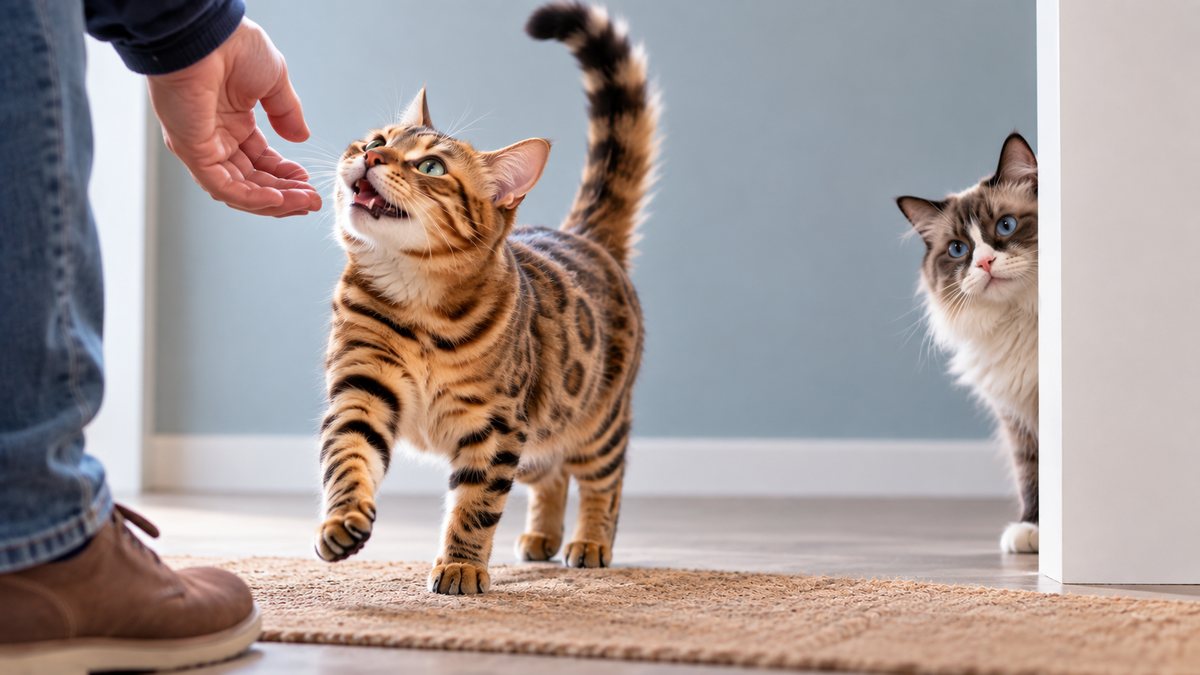
Compare breeds by response to unfamiliar people. The ordering follows the characteristic itself rather than the alphabet whenever a meaningful order exists.
Discuss Response to unfamiliar people in the forum
| # | Breed | Response to unfamiliar people |
|---|---|---|
| 1 | Very high American Bobtails are notably outgoing and socially confident, and many extend that friendliness readily to household visitors. | |
| 2 | Very high Australian Mists were selected as easygoing companion cats and are characteristically tolerant and people-friendly, making confident visitor acceptance especially likely. | |
| 3 | Very high Bambinos combine strongly people-seeking Sphynx ancestry with an outgoing companion temperament, so many actively investigate and solicit attention from visitors. | |
| 4 | Very high Bombays are typically outgoing with visitors and often place themselves at the center of social activity. | |
| 5 | Very high Confident outgoing temperament commonly extends to visitors. | |
| 6 | Very high Colorpoint Shorthairs share the Siamese family's extroverted, people-focused temperament and commonly investigate, vocalize to, or seek interaction from newcomers. | |
| 7 | Very high Outgoing attention-seeking temperament readily generalizes to visitors. | |
| 8 | Very high Outgoing social behavior generally includes unfamiliar people. | |
| 9 | Very high Donskoys are notably people-oriented and attention-seeking; visitors are commonly treated as potential social partners rather than something to avoid. | |
| 10 | Very high Dwelfs inherit a strongly social, attention-seeking companion profile from Sphynx and related ancestry, making ready engagement with visitors a reasonable expectation. | |
| 11 | Very high European Burmese are characteristically extroverted and people-focused; unfamiliar people are often approached readily and incorporated quickly into social activity. | |
| 12 | Very high German Rex cats are typically lively, affectionate and strongly people-oriented, making curious and friendly engagement with visitors especially likely. | |
| 13 | Very high Outgoing confident temperament supports strong visitor sociability. | |
| 14 | Very high Khao Manees are highly social, curious and people-oriented; many actively investigate visitors and seek interaction rather than hanging back. | |
| 15 | Very high LaPerms are notably affectionate, inquisitive and people-focused, and many readily approach visitors or seek contact after minimal hesitation. | |
| 16 | Very high Minskins are bred as highly social companion cats and commonly show the people-seeking confidence associated with Sphynx ancestry, including toward visitors. | |
| 17 | Very high Oriental Bicolors share the Oriental family's extroverted, attention-seeking temperament and commonly engage readily with unfamiliar people. | |
| 18 | Very high Oriental Longhairs are extroverted, people-focused cats and commonly approach, investigate and interact with visitors rather than avoiding them. | |
| 19 | Very high Exceptionally friendly temperament commonly extends to unfamiliar people. | |
| 20 | Very high Outgoing, attention-seeking temperament commonly extends readily to unfamiliar people. | |
| 21 | Very high The Suffolk's Havana Brown ancestry supports a strongly people-oriented, curious temperament; unfamiliar people are likely to be investigated and engaged readily. | |
| 22 | Very high Outgoing inquisitive temperament supports visitor engagement. | |
| 23 | Very high These Thai variants share the Thai breed's highly social, inquisitive temperament, making ready engagement with unfamiliar people the best current expectation. | |
| 24 | Very high Outgoing temperament supports rapid engagement with visitors. | |
| 25 | High Abyssinians are typically bold, interactive and curious, so most investigate unfamiliar people readily rather than remaining withdrawn. | |
| 26 | High Aegeans are usually sociable, confident cats; after a brief look-over they commonly approach visitors rather than remaining hidden. | |
| 27 | Generally confident and adaptable American Curls are typically inquisitive and even-tempered rather than strongly wary, and they adapt readily to new situations. | |
| 28 | High American Ringtails are generally people-oriented and curious, so unfamiliar people are more likely to prompt investigation and friendly contact than prolonged avoidance. | |
| 29 | High Even temperament supports good visitor acceptance. | |
| 30 | High The Asian group's affectionate, extroverted Burmese-derived temperament usually produces good visitor confidence and relatively quick social engagement. | |
| 31 | High Tiffanies combine an affectionate, people-oriented temperament with a somewhat softer manner; most warm to visitors readily after a short assessment. | |
| 32 | High Balinese cats are highly social and inquisitive; most investigate newcomers and often engage readily once they have had a brief introduction. | |
| 33 | High Confident inquisitive temperament often supports visitor engagement. | |
| 34 | High Gentle social temperament generally supports visitor acceptance. | |
| 35 | High Brazilian Shorthairs are generally agile, affectionate and socially adaptable; unfamiliar people commonly elicit curiosity rather than sustained withdrawal. | |
| 36 | Generally outgoing Burmillas are typically mellow and outgoing rather than strongly reserved. | |
| 37 | High Cherubim cats have a companion-oriented, relaxed social profile; most should accept visitors readily, although individual confidence and early socialization still matter. | |
| 38 | Generally easygoing Their gentle, easygoing nature usually makes them comfortable household companions rather than strongly defensive cats. | |
| 39 | High Foldex cats are bred from companion-oriented Persian/Exotic and Fold lines and are generally friendly and easygoing, so most warm to visitors without prolonged fear. | |
| 40 | High Curious social temperament supports relatively ready visitor engagement. | |
| 41 | High Highlanders are generally confident enough to greet and perform for visitors rather than disappearing. | |
| 42 | High Kinkalows are generally playful, sociable companion cats; their Munchkin and Curl background supports curious, relatively easy acceptance of unfamiliar people. | |
| 43 | High Korn Ja cats are traditionally characterized as affectionate and people-oriented; the best current assessment is relatively confident acceptance of unfamiliar people after a short introduction. | |
| 44 | High Kurilian Bobtails are confident, intelligent and socially engaged; most are more inclined to investigate visitors than retreat, though they may assess first. | |
| 45 | High Lambkins are generally gentle, companion-oriented cats; unfamiliar people are likely to be met with mild curiosity and friendly acceptance once the cat feels secure. | |
| 46 | High The breed is commonly described as amiable and socially confident. | |
| 47 | High Mekong Bobtails are social, confident and strongly engaged with people; visitors usually prompt curiosity and relatively quick interaction rather than avoidance. | |
| 48 | High Minuets are typically sweet, easygoing and people-friendly; they may observe a newcomer briefly but generally warm up without strong stranger anxiety. | |
| 49 | High Munchkins are commonly outgoing, curious and playful with people, so unfamiliar visitors are more likely to be investigated and accepted than persistently avoided. | |
| 50 | High Neva Masquerades share the Siberian's confident, sociable temperament; most accept visitors well, often after a brief period of assessment. | |
| 51 | Usually outgoing with strangers An Ocicat is typically confident and friendly even with unfamiliar people. | |
| 52 | Generally confident and welcoming once comfortable. | |
| 53 | High Historical descriptions portray the Oregon Rex as affectionate and people-oriented; the best available inference is a curious, relatively outgoing response to newcomers. | |
| 54 | Outgoing Typically outgoing with visitors and household activity rather than reserved. | |
| 55 | High Ragdolls are easygoing and socially tolerant; most accept visitors well, although some prefer a calm introduction before seeking contact. | |
| 56 | High Sam Sawets are generally confident and curious with visitors rather than strongly fearful. | |
| 57 | High Easygoing temperament supports visitor acceptance. | |
| 58 | May be briefly shy in a new situation but often warms quickly. | |
| 59 | High Outgoing social temperament generally extends to visitors after introduction. | |
| 60 | High Confident friendly temperament generally supports visitor acceptance. | |
| 61 | High Somalis are inquisitive, active and socially engaged; most are inclined to investigate newcomers and often warm to them quickly. | |
| 62 | High Suphalaks are generally described as affectionate and people-oriented; the best current assessment is confident curiosity and fairly rapid acceptance of visitors. | |
| 63 | High Tennessee Rex cats are reported as affectionate, social companions; unfamiliar people are likely to receive curious attention and generally friendly acceptance. | |
| 64 | High Toybobs are typically sociable, affectionate and confident companion cats; many accept unfamiliar people readily after a brief introduction. | |
| 65 | High Toygers are selected for confident, tractable companion temperament and are generally outgoing enough to investigate and accept visitors readily. | |
| 66 | High Turkish Angoras are confident, curious and socially involved; many investigate visitors readily, although they often retain a selective streak about close handling. | |
| 67 | High Ukrainian Levkoys are bred as sociable, people-oriented companions; most should accept visitors readily, with curiosity outweighing prolonged stranger avoidance. | |
| 68 | High York Chocolates were described as affectionate, friendly companion cats; the best historical assessment is relatively easy acceptance of unfamiliar people after a short introduction. | |
| 69 | Moderate American Wirehairs tend to be even-tempered but not indiscriminately social; many watch a newcomer first and become friendly once the situation feels routine. | |
| 70 | Moderate Aphrodite Giants are typically calm and people-friendly, but their composed temperament is more consistent with measured acceptance of newcomers than instant greeting. | |
| 71 | Moderate Arabian Maus are alert, self-possessed cats; many assess unfamiliar people cautiously at first, then relax when the visitor proves nonthreatening. | |
| 72 | Moderate Generally tolerant but not characteristically effusive with unfamiliar people. | |
| 73 | Moderate California Spangled cats were described as affectionate and interactive but also observant; a watch-first, warm-up-after-introduction response is the best current expectation. | |
| 74 | Moderate Chantilly-Tiffany cats are affectionate with their people but often comparatively quiet and selective, so newcomers may receive a cautious inspection before friendship. | |
| 75 | Moderate Cymrics are affectionate and loyal but can be discerning with unfamiliar people; many observe first and become sociable once reassured. | |
| 76 | Moderate Cyprus cats are generally confident and adaptable, but their landrace background supports a balanced rather than indiscriminately outgoing response to unfamiliar people. | |
| 77 | Moderate European Shorthairs are generally balanced and adaptable, but stranger response varies; many calmly assess a visitor before deciding whether to interact. | |
| 78 | Moderate German Longhairs are generally calm, balanced companion cats; newcomers are likely to be accepted after a measured introduction rather than greeted with intense enthusiasm. | |
| 79 | Moderate Korean Bobtails are best assessed as balanced with newcomers: typically observant at first, then accepting when the visitor is calm and nonthreatening. | |
| 80 | Moderate Manx cats are devoted and confident but can be selective about unfamiliar people; a watchful first response followed by friendly acceptance is common enough to expect. | |
| 81 | Moderate Friendly but not necessarily immediately demonstrative with everyone. | |
| 82 | Moderate Pixie-bobs are strongly bonded, calm and socially capable, but often somewhat reserved in manner; many inspect visitors before choosing to interact. | |
| 83 | Moderate Scottish Straights are usually calm and affectionate but not uniformly extroverted; many accept visitors quietly after an initial period of observation. | |
| 84 | Moderate The Transylvanian is best assessed as calm but initially watchful with unfamiliar people, generally becoming more accepting once the situation feels safe. | |
| 85 | Moderate Turkish Vankedisi cats are expected to share much of the Turkish Van population's confident but selective social style, often assessing newcomers before engaging. | |
| 86 | Somewhat reserved at first They can be slightly reserved initially, becoming openly affectionate once familiar with someone. | |
| 87 | Low Chartreux can be reserved with unfamiliar people while strongly attached to family. | |
| 88 | Low Chausies can be intensely bonded and confident yet retain a vigilant, high-alert quality; unfamiliar people are more likely to be assessed carefully than greeted indiscriminately. | |
| 89 | Low Dragon Li cats tend to be independent, alert and strongly aware of their surroundings; they are more likely to remain reserved with newcomers until trust develops. | |
| 90 | Often reserved or shy Maus can be shy and sensitive around unfamiliar people or situations. | |
| 91 | Low Himalayans tend toward the Persian side of the temperament spectrum: affectionate at home but often reserved and slow to engage with unfamiliar people. | |
| 92 | Low The Kanaani's athletic, alert and relatively independent profile suggests more caution with unfamiliar people than is typical of highly social companion breeds. | |
| 93 | Low Korat devotion can be selective; unfamiliar people may receive a more reserved response. | |
| 94 | Initially cautious Lykoi often watch unfamiliar people or pets carefully before deciding that they are safe. | |
| 95 | Often shy or reserved with strangers. | |
| 96 | Low Persians tend to reserve affection for familiar people rather than immediately engaging everyone. | |
| 97 | Low The Raas is a locally developed island cat with limited temperament documentation; its independent landrace profile supports a cautious-to-neutral initial response to unfamiliar people. | |
| 98 | Low Russian cats are characteristically cautious with strangers and often watch from a safe distance before deciding whether to approach. | |
| 99 | Low Savannahs may be selective/reserved with unfamiliar people despite strong family loyalty. | |
| 100 | Low Some Scottish Folds are initially reserved with unfamiliar people. | |
| 101 | Can be reserved at first with unfamiliar people, then affectionate once comfortable. | |
| 102 | Variable; outgoing to somewhat shy Most are outgoing, but some Snowshoes are distinctly shy with strangers. | |
| 103 | Low Sokokes are alert, active and relatively independent; unfamiliar people may be watched cautiously at first, with social engagement increasing as trust develops. | |
| 104 | Low May be reserved/selective with unfamiliar people. | |
| 105 | Usually outgoing Peterbalds commonly welcome visitors and can be enthusiastic hosts. | |
| 106 | Usually outgoing The breed is characteristically extroverted and generally meets people with confidence. |








































































































Breed comparisons describe tendencies, not guarantees about an individual cat. Approximate entries are kept separate from the canonical research record and can be refined as better evidence arrives.
 English