
Seasonal coat changes in Cat Breeds
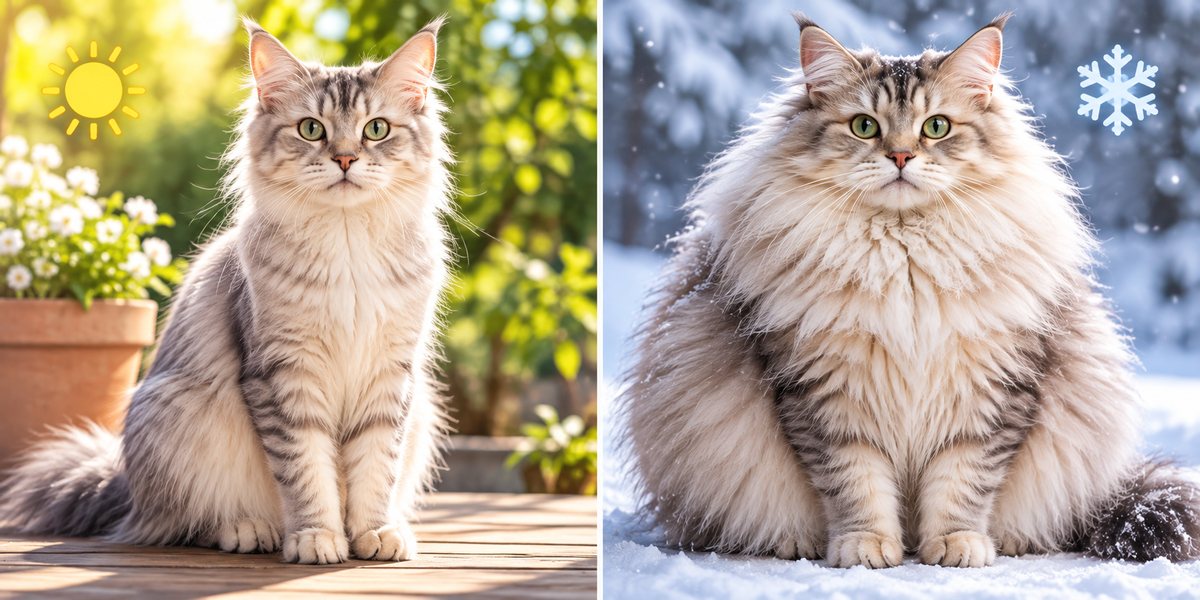
Compare breeds by seasonal coat changes. The ordering follows the characteristic itself rather than the alphabet whenever a meaningful order exists.
Discuss Seasonal coat changes in the forum
| # | Breed | Seasonal coat changes |
|---|---|---|
| 1 | Pronounced spring shed The Aegean commonly sheds excess coat in spring, with indoor cats often shedding to some degree year-round. | |
| 2 | Moderate seasonal change The Tiffanie usually develops a somewhat fuller cold-season coat and sheds more noticeably in spring; its light undercoat keeps the change below that of heavy double-coated longhairs. | |
| 3 | Mild seasonal change The Brazilian Shorthair’s glossy close coat has no substantial undercoat, so seasonal change is generally mild rather than a pronounced spring coat blow. | |
| 4 | Modest seasonal change The Chausie’s short coat generally changes modestly with the seasons; shedding may rise during spring and autumn without developing a heavy longhair-style coat blow. | |
| 5 | Pronounced spring fall shed The Cymric double coat changes distinctly with the seasons, with heavier spring shedding and a second autumn turnover as the plush undercoat renews. | |
| 6 | Pronounced seasonal shed The Exotic Shorthair’s unusually dense plush coat undergoes a substantial seasonal turnover, especially when winter undercoat is released in spring. | |
| 7 | Moderate to heavy seasonal shed The plush, undercoated Foldex coat commonly sheds more heavily in spring and autumn; longhaired Foldex cats show the seasonal coat change most visibly. | |
| 8 | Mild seasonal change The short German Rex coat has reduced guard hair and a soft waved texture, so seasonal change is generally mild rather than a heavy coat blow. | |
| 9 | Low seasonal coat burden The short silky coat is not a heavy shedder, so seasonal coat changes are usually modest. | |
| 10 | Heavy spring fall shed The Himalayan’s long, dense coat has a strong seasonal cycle, with substantial spring shedding and another increase as the winter coat develops and renews in autumn. | |
| 11 | Modest seasonal change The Khao Manee’s short shining coat generally changes only modestly with the seasons and should not develop a heavy winter undercoat. | |
| 12 | Minimal to mild seasonal change The Korn Ja’s fine close Thai-type coat has a light undercoat, so seasonal change should be slight and unlikely to produce a heavy shed. | |
| 13 | Can molt dramatically Lykoi may shed or molt most of the coat at least once, producing striking changes in appearance. | |
| 14 | Pronounced seasonal shed The plush Manx double coat commonly sheds heavily when the undercoat turns over, especially in spring and again to a lesser degree in autumn. | |
| 15 | Moderate to heavy seasonal shed The dense Minuet coat tends to shed more strongly during spring and autumn; the seasonal change is especially visible in longhaired cats. | |
| 16 | Pronounced spring shed The dense semi-long Nebelung coat becomes fuller in cool weather and typically sheds a noticeable amount of undercoat in spring. | |
| 17 | Heavy spring coat blow The Neva Masquerade’s dense triple coat is strongly seasonal: a full winter coat develops in cold weather and a heavy undercoat shed follows in spring. | |
| 18 | Mild seasonal change Historical Oregon Rex cats had short rexed coats with reduced guard hair, making a mild seasonal turnover more plausible than a heavy undercoat shed. | |
| 19 | Heavy spring fall shed The Persian’s very dense long coat has a pronounced seasonal turnover, with heavy shedding as winter undercoat is released and renewed. | |
| 20 | Pronounced seasonal shed The thick Pixie-bob double coat commonly changes substantially with the seasons, producing a noticeable spring shed in both short- and longhaired cats. | |
| 21 | Mild to moderate seasonal change The Raas cat’s short resilient island coat is expected to show a mild-to-moderate seasonal turnover, without the heavy spring coat blow of cold-climate double coats. | |
| 22 | Pronounced spring shed The dense plush double coat of the Russian type can shed surprisingly heavily in spring despite its short length, as the thick undercoat turns over. | |
| 23 | Mild seasonal change The short Savannah coat has no heavy undercoat, so seasonal change is usually mild, with a modest increase in loose hair during spring or autumn. | |
| 24 | Minimal to mild seasonal change The Sokoke’s very short warm-climate coat has little undercoat, so it should show only a small seasonal change rather than a pronounced coat blow. | |
| 25 | Spring fall shed Seasonal coat: spring fall shed. | |
| 26 | Mild to moderate seasonal change American Curls usually have only a mild-to-moderate seasonal change because the silky coat carries little undercoat; longhairs may show the change more clearly in the tail and furnishings. | |
| 27 | Moderate spring fall change The Ringtail’s short-to-medium coat and moderate undercoat usually produce a visible spring and autumn turnover, stronger in longer-coated individuals. | |
| 28 | Moderate spring fall shed The dense American Shorthair coat typically releases more hair in spring and autumn as its protective coat adjusts to temperature and day length. | |
| 29 | Moderate spring fall shed The dense, crimped American Wirehair coat commonly sheds more during spring and autumn turnover, although the wiry texture can hold loose hairs until grooming. | |
| 30 | Spring winter coat shed Seasonal coat: spring winter coat shed. | |
| 31 | Winter coat sheds spring Seasonal coat: winter coat sheds spring. | |
| 32 | Spring fall coat change Seasonal coat: spring fall coat change. | |
| 33 | Spring fall coat change Seasonal coat: spring fall coat change. | |
| 34 | Mild to moderate seasonal change The California Spangled’s short dense coat may shed somewhat more during spring and autumn, but its seasonal change should remain moderate rather than dramatic. | |
| 35 | Moderate seasonal change The silky semi-long Chantilly-Tiffany coat can become fuller in cooler months and shed more in spring, but little undercoat means it does not usually blow coat heavily. | |
| 36 | Undercoat sheds couple times year Seasonal coat: undercoat sheds couple times year. | |
| 37 | Moderate spring fall change The semi-long Cherubim coat typically becomes fuller in cooler weather and releases more loose hair during spring and, to a lesser extent, autumn turnover. | |
| 38 | Moderate seasonal undercoat change The Cyprus cat commonly carries more undercoat in cooler weather and sheds it in spring; semi-longhaired individuals show the seasonal transition most clearly. | |
| 39 | Moderate spring fall shed The Dragon Li’s dense, resilient natural coat is expected to shed more clearly in spring and autumn as its weather-adapted undercoat renews. | |
| 40 | Mild to moderate seasonal change The Egyptian Mau has a short coat, so seasonal change is not dramatic, but coat density can shift and shedding usually rises modestly during spring and autumn. | |
| 41 | Moderate spring fall shed The European Shorthair’s dense natural coat typically undergoes a moderate spring and autumn turnover as undercoat density adjusts to the season. | |
| 42 | Moderate spring shed The flowing German Longhair coat generally becomes fuller in winter and sheds more in spring as seasonal undercoat is released. | |
| 43 | Moderate seasonal shed Highlanders generally shed more during seasonal coat turnover; the change is more obvious in longhaired cats and in individuals with a denser undercoat. | |
| 44 | Spring fall shed Seasonal coat: spring fall shed. | |
| 45 | Mild to moderate seasonal change Kinkalows can be short- or semi-longhaired; seasonal change is usually mild to moderate, with longer and more undercoated cats showing the clearer spring shed. | |
| 46 | Moderate spring shed The Korean Bobtail’s weather-adapted coat typically carries more undercoat in cold weather and sheds it noticeably as temperatures rise in spring. | |
| 47 | Moderate seasonal shed The Kurilian Bobtail develops a practical weather-resistant coat that sheds more during seasonal transitions; semi-longhairs show the spring coat release particularly clearly. | |
| 48 | Mild to moderate seasonal change The Lambkin’s curly coat can change modestly with the seasons; longer-coated cats may release more hair in spring, with curls retaining some loose hairs until grooming. | |
| 49 | Moderate seasonal change Munchkins usually show a moderate seasonal coat change; longhaired cats develop and release more visible furnishings while shorthairs mainly show an increase in loose undercoat. | |
| 50 | Mild to moderate seasonal change Ojos Azules cats were described with ordinary short-to-medium domestic coats, so a mild-to-moderate spring and autumn turnover is the best current expectation rather than an extreme coat blow. | |
| 51 | Mild to moderate seasonal change The fine Oriental Longhair coat can become fuller in cooler months and shed more in spring, but minimal undercoat limits the intensity of the seasonal coat blow. | |
| 52 | Moderate seasonal shed The RagaMuffin’s dense medium-long coat usually becomes fuller in cooler weather and sheds more noticeably during spring coat turnover. | |
| 53 | Spring fall shed · density varies by season Seasonal coat: spring fall shed; density varies by season. | |
| 54 | Moderate spring fall shed Scottish Folds commonly shed more in spring and autumn as their dense undercoat turns over; longhaired Folds show the change more visibly. | |
| 55 | Heavier spring fall shed Seasonal coat: heavier spring fall shed. | |
| 56 | Moderate seasonal shed The dense Selkirk Rex coat undergoes a moderate seasonal turnover; loose hairs can remain caught in the curls, making shedding more apparent during grooming. | |
| 57 | Moderate spring shed The Somali’s fine semi-long coat develops more fullness in cooler weather and usually sheds more noticeably in spring, particularly around the ruff, breeches and tail. | |
| 58 | Mild to moderate seasonal change Tennessee Rex cats can show a mild-to-moderate seasonal turnover; longhaired and more densely undercoated individuals show the change more clearly than shorthaired cats. | |
| 59 | Mild to moderate seasonal change Toybobs may be short- or semi-longhaired, so seasonal change ranges from mild to moderate; semi-longhairs usually show the clearer winter fullness and spring shed. | |
| 60 | Moderate spring fall shed The Transylvanian’s dense undercoat and coarser guard hairs point to a moderate seasonal cycle, with more undercoat released in spring and renewed toward winter. | |
| 61 | Moderate winter summer change The Turkish Vankedisi develops a fuller semi-long winter coat and sheds back toward a lighter summer coat, producing a noticeable spring increase in loose hair. | |
| 62 | Moderate seasonal change The historical York Chocolate’s silky semi-long coat was expected to become fuller in cooler weather and shed more in spring, without the massive coat blow of heavily undercoated longhairs. | |
| 63 | Modest seasonal change The short, close Abyssinian coat changes only modestly with the seasons; a small rise in loose hair is more likely than a dramatic coat blow. | |
| 64 | Slight seasonal change The Arabian Mau’s close hot-climate coat lacks a substantial undercoat, so seasonal change should be slight, with only a modest rise in loose hair rather than a true coat blow. | |
| 65 | Mild seasonal change The Asian’s fine, close coat has little bulky undercoat, so seasonal change is usually mild and mainly appears as a temporary increase in loose short hairs. | |
| 66 | Minimal seasonal change The Australian Mist’s very short coat lacks a substantial undercoat, so seasonal change is slight and usually requires no special shedding-season grooming. | |
| 67 | Mild seasonal change The Balinese has a fine semi-long coat without a downy undercoat, so seasonal change is relatively mild; spring may bring more loose hair without a dense coat blow. | |
| 68 | Minimal to mild seasonal change The Bombay’s very short satin coat carries little undercoat; seasonal turnover is therefore usually subtle, with only a small increase in shedding. | |
| 69 | Mild seasonal change Burmillas generally show a mild seasonal increase in shedding; semi-longhaired individuals display the change more visibly than shorthairs. | |
| 70 | Minimal to mild seasonal change The Colorpoint Shorthair’s fine close coat has little undercoat, so seasonal change is normally slight and chiefly visible as a temporary increase in loose hair. | |
| 71 | Minimal seasonal change The Cornish Rex has an exceptionally short coat dominated by soft down hair, so seasonal coat change is usually slight, though individual cats may shed or thin unevenly. | |
| 72 | Minimal to mild seasonal change The European Burmese has a fine, close coat with little undercoat, so seasonal coat change is usually subtle and grooming demand changes little through the year. | |
| 73 | Mild seasonal change The Kanaani’s close short coat carries little undercoat, so seasonal change should be mild, with somewhat more loose hair during transitional months. | |
| 74 | Minimal to mild seasonal change The Mekong Bobtail’s fine, close coat has little undercoat, so seasonal turnover is generally slight and rarely creates a major grooming burden. | |
| 75 | Modest seasonal change The Ocicat’s short tight coat usually shows only modest seasonal turnover, with a temporary increase in loose hair rather than a major change in coat volume. | |
| 76 | Mild seasonal change Seasonal change is generally mild in Oriental Bicolors because the coat is fine and lightly undercoated; semi-longhaired individuals can show a somewhat fuller winter coat. | |
| 77 | Minimal to mild seasonal change The Oriental Shorthair’s very short close coat has little insulating bulk, so seasonal change is slight and generally easy to manage. | |
| 78 | Variable minimal hair cycle change Peterbald coat types range from bald to brush or straight, so seasonal change varies; hairless cats show virtually none while coated individuals may show modest density changes. | |
| 79 | Minimal to mild seasonal change The Sam Sawet’s short, fine Thai coat should change only slightly with season, producing little more than a temporary increase in loose hair. | |
| 80 | Modest seasonal change The Serengeti’s short tight coat normally changes only modestly through the year, with some seasonal shedding but little change in overall coat volume. | |
| 81 | Minimal to mild seasonal change The Serrade Petit’s fine close North African coat has only a light undercoat, so seasonal change should remain slight. | |
| 82 | Minimal to mild seasonal change The Siamese coat is very short, fine and lightly undercoated; seasonal change is normally subtle, although shedding can rise briefly in spring or autumn. | |
| 83 | Minimal to mild seasonal change The Singapura’s very short fine coat has little bulk, so seasonal coat change is slight and generally limited to a brief increase in loose hairs. | |
| 84 | Minimal to mild seasonal change The Suffolk’s smooth single Oriental-derived coat should show only a slight seasonal turnover, without a dense winter undercoat to shed. | |
| 85 | Minimal to mild seasonal change The Thai’s very short flat coat changes little in volume with the seasons; a small increase in shedding may occur during transitional months. | |
| 86 | Minimal to mild seasonal change These Thai varieties have a fine close single coat, so seasonal change is expected to be slight rather than a substantial spring or autumn coat blow. | |
| 87 | Mild seasonal change The Tonkinese has a short sleek coat; seasonal turnover is generally mild, with a temporary increase in loose hair rather than a dramatic density change. | |
| 88 | Minimal hair cycle change Because the Bambino is hairless or nearly so, there is no normal seasonal coat blow; warmth, sun protection and skin care matter more than seasonal grooming. | |
| 89 | Minimal seasonal change The Burmese single coat is short, silky and close to the body, so seasonal coat change is minimal and shedding stays comparatively even through the year. | |
| 90 | Minimal seasonal change The Devon Rex’s short, sparse waved coat usually shows little conventional seasonal change; coat density can fluctuate more by individual and body area than by a strong spring shed. | |
| 91 | Minimal hair cycle change The hairless or fine-down Dwelf does not undergo a conventional seasonal shed; environmental temperature affects comfort more than coat volume. | |
| 92 | Minimal seasonal change The Korat’s close single coat has no dense undercoat, so seasonal change is minimal and there is little winter coat to blow in spring. | |
| 93 | Minimal hair cycle change The Minskin’s sparse coat and fur points leave little hair available for a seasonal coat change, so seasonal management centers on skin and temperature rather than shedding. | |
| 94 | Minimal seasonal change The Snowshoe’s smooth single-layer coat has no undercoat, so seasonal coat change is minimal apart from a small temporary rise in loose hair. | |
| 95 | Minimal hair cycle change The Sphynx has no conventional coat to blow seasonally; fine down can fluctuate, but temperature control and skin care are far more important than seasonal shedding. | |
| 96 | Minimal seasonal change The Suphalak’s very short, close coat lacks undercoat, making seasonal coat change minimal under typical indoor conditions. | |
| 97 | Minimal hair cycle change The Ukrainian Levkoy is hairless or finely downed, so conventional seasonal coat turnover is minimal and cold-weather protection matters more than shedding. | |
| 98 | Seasonal coat changes can increase grooming needs. | |
| 99 | May grow fine winter coat then lose in warm weather Seasonal coat: may grow fine winter coat then lose in warm weather. | |
| 100 | Lighter summer coat · fuller winter ruff tail Seasonal coat: lighter summer coat; fuller winter ruff tail. | |
| 101 | Kitten coat thinner shorter · adult two layered Seasonal coat: kitten coat thinner shorter; adult two layered. | |
| 102 | Dense winter undercoat · shorter summer coat Seasonal coat: dense winter undercoat; shorter summer coat. | |
| 103 | Thick full winter triple coat · shorter less dense summer Seasonal coat: thick full winter triple coat; shorter less dense summer. | |
| 104 | Short shedding seasons Seasonal coat: short shedding seasons. | |
| 105 | Shorter summer · fuller winter mane britches plume Seasonal coat: shorter summer; fuller winter mane britches plume. | |
| 106 | Shorter summer · heavier winter with paw tufts Seasonal coat: shorter summer; heavier winter with paw tufts. |










































































































Breed comparisons describe tendencies, not guarantees about an individual cat. Approximate entries are kept separate from the canonical research record and can be refined as better evidence arrives.
 English