
Tangle & matting tendency in Cat Breeds
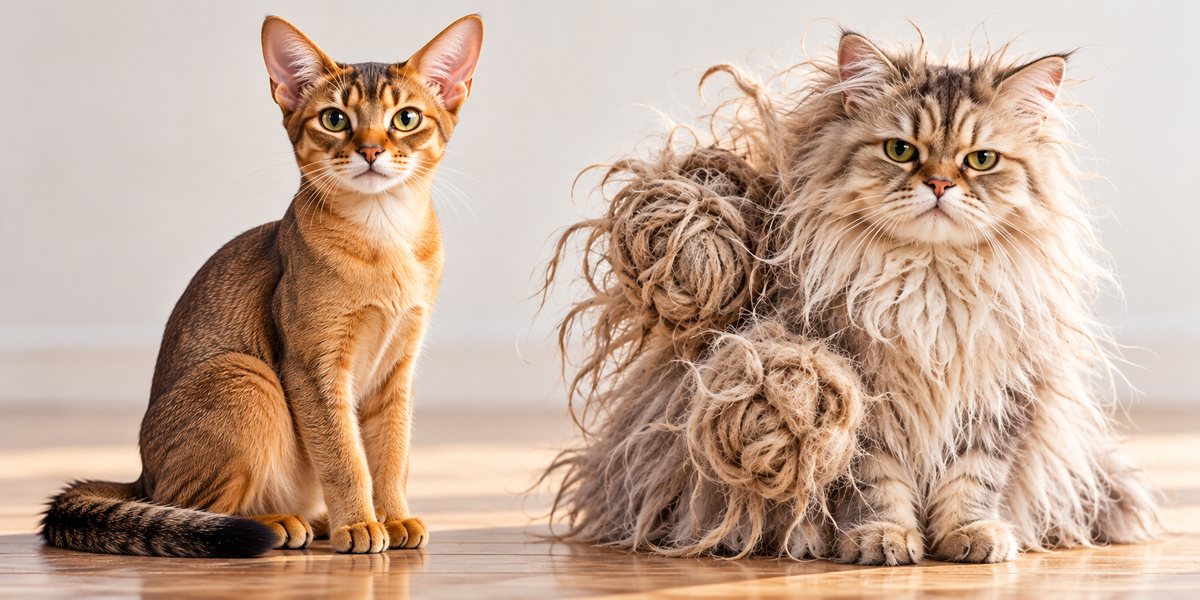
Compare breeds by tangle & matting tendency. The ordering follows the characteristic itself rather than the alphabet whenever a meaningful order exists.
Discuss Tangle & matting tendency in the forum
| # | Breed | Tangle & matting tendency |
|---|---|---|
| 1 | Very high The long fine coat and abundant undercoat readily felt into tight mats; daily combing is normally needed to prevent painful knots close to the skin. | |
| 2 | Very low The fine, close Burmese-family coat carries little bulky undercoat and is highly resistant to matting. | |
| 3 | Moderate to high if neglected The long plush coat and dense undercoat can compact into mats, especially behind the ears, under the forelegs and through the trousers, so regular combing matters. | |
| 4 | Very low The fine close coat has little undercoat and is highly resistant to tangling. | |
| 5 | Low to moderate by length Shorthairs rarely mat; longhaired Highlanders can develop knots in furnishings and friction areas, particularly during seasonal shedding. | |
| 6 | High The long coat and dense undercoat readily form tight mats without frequent, often daily, combing, especially in the armpits, belly and behind the ears. | |
| 7 | Moderate to high by texture Silkier coats may stay relatively free, while cottonier dense coats can mat quickly; armpits, belly, trousers and chest are the main problem areas. | |
| 8 | Moderate to high in longhair The dense plush coat can compact; longhaired Minuets are particularly prone to knots behind the ears, under the forelegs and through the trousers without regular combing. | |
| 9 | Moderate to high seasonal The dense Siberian-type triple coat can form knots as winter undercoat loosens, with the ruff, belly and trousers needing particular attention. | |
| 10 | Moderate to high Dense curls can interlock and felt, especially in longhaired Selkirks; gentle combing is needed because overbrushing can also disrupt the characteristic curl. | |
| 11 | Very low The short tight silky coat is highly resistant to matting. | |
| 12 | Moderate to high seasonal The semi-long triple coat can knot as the thick winter undercoat sheds; ruff, belly, armpits and trousers need the closest attention. | |
| 13 | Low to moderate seasonal The resilient short-to-semi-long coat is usually manageable, but denser seasonal undercoat can knot around the ruff, armpits and hindquarters if ignored. | |
| 14 | Low to moderate by length Shorthairs have little matting risk; longer-coated American Bobtails can develop small tangles in the ruff, belly and hindquarters without regular combing. | |
| 15 | Low to moderate The soft short-to-medium coat is not strongly mat-prone, but seasonal undercoat and friction areas can produce small tangles in fuller-coated cats. | |
| 16 | Moderate in semilong Shorthaired cats have little risk, while semi-longhaired Aphrodite Giants can tangle around the ruff, belly and hindquarters, especially during seasonal coat change. | |
| 17 | Low to moderate Despite its length, the fine silky coat has relatively little undercoat; tangles are most likely in the armpits, belly and behind the ears rather than across the whole coat. | |
| 18 | Low to moderate by length Shorthairs have minimal tangle risk; semi-long Burmillas can knot in feathering and friction areas but are generally easier than heavily undercoated longhairs. | |
| 19 | Low to moderate The silky semi-long coat has little or no woolly undercoat, so severe matting is uncommon, though ruff, belly and hindquarter tangles can occur. | |
| 20 | Low to moderate during shed The woolly double coat is short, but dense shed undercoat can compact if neglected during heavy seasonal moults. | |
| 21 | Low to moderate The silky semi-long Ragdoll-family coat is less mat-prone than a heavy Persian coat, but armpits, belly and hindquarters can knot during shedding. | |
| 22 | Moderate The medium-long double coat can tangle through the belly, britches and ruff, with risk rising during seasonal shedding. | |
| 23 | Low to moderate seasonal Short coats rarely tangle; semi-long Cyprus cats can develop knots as the seasonal undercoat thickens, especially in friction areas. | |
| 24 | Low to moderate Although short, the extremely thick plush coat can pack and clump if neglected, particularly during shedding or when an older cat grooms poorly. | |
| 25 | Moderate by coat length Shorthaired Foldex usually have low risk, while longhaired cats with plush undercoat can mat behind the ears, under the legs and through the trousers. | |
| 26 | Moderate The flowing long coat is not as cottony as a Persian coat, but regular combing is needed to prevent knots in the ruff, belly and hindquarters. | |
| 27 | Low to moderate by length Short coats have little risk; semi-long Kinkalows may knot around the belly, legs and tail furnishings but are not typically heavy mat formers. | |
| 28 | Low to moderate seasonal The short-to-medium natural coat is usually manageable, but denser seasonal undercoat can knot in fuller-coated individuals. | |
| 29 | Moderate The curly plush coat can interlock and felt if neglected, particularly in longer-coated Lambkins and in friction areas. | |
| 30 | Low to moderate The airy curls carry little heavy undercoat and are often less mat-prone than they look, but ringlets can knot if allowed to felt together. | |
| 31 | Low to moderate The short plush double coat seldom forms longhair-type mats, but dense shed undercoat can compact if grooming is neglected. | |
| 32 | Low to moderate by length Shorthairs rarely tangle; longhaired Munchkins have a silky coat without an especially heavy undercoat, so risk is moderate rather than extreme. | |
| 33 | Moderate The dense medium-long coat can knot behind the ears, in the armpits and through the hindquarters if regular combing lapses. | |
| 34 | Moderate seasonal The coarse guard coat resists tangling, but the woolly undercoat can felt during seasonal shedding, especially around the ruff, belly and hindquarters. | |
| 35 | Low to moderate by length Shorthaired individuals would have little risk; medium-coated cats can develop ordinary friction-area tangles but lack a known breed-specific severe matting tendency. | |
| 36 | Moderate in longhair The thick woolly double coat can pack during shedding; longhaired Pixie-bobs need particular attention to the belly, britches and underarms. | |
| 37 | Very low The short resilient coat has little practical tangle risk despite a moderate undercoat. | |
| 38 | Low to moderate The soft silky coat is generally easier than a Persian coat, but its length and density still allow knots in the armpits, belly and hindquarters if combing is neglected. | |
| 39 | Low to moderate The silky semi-long coat has relatively little woolly undercoat, so severe matting is uncommon; armpits, belly and shedding-season friction areas are the usual trouble spots. | |
| 40 | Low to moderate by length Shorthaired Folds have low risk despite dense undercoat; longhaired Folds can mat around the ruff, belly, trousers and behind the ears. | |
| 41 | Low to moderate by length The plush shorthair is low risk, while semi-long Scottish Straights need regular checks of furnishings and friction areas for knots. | |
| 42 | Low to moderate The fine semi-long coat is less mat-prone than heavily undercoated longhairs, but the ruff, belly and breeches can still form knots without periodic combing. | |
| 43 | Moderate The soft rexed coat can let curls interlock, particularly in longhaired cats and friction areas, so gentle detangling is preferable to aggressive brushing. | |
| 44 | Low to moderate by length Short coats rarely tangle; semi-long Toybobs can knot in the ruff, belly and tail furnishings but generally remain manageable with periodic combing. | |
| 45 | Low to moderate The silky semi-long coat has a light undercoat and is not an extreme mat former, but the ruff, belly and hindquarters can knot if neglected. | |
| 46 | Very low The short, close ticked coat rarely tangles; an occasional light brushing is normally enough to keep loose hair from collecting. | |
| 47 | Low The silky coat and sparse undercoat resist matting well, including in longhairs, though feathering behind the ears and under the legs still benefits from periodic combing. | |
| 48 | Very low The dense but short, resilient coat does not normally mat; shedding hair is a grooming issue rather than tangling. | |
| 49 | Low but handle gently True mats are uncommon in the short crimped coat, but rough brushing can damage its wiry texture, so any snags should be separated gently. | |
| 50 | Very low The close coat has no substantial undercoat, so tangles and mats are unusual. | |
| 51 | Very low The very short coat lacks a heavy undercoat and essentially does not mat under normal conditions. | |
| 52 | Very low The fine single semi-long coat lacks a downy undercoat, so it is notably resistant to matting for a longhaired cat. | |
| 53 | Very low The short, sleek pelt-like coat rarely tangles or mats. | |
| 54 | Low The silky single coat lacks the dense woolly undercoat that drives severe matting, although the ruff and friction areas can still form occasional knots. | |
| 55 | Very low The short satin coat lies close to the body and has minimal undercoat, making matting exceptionally uncommon. | |
| 56 | Very low The short, silky coat has no substantial undercoat and is not normally prone to tangles. | |
| 57 | Low The coat is exceptionally dense but short; loose undercoat can pack during shedding, yet true mats are uncommon when the cat is healthy and mobile. | |
| 58 | Very low The short silky single coat lies close to the body and almost never mats. | |
| 59 | Very low The short practical coat is dense but not long enough to form significant mats under normal care. | |
| 60 | Very low The short coat presents little practical matting risk. | |
| 61 | Very low The very short waved coat does not normally mat; grooming should be gentle because the reduced coat is more easily damaged than tangled. | |
| 62 | Very low The short velvety waves rarely form conventional mats, though fragile hairs call for gentle handling. | |
| 63 | Very low The short resilient natural-cat coat is not prone to matting, even though seasonal undercoat can shed heavily. | |
| 64 | Very low The short-to-medium coat remains close and smooth enough that matting is unusual. | |
| 65 | Very low The fine close-lying coat has little undercoat and almost never mats. | |
| 66 | Very low The functional short coat can shed a dense seasonal undercoat but does not ordinarily tangle. | |
| 67 | Very low The short soft rexed coat is not normally mat-prone, though it should be handled gently to avoid breaking altered hairs. | |
| 68 | Very low The short smooth coat has negligible tangle risk. | |
| 69 | Very low Both coat lengths have very little undercoat, so even longhaired Japanese Bobtails are unusually resistant to matting. | |
| 70 | Very low The short close coat with little undercoat is not prone to tangling. | |
| 71 | Very low The short shining coat has essentially no routine matting problem. | |
| 72 | Very low The close single coat is exceptionally resistant to tangling and matting. | |
| 73 | Very low The short fine Thai-type coat carries little undercoat and rarely tangles. | |
| 74 | Low The silky coat is specifically easy to maintain in both lengths; occasional knots can occur in semi-long furnishings, but widespread matting is unusual. | |
| 75 | Very low The short fine coat has little undercoat and almost never mats. | |
| 76 | Very low The short tight coat is not prone to tangling or matting. | |
| 77 | Very low The historical short rexed coat would have had little conventional matting risk, although altered hairs required gentler handling than a normal straight coat. | |
| 78 | Very low to low Shorthaired cats have negligible risk, while semi-long Oriental-family coats remain relatively tangle-resistant because the undercoat is light. | |
| 79 | Low The fine silky semi-long coat has minimal woolly undercoat, so mats are uncommon; occasional combing of the plume, belly and friction areas is usually sufficient. | |
| 80 | Very low The very short close coat essentially does not mat. | |
| 81 | Low The dense double coat is short and plush rather than long enough to tangle; shed undercoat may compact slightly but true mats are uncommon. | |
| 82 | Very low The short fine Thai-type coat has little undercoat and is not normally prone to tangling. | |
| 83 | Very low The short coat lacks a heavy undercoat and rarely mats. | |
| 84 | Very low The short fine coat and light undercoat make tangles unusual. | |
| 85 | Very low The very fine close coat has minimal undercoat and essentially no matting tendency. | |
| 86 | Very low The short ticked coat has negligible matting risk. | |
| 87 | Very low The smooth single-layer coat lacks undercoat and almost never tangles. | |
| 88 | Very low The very short hard coat has little undercoat and does not normally mat. | |
| 89 | Very low The smooth single coat has negligible tangle risk. | |
| 90 | Very low The very short single coat has no undercoat and does not normally tangle. | |
| 91 | Very low The very short flat coat is not prone to tangling. | |
| 92 | Very low The fine single coat lies close to the body and has negligible matting risk. | |
| 93 | Very low The short sleek coat is too close and smooth to develop routine mats. | |
| 94 | Very low The short coat has negligible tangle or matting risk. | |
| 95 | Very low The short coat and dense but compact undercoat are unlikely to form true mats; seasonal loose hair is the more relevant grooming issue. | |
| 96 | Low The fine silky semi-long coat has little or no woolly undercoat, making it notably resistant to matting despite its length. | |
| 97 | Low The cashmere-like single coat lacks an undercoat and is unusually resistant to matting; occasional knots are most likely in winter furnishings. | |
| 98 | Low The silky semi-long coat carries relatively little woolly undercoat, so severe mats are uncommon, though fuller winter coat benefits from periodic combing. | |
| 99 | Negligible With hairless skin or only fine down, conventional coat tangles and mats are not a practical concern. | |
| 100 | Negligible Hairless, flocked and velour coats do not form conventional mats; brush-coated individuals may need only minor detangling. | |
| 101 | Negligible The hairless or fine-down coat does not create conventional tangles or mats. | |
| 102 | Negligible The sparse coat does not normally produce conventional mats; coat cycling and skin care are more relevant than detangling. | |
| 103 | Negligible Sparse body hair and fine fur points do not create a meaningful conventional matting problem. | |
| 104 | Negligible Hairless, peach and down coats do not form conventional mats; brush or straight-coated individuals may need only ordinary light detangling. | |
| 105 | Negligible Without a conventional coat, tangles and mats are not a grooming issue. | |
| 106 | Negligible Hairless or fine-down skin does not produce conventional tangles or mats. |








































































































Breed comparisons describe tendencies, not guarantees about an individual cat. Approximate entries are kept separate from the canonical research record and can be refined as better evidence arrives.
 English