
Cherubim cats appeal to people who want a substantial companion with a gentle presence, a semi-longhaired coat and an affectionate household nature. They are not, however, a breed label that answers every important question by itself. Recognition differs between registries, individual personalities vary, and health documentation deserves careful attention. The best match is a caregiver who appreciates a large indoor cat and is prepared to verify what “Cherubim” means in a particular breeding program.
| Feature | What to expect |
|---|---|
| Adult size | Females approximately 10–15 lb (4.5–6.8 kg); males approximately 15–20 lb (6.8–9.1 kg) |
| Build | Large, moderate type with substantial bone and muscle |
| Coat | Semi-long, silky and smooth-falling, with relatively little undercoat |
| Temperament | Affectionate, calm, easy-going and playful, with individual variation |
| Recognition | A championship breed in TICA’s Ragdoll Breed Group from 2025; recognition is not universal |
| Expected lifespan | At least 10 years according to the breed description, with many said to reach their mid-to-high teens |
Identity and recognition
Cherubim is formally recognized within TICA as a championship breed in the Ragdoll Breed Group, with that status effective from 2025. The breed is described as related to Ragdoll lines, but that formal position does not apply across every registry. FIFe’s current recognized-breed list includes Ragdoll but not Cherubim, and Cherubim was not found in the CFA materials reviewed. Recognition is therefore registry-specific rather than universal.
That distinction matters when a buyer is comparing a pedigree, a kitten advertisement or a price. A cat may be called Cherubim in ordinary conversation, while its paperwork uses a different designation, reflects another registry’s rules or does not establish the claimed ancestry at all. The name alone cannot authenticate the cat. Ask to see the pedigree, registration details and the breeder’s written explanation of the cat’s category before paying a deposit.
Terminology can also be confusing. The recognized categories include mink, sepia and traditional, along with divisions such as solid, tortie, tabby, mitted and bicolor. “Traditional” should not automatically be treated as identical to every use of “solid”; the terms can refer to different classification systems or descriptions. A careful breeder should be able to explain both the parents’ registered identities and how the kitten’s color and pattern are recorded.
History and relationship to Ragdoll lines
Cherubim’s formal identity is closely connected with Ragdoll lines, which explains both the shared type and some of the health questions that prospective caregivers should ask. This relationship does not mean that every statement made about Ragdolls can automatically be transferred to Cherubim. It does mean that pedigree details, line history and the breeder’s approach to cardiac screening are relevant parts of evaluating a Cherubim kitten.
The breed’s developing recognition also helps explain why advertisements and community descriptions may not always agree. Formal standards can coexist with inconsistent use of a name in private sales or rescue settings. One rescue caregiver described two nearly three-year-old cats as sweet pets whose previous “no breed, no show” label related to their coloring. That experience is a useful reminder that a pleasant companion and a clearly documented pedigree are separate questions.
Size, structure and coat
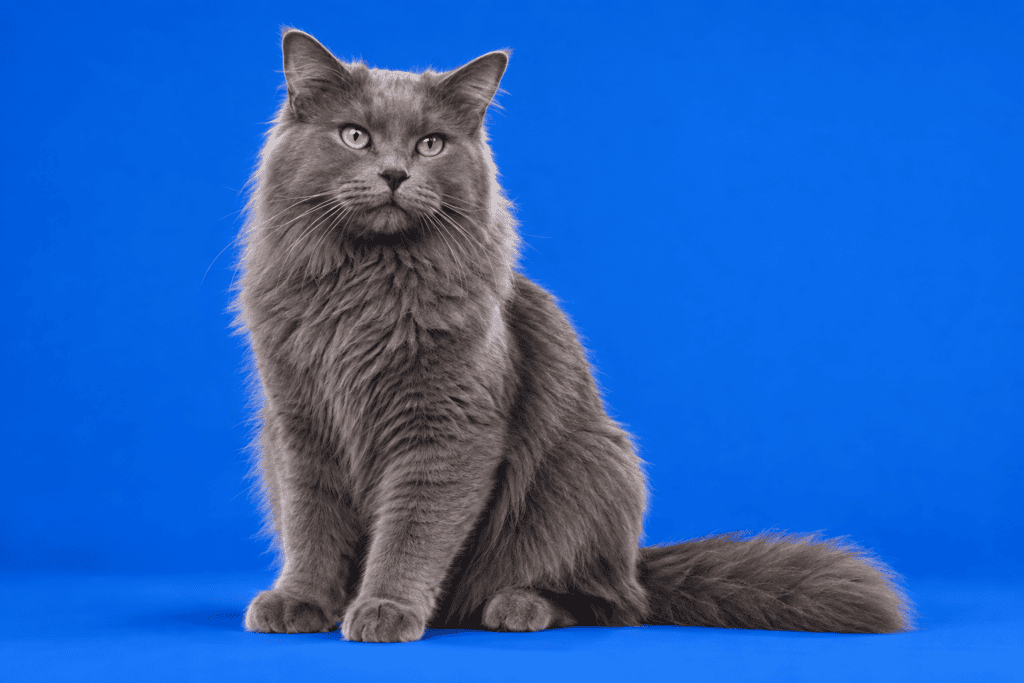
A Cherubim is intended to be a large, moderate-type cat rather than a delicate or extremely elongated one. The head has a broad modified wedge, the eyes are large and oval, and the body combines substantial bone and musculature with a broad chest. Large, rounded feet support the frame, while the tail is approximately body length and the hind legs are slightly longer than the front legs.
Size develops gradually. Females are described at approximately 10–15 pounds, and males at approximately 15–20 pounds, although a general range of 12–18 pounds is also displayed in the breed information. Physical maturity may continue until about three or four years, and full color development may take roughly three years. A young adult may therefore look less finished than its eventual adult form.
The coat is semi-longhaired, silky and smooth-falling, with a minimal undercoat. Seasonal changes are allowed, and some unaltered adults may have a shorter coat. This texture may feel less dense than a heavily undercoated longhair, but it should not be interpreted as hair-free or maintenance-free. A caregiver may still find hair on furniture and clothing, and an owner of rescued Cherubims reported noticeable hair throughout the home.
Combing should be adjusted to the individual rather than dictated by a fixed promise about the breed. Check areas that experience friction, including behind the legs, around the neck and beneath the body, and increase grooming when loose hair or tangles begin to accumulate. Seeing the adult cat and its living environment is more informative than relying on a label such as “low shedding.”
Colors and eye variations
Cherubim color expression is organized into mink, sepia and traditional categories. Depending on the category, the permitted patterns and white divisions include solid, tortie, tabby, mitted, bicolor and related forms. The terminology is part of the breed’s classification system, not merely a description of how a kitten looks in a photograph.
Eye color also varies by category. Mink cats may have blue-green through aqua eyes; sepia cats may show gold through green; and traditional Cherubim may have bronze, copper, gold, yellow-green or hazel eyes. Color can continue developing as the cat matures, so a buyer should ask how the breeder records the kitten’s expected category and what documentation supports it.
Temperament and daily companionship
A Cherubim is described as affectionate, calm, easy-going and playful. That combination can suit a household looking for a sociable cat that is not constantly intense, but calm should not be confused with inactive. Interactive play, climbing opportunities and attention remain part of a satisfying routine.
These descriptions support the possibility of a friendly family companion, not a guarantee that every cat will be a lap cat, enjoy restraint, welcome strangers or tolerate long periods alone. Child compatibility and dog compatibility likewise depend on the individual and on how introductions are managed. Meeting an adult cat is especially valuable because it reveals preferences that a breed description cannot: whether the cat seeks contact, how it responds to handling and how quickly it settles in a new interaction.
Kittens raised underfoot around household sounds, routines, children and handling may receive useful early exposure. Those experiences describe a particular rearing program, however, rather than guaranteeing an adult temperament or proving that every cat will enjoy being picked up. Ask what handling and socialization actually involved, and look for a breeder who can describe the kitten’s observed behavior rather than offering only broad assurances.
Home setup and care
Large size changes the practical requirements of ownership. Choose a carrier that allows the adult cat to turn and settle comfortably, a litter box with appropriate dimensions, and scratching structures that will not tip when a heavy cat leans into them. Cat trees, shelves and perches should be stable and weight-appropriate, with resting places at both elevated and quiet ground-level locations.
An apartment can work if it provides usable territory, vertical space, retreat areas and daily interaction. A house is not automatically better if the cat has no secure places to withdraw or no opportunities for play. Resource placement matters: separate food, water, litter, resting and scratching areas where possible, especially in a multi-cat home.
Interactive play helps preserve fitness and gives a calm cat an appropriate outlet for energy. Food portions should follow life stage, veterinary advice and observed body condition rather than the breed’s size range. The abdominal fat pad permitted in the standard is not, by itself, proof of obesity; assess the whole body and ask a veterinarian to help interpret changes in weight or shape.
Indoor living is a sensible default for a large, valuable and sociable cat. Secure outdoor access, such as a catio or supervised harness activity, may be considered for an individual that tolerates it. Free roaming is not a documented requirement and brings avoidable risks. Any outdoor arrangement should also prevent access to birds, rodents, reptiles and other vulnerable small animals.
Health questions and breeder checks
The most important inherited-health question concerns hypertrophic cardiomyopathy, or HCM, associated with some Ragdoll lines. That association should guide questions about ancestry and screening; it is not evidence that Cherubim as a whole has a proven breed-wide cardiac disorder.
Ask specifically whether the breeder has used testing relevant to the MYBPC3 mutation and request the identified result, laboratory and date. A negative result for that mutation does not exclude HCM, because a genetic test addresses a particular mutation rather than every possible cause of heart disease. Veterinary cardiac assessment, including echocardiography when indicated, is the diagnostic standard for evaluating the heart.
A responsible purchase conversation should include the pedigree and registration paperwork, health histories for the parents and close relatives, vaccination and parasite records, socialization details, cardiac-care practices, a written contract and a return policy. The quality of those answers is more informative than a confident claim that a registration category alone proves health.
Lifespan and long-term planning
The breed description estimates a lifespan of 10 or more years and says that many Cherubim reach their mid-to-high teens. Treat this as a planning estimate, not a guarantee or a population-derived average. Long-term care may include changing nutritional needs, dental care, preventive veterinary visits, insurance or emergency savings, and equipment that remains suitable as the cat reaches full size.
Price and availability
Published asking prices show how strongly cost depends on location, breeder and category. A Maryland breeder’s July 2026 update listed examples of US$1,900, with some color categories at US$2,650; a Canadian breeder listed kittens beginning April 15, 2026, at CAD$2,500. These are dated advertisements and asking prices, not completed-sale averages or a universal Cherubim budget. The [Maryland nursery listing](https://www.dazzlingragdolls.com/nursery.html) and [Canadian purchase information](https://www.ancasterragdollcats.com/kitten-purchase-process) can be checked for their stated terms.
Availability appears uneven and breeder-dependent. One United States program showed 2026 kittens subject to waitlist selection, while a German breeder was reported to offer Cherubim as well as retired breeding adults. A buyer may therefore need to consider a waitlist, an older kitten or a retired adult rather than focusing only on immediately available babies. Verify the registry identity, pedigree and contract before sending money; attractive photographs and a rare-sounding name are not substitutes for documentation.
No reliable breed-wide adoption-fee range or recurring-cost estimate is established. Plan locally for food, litter, routine and emergency veterinary care, preventive treatment, grooming, insurance if chosen, and large-cat equipment. The purchase price is only one part of the financial commitment.
Is a Cherubim cat right for you?
A Cherubim may suit someone seeking a large, affectionate and playful indoor companion who is willing to provide sturdy resources, regular interaction, coat inspection and ongoing weight awareness. The breed’s calmer description may be appealing in a family or multi-pet setting, provided introductions are gradual and the cat has places to retreat.
It is a weaker choice for someone seeking guaranteed lap behavior, minimal grooming, a hypoallergenic home, a precise low-cost budget or certainty from the breed name alone. The practical decision is conditional: choose the individual and breeder you can verify, not merely the appearance or category advertised. Meet the cat when possible, inspect the paperwork, ask how health decisions are made and consider whether the adult size fits your home and equipment.
What owners and caregivers say
Owners and caregivers describe the possible experience in warm but varied terms. A caregiver who adopted an adult Cherubim from a German breeder reported being very happy with the cat; the process included a contract, proof of neutering and a prior meeting, with retired breeding adults available as an option. That kind of arrangement may appeal to someone who wants to assess an adult personality rather than predict one from a kitten.
The rescue experience can look different. A caregiver who adopted two nearly three-year-old cats described them as sweet pets but also reported cat hair throughout the home. The account captures an important practical contrast: a silky, lightly undercoated coat can be pleasant to handle while still leaving visible hair around the house.
Breeder descriptions of kittens raised around household sounds, children, routines and handling suggest thoughtful early socialization in those particular homes. They do not remove the need to evaluate the individual cat. Likewise, community warnings about inconsistent use of the Cherubim name, questionable pedigrees and suspicious advertisements should be treated as reasons to verify documents and breeder practices, not as proof that every breeder or cat is problematic.
Together, these experiences point to a realistic expectation: Cherubim ownership may bring a rewarding, gentle relationship, but it also brings hair, substantial equipment, individual personality differences and a need for careful documentation. Those trade-offs are manageable for a prepared caregiver and important to recognize before committing.
 English