
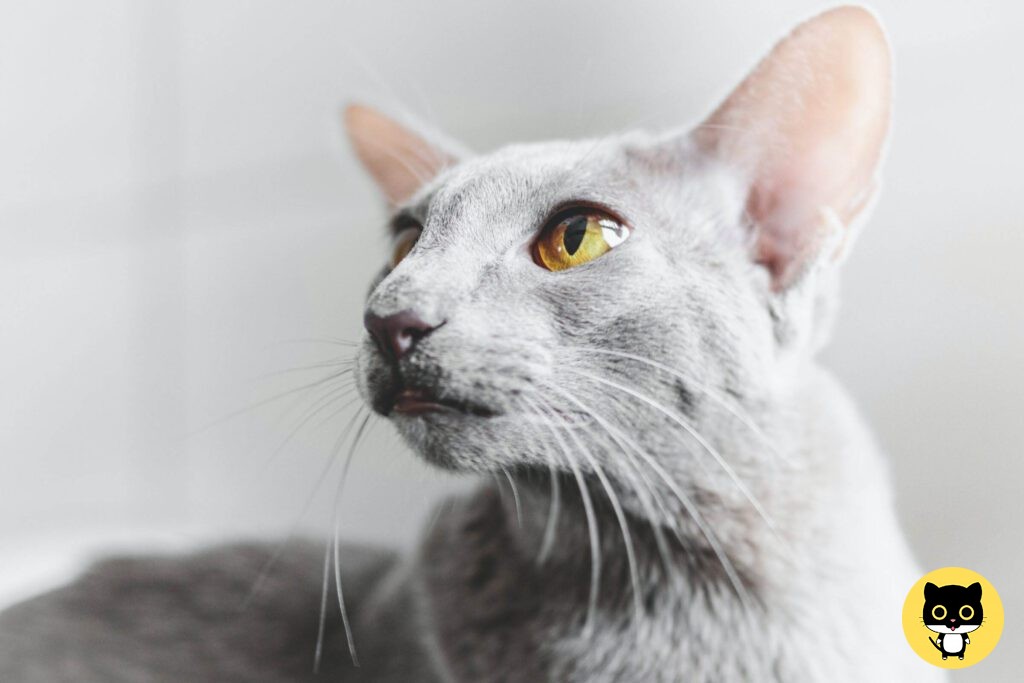
The Colorpoint Shorthair is easiest to understand as two things at once: a refined, blue-eyed pointed cat with Siamese-type lines, and a highly interactive companion whose daily needs may be more demanding than its short coat suggests. Its appearance attracts attention, but the more important suitability question is whether a household wants an active, vocal cat that commonly seeks involvement with people.
Quick Facts
| Quick fact | What it means for caregivers |
|---|---|
| Body and coat | Medium-sized, slender and long-lined, with a fine, close short coat |
| Eyes | Blue in the CFA breed profile |
| Point colors | Solid, lynx or tabby, and particolor point categories are recognized by CFA; details vary by registry |
| Temperament | Often active, curious, vocal and people-oriented, though individuals differ |
| Estimated lifespan | Broad published estimates range from about 12 to 17 years; these are not results from a defined Colorpoint survival study |
What the Colorpoint Shorthair is
The Colorpoint Shorthair is a defined pedigree breed in the Cat Fanciers’ Association, or CFA, with Siamese-type structure and additional recognized point colors. CFA rules permit Siamese cats as an outcross. That formal identity matters because a pointed coat by itself does not prove that a cat is a Colorpoint Shorthair, just as blue eyes and a Siamese-like outline do not establish pedigree.
Registry names are not interchangeable. TICA places relevant cats within its Siamese Breed Group, while FIFe presents Siamese as its shorthaired colourpoint breed. These systems may organize similar-looking cats differently, so a prospective buyer should ask which registry is involved, what the pedigree says and which parents are recorded. A confident label, an attractive appearance or a high price cannot replace those documents.
This distinction is especially useful when considering a rescue or rehomed cat. “Siamese,” “Colorpoint” and “lynx point” may be practical descriptions of appearance rather than evidence of CFA registration. A pointed-looking cat can be a wonderful companion without being a pedigreed Colorpoint Shorthair. Identity and suitability are related purchasing questions, but they are not the same question.
Appearance, points and coat
The body is medium-sized, svelte and refined rather than heavy. Long, tapering lines continue through the body, legs and tail; the head forms a wedge, the ears are large, and the tail narrows toward its tip. This is a cat whose elegance comes from proportion and length, not from a bulky frame. No authoritative sex-specific adult size table was verified, so weight-based expectations are less useful than assessing overall condition and body balance.
The coat is short, fine, silky and close-lying, which gives the cat a neat appearance and a light feel when stroked. It is not non-shedding. A fine coat can still leave hair on furniture and clothing, with the amount changing according to the individual cat, season, grooming, health and household environment.
Blue eyes are required in the CFA profile. CFA recognizes solid point, lynx or tabby point, and particolor point categories, while the range of accepted colors and the treatment of genetic backgrounds can differ between registries. Someone buying for a particular showing or registration outcome should therefore check the relevant [breed standard](https://cfa.org/wp-content/uploads/2024/03/colorpoint-shorthair-standard.pdf) rather than relying on photographs or a breeder’s informal color description.
Point coloration is temperature-sensitive. The cooler extremities—such as the face, ears, legs and tail—develop darker color, while the body remains lighter. Point contrast can change as a cat matures or experiences cooler conditions. This explains why caregivers may notice a cat becoming darker or changing visually over time, but it does not prove pedigree. The same underlying colorpoint biology can occur in cats registered under different systems and in cats with no documented pedigree.
Living with the temperament
Conversation is often part of life with a Colorpoint Shorthair. Breed descriptions commonly portray these cats as vocal, active, inventive and strongly interested in human activity. That can be rewarding for someone who wants a responsive companion that announces preferences, follows household routines and joins in daily interactions. It can be tiring for someone hoping for a quiet cat that spends most of the day independently.
Activity is best met with participation rather than a pile of unattended toys. Interactive play, sturdy climbing opportunities, scratching surfaces and safe places to investigate give the cat appropriate outlets for movement and curiosity. Rotating toys and introducing short training sessions can help maintain interest. There is no dependable breed-wide intelligence score or fixed exercise quota, so the useful approach is to observe the individual: some cats will work eagerly for food rewards, while others prefer movement, attention or novelty.
Reward-based training can make practical tasks easier. Carrier entry, nail care, grooming, handling and cooperative veterinary care can all be introduced in small steps with food or another valued reward. Training is not evidence that every Colorpoint Shorthair will enjoy being carried or restrained. A cat may be highly social and still object to a particular form of handling.
People-orientation also does not guarantee lap behavior. One cat may sleep pressed against a caregiver, another may prefer to sit nearby, and a third may seek attention in brief, energetic visits. Meeting an adult is therefore more informative than treating “affectionate” as a promise: an adult encounter can reveal vocal style, confidence, tolerance of touch and whether the cat actually chooses close physical contact.
Household suitability
A household that enjoys an involved companion may be a good match. The caregiver should be prepared to provide regular social contact, play and environmental interest rather than assuming that a short coat means a low-demand lifestyle. Someone who works long hours may need to plan enrichment and companionship carefully, especially if the cat shows distress or frustration when left without interaction.
Respectful children, compatible cats and cat-safe dogs can be suitable housemates when introductions are gradual. Supervision, separate resources and escape spaces give the cat choices while relationships develop. Social confidence is individual, so a breed label should not be used to skip introductions or to assume that a particular cat will enjoy a busy home.
Small pets require a different standard of caution. Ordinary feline predatory behavior can endanger rodents, birds, reptiles and other small animals even when a cat is friendly with people. Secure separation is more reliable than expecting training to remove that risk.
Care and grooming
A weekly comb or quick brush is a sensible starting point for a healthy shorthaired cat. The goal is not elaborate coat styling but the removal of loose hair and early detection of tangles, skin changes or areas that have become uncomfortable. Some cats need less, while others shed enough that more frequent brief sessions are useful.
Routine bathing is generally unnecessary. A clean, healthy short coat usually needs simple grooming rather than regular shampooing. A silky texture should not be confused with an allergy-free coat; an allergic household should spend time with the particular cat and assess its own response before committing.
Everyday care also includes scratching surfaces, dental and nail care as appropriate, vaccination and parasite prevention guided by a veterinarian, and a carrier-training plan made before an emergency occurs. Because this breed may be active and exploratory, secure windows, balconies and doors are important. Vertical space can increase usable territory without requiring a very large floor plan.
Health, testing and longevity
The direct population-level health evidence for Colorpoint Shorthairs is limited. A small sampled Colorpoint group has been examined in relation to rdAc-associated retinal degeneration, and conditions reported in Siamese or related Oriental populations include amyloidosis, mucopolysaccharidosis VI, hyperesthesia and urate urolithiasis. These related-breed findings justify sensible questions about family history and veterinary care, but they do not provide Colorpoint Shorthair prevalence estimates or establish that every cat needs a universal disease panel.
A breeder should be able to identify the parents, provide registration and pedigree records, explain the family health history and share veterinary records. Ask for copies of DNA tests that were actually performed, including the laboratory and interpretation. There is no verified universal mandatory Colorpoint Shorthair testing panel, so a long list of claimed tests should not be accepted without knowing what each test examines and why it was used.
Questions about retinal disease, unexplained early deaths, kidney or urinary problems and inherited conditions in close relatives are more useful than asking whether a breed is simply “healthy.” A responsible answer may include uncertainty. The important point is whether the breeder knows the family background, keeps appropriate records and is willing to discuss veterinary findings without presenting the breed as either risk-free or inherently fragile.
Published lifespan estimates are broad rather than definitive. VCA gives an estimate of about 12–15 years, while Zoetis gives about 13–17 years. These figures can help with long-term planning, but they are commercial or veterinary profile estimates, not results from a defined Colorpoint Shorthair survival study. Nutrition, preventive care, inherited background, environment and individual chance all influence how long a particular cat lives.
Buying, adopting and verifying identity
Documentation is part of consumer protection as well as part of cat fancy administration. Before paying for a kitten, ask to see the registration details, pedigree, parent identification and contract. Confirm which registry is issuing the papers and whether the registration being offered actually corresponds to the breed name being advertised. If the seller cannot document the parents or the registration status, the cat may still be an appealing companion, but the claim of pedigreed Colorpoint Shorthair status remains unsupported.
Price examples need careful context. Adopt-a-Pet gives a general U.S. breeder estimate of $800–$1,500, but this is a broad estimate rather than a dated, region-specific sale record for a documented pedigreed kitten. A 2023 caregiver account described a claimed $700 sale in the United States from an unregistered accidental litter. That account is useful as a warning about status and documentation, not as a normal current breeder-market price.
For adoption, Adopt-a-Pet gives a general U.S. shelter or rescue fee estimate of $50–$300. Actual fees vary with region, organization, age, veterinary work and demand. A rescue cat identified as a Siamese, Colorpoint or lynx point may have the appearance without the pedigree, and that distinction should be stated plainly rather than treated as a defect. Adoption can still be an excellent route to a pointed companion.
No dependable region-specific availability or waiting-time estimate can be applied broadly. Prospective caregivers should contact local breeders and rescues directly, compare veterinary costs in their area and budget for routine care, emergencies, enrichment and transport. The least expensive acquisition price is not necessarily the lowest-cost choice if records, early veterinary care or responsible support are missing.
What owners and caregivers say
Owners describe the emotional side of these cats with striking warmth. One caregiver who discussed a cat named Yuki remembered an especially affectionate cuddlebug who slept on the owner’s head. That is a vivid example of close attachment, but it should remain an example rather than a breed-wide promise. A Colorpoint Shorthair may be devoted without being a lap cat, and an adult meeting remains the best way to assess the individual’s preferred form of closeness.
Other caregivers notice the visual identity changing over time. People discussing pointed rescue or domestic cats have described darker coat areas during maturation, vivid blue eyes and repeated uncertainty about whether the cat was “really” a particular breed. Those observations fit temperature-sensitive point coloration, but changing points cannot settle ancestry. Papers and parentage answer the registry question; behavior and an in-person meeting answer much more of the companionship question.
The most useful conclusion is conditional rather than absolute. Choose this breed if you want an elegant shorthaired cat and are prepared for the possibility of frequent communication, curiosity, play and social involvement. Before purchase, verify the pedigree instead of equating a pointed coat with a breed name. Ask about family health without turning related-breed findings into guaranteed diagnoses, and meet the adult whenever possible to assess handling tolerance, vocal style and social confidence. A caregiver who makes those distinctions is more likely to choose both the right cat and the right expectations.
 English