
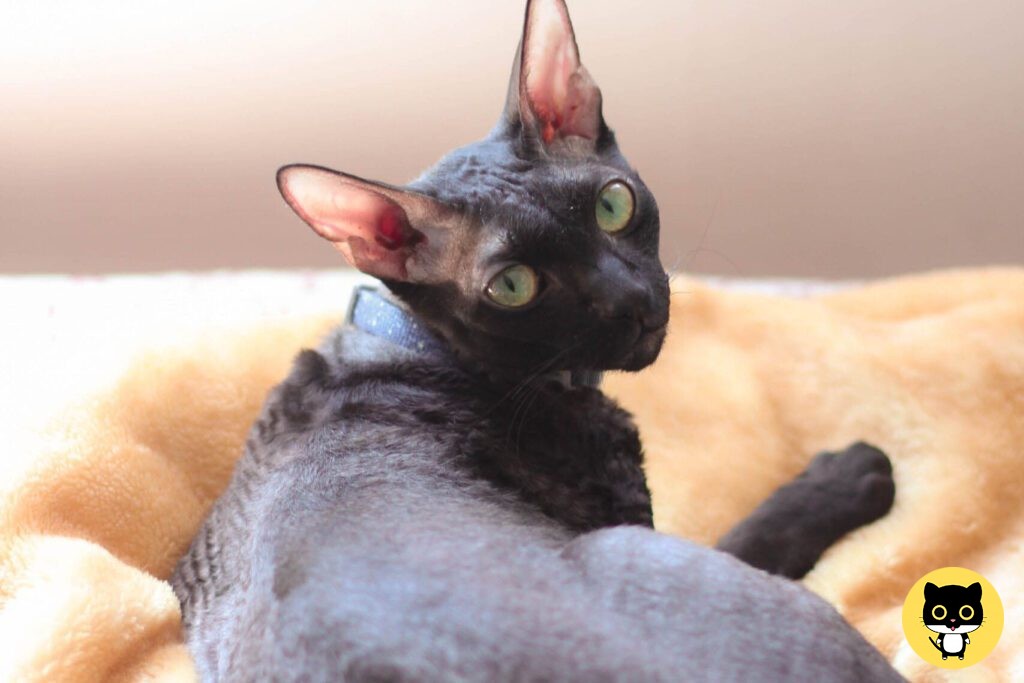
The Cornish Rex is a cat for people who want an involved companion rather than a decorative presence. Its fine, rippled coat is unusual, but the more important question is how a household feels about an active, curious cat that may follow its people, ask for interaction and seek the warmest place in the room. The coat can make grooming relatively simple; it does not make the whole cat low-maintenance.
Quick Facts
| Feature | What to expect |
|---|---|
| Size | Small to medium; published guide figures are about 5–7 lb for females and 8–10 lb for males |
| Build | Long, fine-boned and muscular, with long legs, a deep rib cage, an arched back and a tucked abdomen |
| Coat | Short, fine and close-lying, with a soft, regular wave; shedding is reduced for some households but not absent |
| Typical activity | Agile, playful, curious and interested in household activity |
| Companionship | Often people-oriented, though affection may mean staying nearby rather than accepting lap time or restraint |
| Grooming | Usually light, with care guided by the individual coat and skin rather than a fixed schedule |
| Estimated lifespan | Published estimates range from about 9–13+ years to around 16 years or more; some sources say reaching 20 is not unusual |
Identity and breed recognition
The Cornish Rex is a recognized breed in CFA, TICA and FIFe. FIFe places it in Category 4 among fully recognized breeds. Those organizations do not use completely interchangeable terminology or standards, so a curly-coated cat is not automatically a pedigreed Cornish Rex. When breed identity, ancestry or health history matters, check the pedigree and registration documents rather than relying on appearance alone. The relevant breed standard is also specific to the registering organization.
The breed began with a naturally occurring curly-coated kitten born in Cornwall, England, in the 1950s. Selective breeding developed the distinctive type that is now associated with the Cornish Rex: an elegant, long-lined body combined with an unusually fine, waved coat. Its name describes both its place of origin and its resemblance to a rex-coated rabbit, not a relationship to the Devon Rex. The two breeds can look superficially similar, but they are separate breeds with different standards and histories.
Appearance and coat
The body looks delicate at first glance but is not frail. A Cornish Rex has a long, fine-boned outline, long legs, a deep rib cage, an arched back and a tucked abdomen, with muscularity beneath the slim profile. Large ears, a long tapering tail and an alert head complete the impression of an athletic cat built for movement rather than bulk.
The coat is the feature most people notice. It is short, dense, soft and close to the body, with waves often described as a Marcel wave. Unlike the usual feline coat, it lacks the typical coarse outer guard-hair layer. Coat density and wave intensity vary, however, and not every Cornish Rex has an equally dramatic curl.
Color and pattern do not reduce to one “correct” Cornish Rex look. Solid colors, tabbies, tortoiseshells, calicos, bicolors, pointed patterns and other broad classes are recognized, although the exact combinations depend on the registry. Eye color is likewise connected to coat category and the applicable standard, so there is no single eye color that defines the breed. CFA’s standard, for example, should not be treated as interchangeable with every other registry’s requirements.
The coat may leave less conspicuous loose hair than the coat of many ordinary or long-haired cats, but “less visible” is not the same as “no shedding.” Hair can still collect on clothing, bedding and furniture, and the amount may change with the individual, season, health and household fabrics. The absence of a typical guard-hair layer also does not make the Cornish Rex reliably hypoallergenic: allergens are associated with skin particles and saliva as well as visible hair. Anyone with significant allergies should spend time with the actual cat and seek medical advice rather than treating the breed label as a guarantee.
Temperament and daily relationship
Energy is central to the Cornish Rex experience. Breed descriptions commonly present it as active, agile, playful and curious, with a strong interest in what people are doing. In practical terms, this is a cat that may turn a quiet room into a climbing route, investigate an open cupboard or expect a game when its caregiver is trying to concentrate.
Enrichment works best when it is varied and available every day. Short, repeated play sessions can be more useful than one occasional burst of activity. Wand toys, chase games, food puzzles, climbing structures and secure high resting places give the cat ways to use both its body and its attention. Because the breed is agile, vertical space should be stable and safely arranged rather than improvised from fragile furniture.
Social interest is common, but it does not have one universal physical expression. A Cornish Rex may follow a caregiver from room to room, sit close during work, join household activities or seek warmth without wanting to be held. Some are enthusiastic lap cats; others prefer proximity on their own terms. An owner describing five Cornish Rex cats found all of them highly people-oriented and energetic, but only three enjoyed being held. That distinction matters for anyone imagining affection as constant physical contact.
Vocality can also be part of the relationship. Some caregivers describe persistent or loud meowing, while others live with a particularly cuddly, clingy and talkative cat. These accounts do not establish that every Cornish Rex is noisy, but they make vocal temperament a sensible question to ask before choosing a kitten or adult. If a quiet home or uninterrupted remote work is important, ask how the individual behaves when attention is delayed.
Handling tolerance should be assessed rather than assumed. One sweet, playful adult stayed close to her caregiver but disliked laps and restraint; patient, non-forced interaction gradually increased her confidence. That experience suggests a useful rule for this breed and for cats generally: companionship is easier to build when the cat can end an interaction safely. A cat that seeks people may still dislike being picked up, groomed for too long or confined.
Home compatibility
The Cornish Rex can suit an active household that enjoys interaction and can provide predictable opportunities for play. Children, other cats and dogs may live successfully with one, provided introductions are gradual, resources are distributed and contact is supervised. The individual’s previous experience matters as much as the breed’s general reputation.
Small pets need a different standard of safety. A Cornish Rex may be playful and affectionate with people while still showing unpredictable prey-directed interest toward a bird, rodent or other small animal. Physical separation is the responsible arrangement; training and supervision should not be treated as a substitute for secure barriers.
Busy homes deserve particular scrutiny. A two-year-old male named Felix was described as lively, people-oriented and affectionate at night, but not a lap cat. His rescue listing also reported anxiety and litter-box accidents in a home with young children. Another cat, Huey, entered rescue because he and a dog did not get along. These cases do not define the breed, but they show why questions about noise, crowding, children, dogs, previous homes and stress responses are more useful than a simple label such as “good with families.”
An adult cat can offer especially clear information about these practical traits. Meeting the cat lets a prospective caregiver observe its response to handling, visitors, household noise and other animals. A kitten may ultimately become a wonderful companion, but its adult preferences are still developing, so the household must allow more uncertainty.
Grooming, warmth and routine care
Grooming is often relatively light for a healthy Cornish Rex. A soft brush, fine comb or gentle hand grooming may be enough to remove loose hair and keep the coat tidy. The fine wave can be disturbed by rough or excessive brushing, so the aim is not to impose a vigorous grooming routine but to inspect the coat and skin and respond to what is actually present.
Skin and oil accumulation are individual issues. Some caregivers report oily ears, paws, nails or tail areas and occasional cleaning or bathing; others say their cats have never needed a bath. A regular visual check of the ears, feet, claws and tail is more reliable than assuming that every Cornish Rex needs frequent bathing. If the skin becomes persistently greasy, irritated, inflamed or malodorous, veterinary advice is more appropriate than repeatedly washing the cat.
Cold protection deserves more attention than the short coat might suggest. The fine coat offers limited protection from cold and rain, so warm, dry sleeping places are useful and wet or chilly conditions should be avoided. Owners have described cats seeking blankets, heated beds, radiators, warm vents and human clothing. Individual preferences differ, but the pattern has a practical consequence: provide warmth that the cat can leave freely rather than forcing clothing or placing a heat source where the cat cannot move away safely.
Routine preventive care remains ordinary cat care: veterinary examinations, vaccinations as advised, parasite control, dental attention, nail care and a balanced diet. The unusual coat should not distract from weight monitoring, litter-box habits, mobility, appetite and behavior. A change in any of these can be more important than whether the coat looks perfectly waved.
Health and lifespan
The clearest breed-relevant inherited-disease screening question is PRA-rdAc, an autosomal-recessive retinal degeneration for which UC Davis lists the Cornish Rex among testable breeds. A prospective buyer can ask a breeder for documented results from relevant parents and ask how those results affect breeding decisions. A DNA result is useful information, not a replacement for a veterinary examination or a complete health history. The breed testing information and PRA-rdAc explanation provide a way to make that question specific.
Hypertrophic cardiomyopathy, or HCM, can occur in cats, but the reviewed information does not establish a Cornish Rex-specific prevalence or causative mutation. It is reasonable to ask about cardiac history in the family and whether a breeder monitors breeding cats, while avoiding both extremes: a generic “healthy breed” promise and an automatic assumption that every Cornish Rex carries a special heart risk. Signs such as breathing difficulty, collapse, marked exercise intolerance or sudden changes in behavior require veterinary assessment.
Longevity figures should be read as estimates rather than equivalent survival statistics. One published guide gives around 16 years or more and says reaching 20 is not unusual; another gives 9–13+ years. These figures differ in scope and should not be used as a promise for an individual cat. Genetics, preventive care, nutrition, environment and chance all influence how long a particular Cornish Rex lives.
Buying, adopting and availability
Acquisition cost varies with region, breeder, pedigree, age, color, inclusion of registration or breeding rights and current availability. United States examples checked around October 1, 2026 included a $2,000 asking price for a 2026-born kitten from an Arizona breeder, a $3,000 asking price for a female kitten listed for Pittsburgh with November 15, 2026 availability, and $1,800 in a breeder purchase agreement. These are dated asking or contract examples, not a market-wide price range. The Arizona listing, Pittsburgh-area listing and purchase agreement also illustrate why contract terms deserve as much attention as the headline price.
Rescue may be less expensive but is not necessarily immediate or geographically convenient. A United States listing gave a $500 fee for Felix, a two-year-old male in Goodyear, Arizona, while Specialty Purebred Cat Rescue listed Huey with a $300 fee. Listings can disappear quickly, and a rescue cat’s history may include stress, household conflict or behavior that changes after settling in. Breed-specific rescue groups and general shelters may therefore require patience, transport planning and flexibility about age and location.
For a breeder purchase, ask to see pedigree or registration documentation, veterinary records, the written contract and relevant PRA-rdAc results. Ask how the kitten has been socialized, how it responds to handling, what it eats, whether it has lived with children or other animals and what happens if the placement fails. A low-shedding appearance should never substitute for evidence of responsible breeding and sound care.
The Cornish Rex is most likely to suit an interactive indoor household that enjoys play, companionship and a cat with a distinctive coat, while accepting that individual boundaries may be firm. It is a poorer fit for someone seeking a silent, highly independent cat or choosing solely to avoid visible hair. The best decision combines the breed’s general tendencies with the actual cat’s history, behavior and health documentation.
What owners and caregivers say
Owners and caregivers describe rewarding relationships with Cornish Rex cats, but their stories make the breed’s variation clearer than a simple description such as “affectionate.” Some cats are highly responsive to strangers and want to be involved in everything; others show attachment by remaining nearby rather than climbing onto a lap. The account of five cats—each energetic and strongly interested in people, but only three comfortable being held—captures why social engagement and handling tolerance should be assessed separately.
Warmth is a recurring part of life with these cats. Caregivers describe blankets, heated beds, radiators, warm vents and clothing as favored resting places during cold weather. That fits the practical limits of the fine coat, although the amount of warmth each cat seeks differs. Offering several safe resting choices is more useful than assuming every individual needs the same temperature or clothing.
Coat care also varies in ordinary, manageable ways. Some cats develop oily areas around the ears, paws, nails or tail and need occasional cleaning; others go without baths. The common lesson is not that bathing is either required or forbidden, but that the caregiver should inspect the individual cat, use gentle methods and address persistent skin changes with a veterinarian.
Finally, the stories point back to the central suitability question. A Cornish Rex may be playful, vocal, people-focused and physically close without being a reliable lap cat. A household prepared to negotiate those preferences, provide warmth and enrichment, and learn the individual’s signals is more likely to find the breed a lively and rewarding companion.
 English