
| Characteristic | What to expect |
|---|---|
| Build | Small to medium, muscular and medium-framed |
| Coat | Short, soft, wavy or curly, with variable density |
| Temperament | Active, curious, playful and socially engaged |
| Grooming | Usually light to moderate, with regular skin and ear checks |
| Estimated lifespan | About 14–17 years or more; an estimate, not a guarantee |
| Typical adult weight | Approximately 5–7 lb for females and 7–9 lb for males; another standard gives about 6–9 lb overall |
Identity and recognition
The Devon Rex is a distinct Rex breed, not a Cornish Rex with a different coat. Its identity combines a particular body and head type with a short, irregularly wavy coat and a lively, people-oriented character. It is recognized as an established breed by CFA, TICA and FIFe. A Devon Rex standard is also published by WCF, although its current recognition classification was not verified here. Readers comparing pedigrees or show eligibility should therefore check the rules of the registry involved rather than assume that every organization classifies the breed in exactly the same way.
Its unusual appearance can make it seem delicate, but the Devon Rex is not simply a decorative or fragile-looking cat. Beneath the oversized ears and fine coat is a muscular, active animal that generally wants to climb, investigate and participate in household life.
Appearance: an athletic cat with a changeable coat
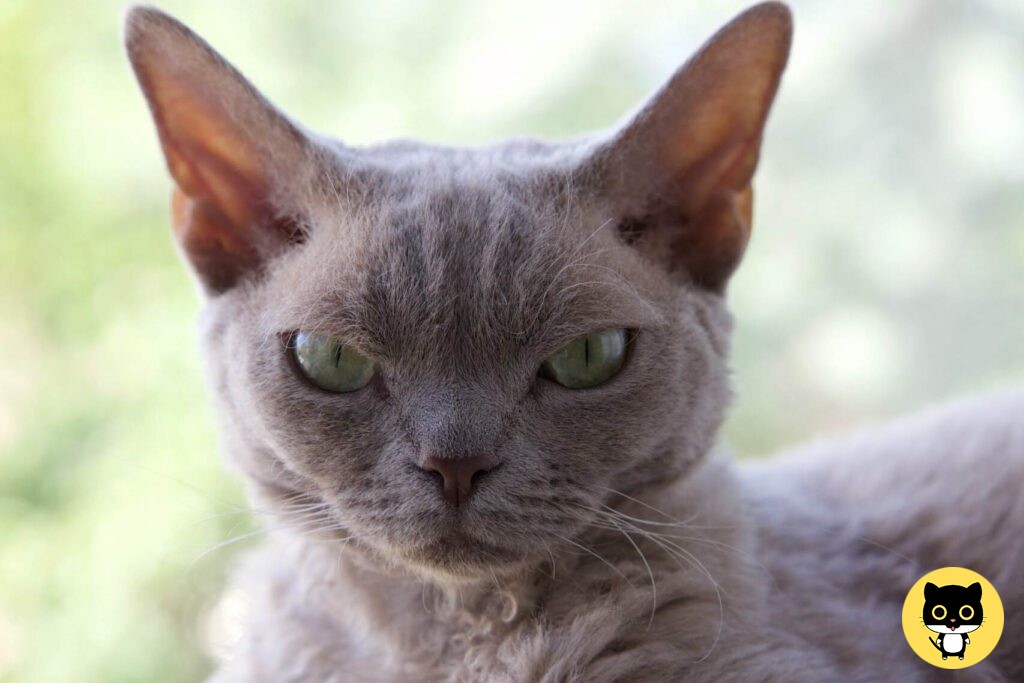
The Devon Rex usually has a modified wedge-shaped head, prominent cheekbones, a short muzzle and large ears set low on the head. Large eyes, long limbs and a long tail complete the impression of a cat built for movement. The body is medium-framed and muscular rather than bulky. Approximate adult weights vary somewhat by source, but females are often placed around 5–7 pounds and males around 7–9 pounds, with a broader typical range of about 6–9 pounds also used.
The coat is short, soft and rexed, meaning that it has a wave or curl rather than lying straight against the body. Guard hairs are sparse and the undercoat is generally limited. Individual coats can look quite different: one Devon may have a loose, full curl, while another may have a thin, suede-like covering or visibly sparse areas. Kittens can also change as they mature and molt, so a young cat’s current coat does not necessarily predict its adult appearance.
Nearly any broad coat-color or pattern group may be seen, including solid, tabby, bicolor, shaded, smoke, tortoiseshell and colorpoint cats. Eye-color requirements depend on the coat category and the registry standard. Blue eyes are commonly associated with colorpoints, while aqua may be associated with mink patterns; other combinations are permitted under applicable standards. The published breed standard is more useful than a general image search when appearance or show eligibility matters.
The coat can make loose hair less conspicuous, but it does not make the Devon Rex hairless or hypoallergenic. A light-feeling coat may still leave hair on bedding, clothing and furniture, and it does not establish lower exposure to the allergens that trigger reactions. One household may notice very little shedding from its Devon, while another may notice considerably more. Anyone with allergies should spend time with the particular adult or kitten they are considering rather than relying on the breed’s reputation.
Temperament and daily companionship
The Devon Rex tends to turn ordinary household activity into an invitation. Many are curious, playful and eager to follow what people are doing. They may perch on a shoulder, trail someone from room to room, initiate a game or settle nearby for warmth. This is often an interactive kind of affection rather than a promise of prolonged lap sitting.
That distinction matters when choosing the breed. A person seeking a cat that participates in daily life may find the Devon Rex especially rewarding. A person wanting a consistently quiet, hands-off companion may find its curiosity and requests for attention tiring. “Velcro” and “independent” are not necessarily opposing descriptions: a Devon may seek intense reunion contact when its caregiver returns, then settle comfortably when the household is empty. Age, personality, companionship and routine can change how social behavior appears.
Young Devons may require more active management than their size suggests. One caregiver described a seven-month-old that received around three hours of play each day and still repeatedly attacked older resident cats. That is not a rule for every kitten, but it illustrates why a playful youngster should not be placed into a multi-cat home on the assumption that the resident cats will provide all necessary exercise or tolerate constant pursuit.
Interactive toys, puzzle feeders, scratching surfaces and secure climbing routes help direct this energy. Vertical space is particularly useful: shelves, cat trees and high resting places allow a Devon to investigate its territory while giving other animals a way to create distance. A smaller home can work well if it is arranged vertically and offers regular play and social contact. Household safety deserves attention too, because a curious climber can reach open windows, appliances, elevated furniture and doors that a less athletic cat might ignore.
There is no breed-specific number of hours that defines how long a Devon Rex can safely be left alone. A kitten, an elderly cat and a confident adult may have very different needs. Plan around the individual’s age, temperament, enrichment, access to food and water, and the predictability of the household routine. A second cat or a dog may provide companionship, but neither should be treated as an automatic solution to boredom or separation.
Living with children, cats and dogs
A Devon Rex may enjoy children, cats or dogs, but sociability does not remove the need for introductions and supervision. A cat that follows people and seeks play may still dislike being held, restrained or pursued. Children should be taught to invite contact rather than force it, and the cat should always have an escape route and a resting place that cannot be reached by small hands or enthusiastic dogs.
Some caregivers describe close friendships developing after gradual introductions. Others describe a nervous Devon around a dog or an overactive kitten making life difficult for resident cats. These experiences point to a practical principle: compatibility is built through management as much as discovered through breed temperament. Use separate food, water, litter and resting areas at first; introduce animals through barriers and scent exchange; and preserve high, quiet spaces where the Devon can observe without being cornered.
The breed’s prey drive also deserves ordinary feline precautions. Secure birds, rodents, reptiles and other small animals rather than assuming that a friendly Devon will ignore them. One caregiver described a Devon catching a fly, a small example of the hunting behavior that can emerge beneath an affectionate domestic personality.
Coat, skin and ear care
Grooming is usually low to moderate, but “low grooming” does not mean no care. For some Devons, a gentle hand pass or very soft grooming is enough to remove loose hair and check the skin. Vigorous brushing can be uncomfortable or unnecessarily rough on a sparse coat. Follow the individual cat’s coat density: areas with more curl may collect small tangles or debris, while thin areas make skin changes easier to see.
Large ears should be checked periodically. A small amount of visible dirt can be discussed with a veterinarian or cleaned according to veterinary guidance, but routine deep cleaning is not a substitute for examination. Odor, pain, redness, discharge or recurring debris should prompt veterinary advice.
Veterinary literature has documented Malassezia carriage and seborrhoeic dermatitis in Devon Rex cats. Grease, unusual odor, scaling, redness or lesions therefore deserve diagnosis rather than automatic bathing, oiling or breed-wide treatment. Sparse hair can make a problem look obvious, but appearance alone cannot identify its cause. A veterinarian can decide whether the issue involves infection, allergy, parasites, irritation or another condition.
Health and choosing a breeder
Devon Rex health planning should be evidence-based rather than either alarmist or dismissive. Breed-relevant concerns include COLQ-associated congenital myasthenic syndrome, also described as hereditary myopathy, as well as the documented dermatological problems above. Breeding programs should also address hypertrophic cardiomyopathy, or HCM, through appropriate cardiac screening. A normal screening result is useful information, but it cannot remove every possible health risk or predict the entire future of a kitten.
A prospective buyer should ask for actual genetic-test results where relevant, details of parental cardiac screening, family health history, veterinary and vaccination records, parasite-control information and an account of how the kittens have been socialized. The breeder should also provide a written return policy. These documents do not guarantee a healthy life; they show whether the breeder is willing to disclose meaningful information and accept responsibility when circumstances change.
Ask a veterinarian to interpret skin, ear, cardiac or neuromuscular concerns. Breed reputation is not a diagnosis, and a single reassuring statement from a seller is not equivalent to a documented test or examination.
Price and availability
Price depends heavily on region, age, pedigree, breeder practices, medical care and whether the cat is being sold or adopted. In United States examples checked on October 2, 2026, one breeder asked from $2,500 USD for pet-quality kittens. Individual rescue listings showed adoption fees of $75, $250 and $500 USD. These are dated asking or adoption examples, not a market-wide average or a promise of what a particular cat will cost.
Public breeder listings have shown Devon Rex availability in several U.S. regions, including Texas and Pennsylvania. Specialty rescue placement is more episodic. A current listing does not establish breeder quality, immediate availability or a typical waiting period. When contacting a breeder or rescue, ask where the cat is located, what veterinary care is included, whether transport is possible and what happens if the placement fails.
Estimated lifespan
An often-cited planning estimate for the Devon Rex is approximately 14–17 years or more. This is an estimate rather than a transparent population-survival study, and it should not be read as a promise for an individual cat. Long-term care planning should include routine veterinary visits, dental care, preventive medicine and a financial reserve for unexpected illness.
Is the Devon Rex right for you?
The Devon Rex is a good fit for a caregiver who wants an active companion and is prepared to provide daily interaction, climbing opportunities, play and thoughtful household management. It can suit an apartment or a first-time caregiver when the environment is safe and the person is willing to learn the cat’s preferences rather than rely on a stereotype.
It is a less obvious choice for someone seeking a reliably low-energy cat, a completely independent pet or a guaranteed lap companion. The Devon’s manageable coat is an advantage, but it does not eliminate shedding, allergy concerns, skin observation or ear care. Its social nature is appealing, but it does not guarantee tolerance of handling or easy integration with another animal.
The most useful next step is to meet the individual cat, preferably an adult if coat, shedding or personality is important. Watch whether the cat seeks proximity, accepts gentle handling, plays intensely, retreats from noise or prefers contact on its own terms. Test allergy response with that individual, review health documentation and assess the household’s capacity for enrichment. Those observations are more informative than the label “affectionate,” “hypoallergenic” or “apartment-friendly” by itself.
What owners and caregivers say
Owners and caregivers describe Devon Rex relationships as rewarding but varied. One owner reported a cat that became needy and vocal when the caregiver returned, yet remained independent and relaxed during the absence. Another described a 14-year-old Devon that was content as an only cat. Together, these experiences suggest that attachment may be expressed through reunion behavior and household participation without requiring constant physical contact.
Other caregivers draw the same distinction in different language. One described a Devon as both “Velcro” and independent, while another found that a young cat wanted attention and play more consistently than cuddling. For a prospective caregiver, the practical question is not simply whether the breed is affectionate. It is whether the household welcomes a cat that may want to be involved, active and nearby while still choosing when and how to be touched.
Multi-cat experiences show why age and energy need to be considered separately from friendliness. A young Devon’s repeated attempts to chase or play with older cats can become stressful even when the kitten is not being deliberately aggressive. In other homes, gradual introductions led to close friendships. Barriers, separate resources and high resting places gave the animals ways to control contact while trust developed.
Coat experiences also vary. One caregiver reported almost no noticeable shedding from one Devon and heavy shedding from a longer-coated individual in the same household, alongside allergy concerns. That account does not establish how much every Devon sheds; it gives a useful reason to evaluate the particular cat. The breed’s fine, unusual coat may reduce visible hair and brushing work, but it cannot promise an allergy-safe home.
The consistent lesson is a balanced one: the Devon Rex is a distinctive, interactive companion, not a maintenance-free novelty. A caregiver who can provide play, vertical territory, safe introductions and documented health information is more likely to enjoy the breed’s intelligence and involvement. A caregiver looking for predictable cuddling, guaranteed low shedding or an automatic companion for another pet should meet the individual cat and plan for variation before committing.
Selected sources
Recognition and appearance information: CFA Devon Rex breed information, TICA Devon Rex breed information, and the FIFe breed listings.
Health literature includes research on congenital myopathy and Devon Rex dermatological findings, including COLQ-associated disease, hereditary myopathy and Malassezia and seborrhoeic dermatitis.
 English