
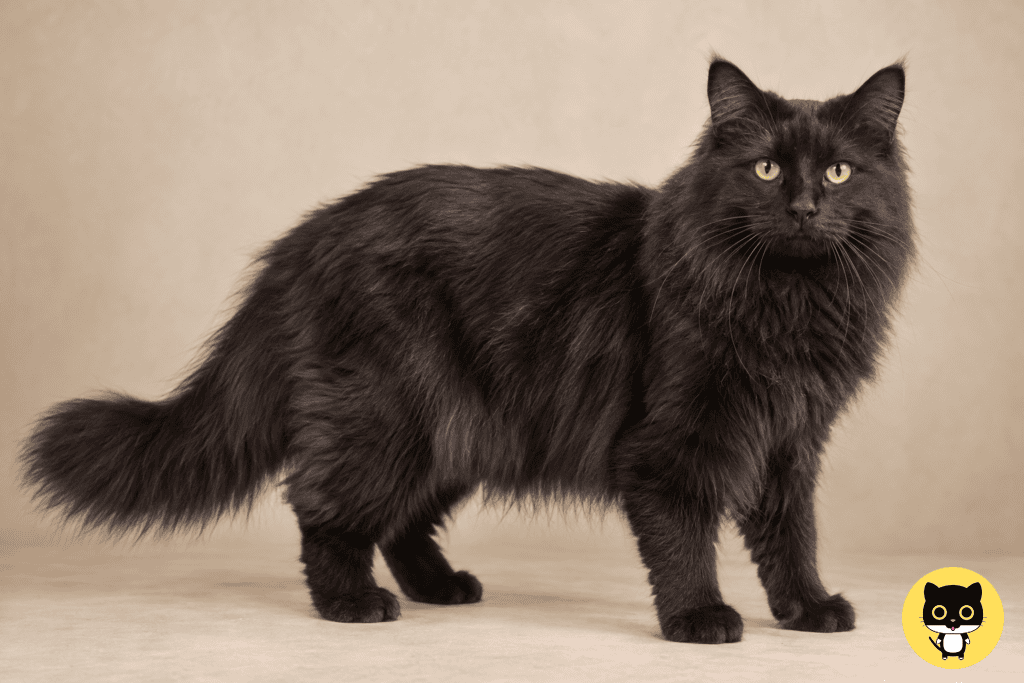
The German Longhair, or Deutsch Langhaar (DLH), is a substantial, long-coated cat for a household that wants an involved companion rather than a purely decorative animal. Its appeal lies in the combination of a silky coat, sturdy build, curiosity and reported friendliness. The practical question is less whether the breed looks attractive than whether a caregiver can comfortably provide regular coat checks, social contact, play and careful individual assessment.
Quick Facts
| Feature | German Longhair at a glance |
|---|---|
| Other name | Deutsch Langhaar (DLH) |
| Build | Substantial, long and rectangular, with strong musculature |
| Coat | Long or semi-long, shiny and silky, with an undercoat |
| Temperament described by breed sources | Friendly, social, playful, curious and moderately active |
| Grooming | Regular inspection and combing; extra attention during seasonal coat change |
| Recognition | Recognition varies by registry and country |
| Lifespan | No dependable breed-specific estimate established |
Identity and breed recognition
German Longhair identity depends on pedigree documentation, not appearance alone. A longhaired cat may have a very similar outline and coat without belonging to this breed. Without traceable registration papers, it is more accurate to describe such a cat as a domestic longhair or a cat of mixed ancestry. The name should also not be confused with German Rex, British Longhair, Persian or the German Longhaired Pointer.
Recognition is not uniform internationally. WCF recognizes German Longhair and publishes a breed standard for it. GCCF currently lists the name as “Breed Name Recognition Only,” while German Longhair was not found on the current breed lists reviewed for CFA, TICA or FIFe. A pedigree should therefore identify the registry that issued it rather than implying that all major organizations recognize the breed in the same way. Readers can compare the WCF breed standard with current registry listings such as the GCCF code list.
The modern breed is associated with German breed-development efforts and the name Deutsch Langhaar. Its relationship with registries and breed organizations remains important because the cat’s appearance alone cannot settle whether a particular animal is a documented German Longhair. For a prospective buyer, the issuing registry, registration number, parentage and transfer paperwork are more useful than a confident verbal description.
Build, head and coat
The body is intended to look strong rather than delicate. The ideal is long and rectangular, with a broad chest, muscular legs and round paws that may carry toe tufts. The tail is medium in length. One standard describes the breed as large, while the German Longhair community describes it as medium-sized; these labels are not necessarily contradictory when sex, lineage and body condition differ. The individual cat’s frame and healthy condition matter more than choosing between two broad size words.
The head has a distinctive geometric quality. It is described as trapezoidal, with rounded cheeks, a blunt muzzle, medium-sized ears with rounded tips and large oval eyes. These features should be read as a general type rather than a promise that every kitten will mature into the same expression. Young cats can change noticeably as the body, head and coat develop.
The coat is long or semi-long, shiny and silky, with an undercoat, a collar and longer hair on the hind legs. The undercoat may become particularly dense in winter. All coat colors are permitted under the standard, with specific restrictions affecting blue and odd eyes in some white or high-white patterns. In other words, color variety is broad, but eye color and white pattern may still have significance in a pedigree assessment.
A close-fitting silky coat may be less prone to severe tangling than some very soft, cottony long coats, but that does not make it maintenance-free. Hair around the ruff, armpits, hind legs and rear end deserves particular attention. A coat that feels smooth when stroked can still conceal a developing mat. Long-haired cats can develop painful mats, and cutting them with household scissors risks injuring the skin; difficult mats are better handled with professional or veterinary help.
Temperament and life with a German Longhair
Breed descriptions present the German Longhair as friendly, people-oriented, social, playful and moderately active. Those qualities suggest a cat that is likely to benefit from regular interaction rather than being left without stimulation for long periods. They do not establish that every cat will be a lap cat, tolerate prolonged restraint, enjoy noisy children or accept dogs. A meeting with the individual cat, ideally including an adult relative where possible, is more informative than relying on the breed label.
Curiosity can make the breed engaging in daily life. One owner described Casimir vom Heidegeist as playful, affectionate during cuddling and petting, interested in new things, fond of climbing and fascinated by water. He was also reported to have integrated into a home with four other cats within four days. That is an appealing example of adaptability, but it remains one cat’s experience rather than a timetable for introductions or evidence that every German Longhair will welcome feline company.
People-oriented behavior can also have different forms. A rehoming description characterized Betje vom Stockberg as confident, unafraid, highly focused on people and willing to be held. Families writing about kittens described them as open, playful, people-oriented and well socialized. Such reports support the possibility of an outgoing companion, while leaving important household questions unanswered: how does this particular cat respond to sudden movement, visitors, veterinary handling, other animals and being touched in sensitive areas?
A social cat still needs choice and retreat. Introductions to resident cats or dogs should be gradual, with separate resources and escape routes rather than an assumption that friendliness will solve every conflict. Children should be taught to allow the cat to approach, stop handling when the cat signals discomfort and leave sleeping or hiding cats alone. A confident temperament is not the same as unlimited tolerance.
Play, climbing and observation points are sensible parts of the home environment. Scratching surfaces, hiding places, sturdy vertical options and interactive games can give a moderately active cat ways to use its body and attention. There is no established breed-specific enrichment schedule, so the caregiver should adjust the routine to the individual: some cats will ask for more play, while others will prefer shorter sessions and longer periods of quiet companionship.
Indoor living and outdoor access
Indoor life can suit a German Longhair when the home is socially and physically interesting. A cat tree that can support a substantial adult, window perches, covered retreats and daily play are more useful than simply providing extra floor space. The cat should have places where it can observe household activity without being forced to participate.
Secure outdoor access may provide additional stimulation, but free roaming should not be treated as a breed requirement. Balconies, patios and enclosures need to be genuinely escape-proof, including protection against climbing and narrow gaps. A cat that is friendly with people may still face traffic, theft, disease and fights outdoors. The reported interest in climbing, hunting or water in an individual cat should not be converted into a claim that unrestricted outdoor access is safe.
Small mammals require particular care. A sociable German Longhair can still show prey-directed behavior, so rabbits, rodents and birds should have secure enclosures and physical separation. Calm behavior around humans does not predict safety around a smaller animal.
Grooming and household care
Many German Longhairs may not need daily combing throughout the year. Once- or twice-weekly coat support can be a reasonable starting point, with more frequent checks when the coat is changing seasonally or when the individual tangles easily. The useful measure is not a fixed schedule but what the coat is actually doing: loose hair, small knots and resistance at the comb indicate that the routine needs attention.
Seasonal shedding can be more noticeable when the dense winter undercoat changes in spring. A silky coat can feel light and close to the body while still leaving hair on furniture, clothing and floors. Anyone seeking a very low-hair home should inspect an adult coat and discuss shedding with the current caregiver rather than treating the breed’s texture as evidence of low shedding.
Regular grooming also has a handling benefit. Brief, calm checks of the ruff, armpits, hindquarters, paws and skin can help a cat become accustomed to touch before a problem develops. Reward-based handling is preferable to forcing a struggling cat through a long session. The caregiver should also maintain ordinary feline care, including claws, teeth, vaccinations and veterinary examinations according to professional advice.
Health, screening and lifespan
No German Longhair-specific disease predisposition or universal health test panel was established. That should be understood as limited breed-specific information, not as proof that the breed is unusually healthy. German Longhairs remain cats that can develop ordinary feline illnesses, and the health history of the individual, its parents and its wider family is more useful than a promise attached to the breed name.
Some breeding programs report practices including genetic testing, blood typing and heart or kidney ultrasound. These are potentially useful questions to ask about, but testing only has meaning when the breeder can explain what was tested, whether the method was DNA-based or imaging-based, who interpreted the result and which parent or relative was examined. A normal screening result reduces uncertainty about the condition assessed; it cannot guarantee lifelong health.
Before reserving a kitten, request the issuing registry, parent records, dated veterinary results and available family-health information. Ask to see the results rather than relying on the phrase “health tested.” It is also reasonable to ask what follow-up care, vaccinations, identification and registration documents are included, and whether the breeder has a written policy for illness discovered after purchase.
There is no dependable breed-specific lifespan estimate to use for planning. A caregiver should therefore think in terms of ordinary feline longevity, the cat’s actual health records and local veterinary costs rather than budgeting around a precise German Longhair number. The absence of a reliable estimate is a reason for sensible preparation, not a reason to assume a short life.
Availability and purchase cost
Availability appears concentrated in German and wider European breed-community networks. GCCF recorded zero registered German Longhairs in both 2024 and 2025, while German breeder pages showed active planning for 2026. That combination supports the cautious description “uncommon in some markets,” but it does not establish a worldwide rarity ranking. A buyer outside Germany or nearby European countries may face long waits, transport arrangements and fewer opportunities to meet adult cats in person.
No reliable current purchase-price example could be supplied with all of the details needed for a meaningful comparison. A price without a region, currency, date, age, companion or breeding status, asking-versus-completed-sale basis and included transport or registration costs can mislead more than it helps. Treat an advertised figure as an asking price unless the seller clearly documents otherwise, and request a written breakdown before paying a deposit.
Scarcity and unusual recognition status make documentation especially important. A responsible purchase should connect the kitten to identifiable parents, a named registry, veterinary records and clear contractual terms. If the seller relies mainly on photographs or says that the cat’s appearance proves its breed, the buyer has not been given enough evidence to assess pedigree identity.
Is a German Longhair a good fit?
A German Longhair may suit a caregiver who enjoys a substantial longhaired cat, wants regular interaction and can provide climbing, play and quiet retreat spaces. The likely care burden may be moderate for an easy coat, but the consequences of neglect are not minor: hidden mats can become painful, and seasonal coat change may increase household hair. This is not the best match for someone who wants a genuinely low-maintenance, low-shedding cat or who cannot inspect the coat consistently.
The breed may also suit a socially engaged home, but “friendly” should not be treated as a guarantee of lap behavior or effortless compatibility. The individual cat’s socialization, boundaries and response to handling matter more when children, dogs or resident cats are involved. Meeting the adult cat, observing its current coat and asking how it behaves during ordinary care can reveal more than a general temperament description.
For an adopter or buyer, the strongest decision combines three kinds of evidence: direct observation of the cat, transparent documentation and an honest assessment of the home. German Longhair can be an affectionate and entertaining companion, but the responsible choice is to buy or adopt the individual cat in front of you—not an idealized promise attached to a relatively uncommon breed name.
What owners and caregivers say
Owners and caregivers describe rewarding relationships with German Longhairs that are playful, curious and closely involved with household life. Casimir’s owner reported affection, climbing, interest in water and quick integration with several resident cats, while other descriptions emphasize confidence, willingness to be held and openness toward people. Families have also praised kittens for being well socialized and ready to engage.
These experiences make the breed’s appeal easy to understand: a German Longhair may be the sort of cat that follows household activity, investigates new experiences and turns grooming or play into shared routines. They do not establish that every cat will behave this way, nor do they answer whether a particular cat will enjoy children, dogs, restraint or constant physical contact. The most useful lesson from these accounts is therefore both positive and practical: expect the possibility of an interactive companion, then assess the individual’s signals, coat and history before committing.
 English