
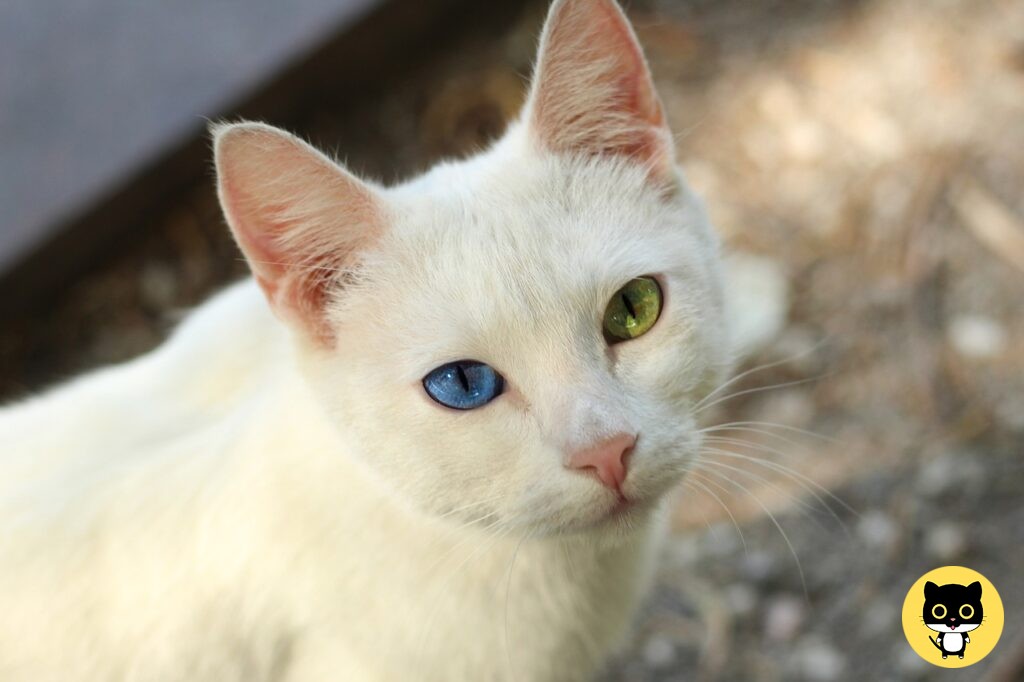
The Khao Manee is a striking Thai-origin cat whose appearance can be easier to recognize than its identity. Its pure white coat, unusual eye colors and lively expression are memorable, but those features can also occur in cats without Khao Manee ancestry. A white or odd-eyed cat may look Khao Manee-like; pedigree records and breeder provenance are what support the claim that it is a pedigreed Khao Manee.
Quick Facts
| Origin | Thailand |
|---|---|
| Coat | Short, fine, smooth and pure white in adults |
| Eyes | Blue, yellow or gold, green, or mismatched combinations, depending on the standard used |
| Personality | Often described as active, curious, communicative and people-oriented |
| Estimated lifespan | About 10–12 years; an estimate rather than a rigorously established population statistic |
| Availability | Limited in many Western markets |
Identity and recognition
Breed identity depends on ancestry, not just a convincing photograph. The Khao Manee is a white, shorthaired Thai breed, and its standard appearance can overlap with that of domestic cats and other white breeds. Personality cannot settle the question either: a friendly, talkative or toy-carrying cat may be delightful without being a Khao Manee.
Registry terminology also varies. TICA uses the spelling Khaomanee and recognizes the breed at Championship level; that status dates to 2015 in the organization’s records. CFA materials accept the breed for registration and currently use Provisional wording, while other CFA materials have described a different competition pathway. Khao Manee does not appear in the current FIFe breed list checked for this guide. These differences matter when a breeder discusses registration, showing or what documentation a buyer should receive.
A registration certificate, traceable pedigree and credible breeder records are therefore more useful than eye color or an informal label. This distinction protects two groups at once: an adopter deciding what an individual cat needs, and a buyer being asked to pay a rare-breed price. An unpapered white cat should not be dismissed as unworthy of care, but it should not be represented as a pedigreed Khao Manee without supporting ancestry.
Build and appearance
The Khao Manee has a medium-sized, muscular yet lithe build. The body is flexible rather than heavy, with medium to slightly long legs that contribute to an athletic outline. The head is described as modified-wedge or heart-shaped, with high cheekbones and large ears. Reliable adult height and weight ranges are not established well enough to make a useful numerical target, so body condition and proportion are more informative than a promised number on a sales page.
The adult coat is pure white, fine and smooth, with a slightly open feel and a sparse-to-moderate undercoat. That does not mean every kitten is born looking like the finished show-standard adult. A colored headcap may remain until roughly 18 months, and a nonwhite kitten can occur when white masks the color underneath. A breeder should be able to explain such variation rather than treating an immature coat as evidence of a different breed.
Eye color is one of the breed’s most noticeable features, but odd eyes are not required. Permitted colors include vivid blue, yellow or gold, green, and mixed or mismatched combinations, with wording differing between registry standards. A blue-and-gold-eyed cat may be especially eye-catching, but a Khao Manee with matching eyes can still fall within the recognized range.
Temperament and daily companionship
Life with a Khao Manee may involve more interaction than its easy coat suggests. Breed descriptions commonly present these cats as active, curious, playful, communicative and interested in people. Some are said to fetch, carry toys or follow household activity. The practical implication is not that every Khao Manee needs a strict exercise program, but that a caregiver should offer play, scratching surfaces, climbing or observation areas and safe opportunities to investigate.
A socially engaged cat is not necessarily a cat that accepts constant handling. Owners describe some Khao Manee cats as affectionate and devoted to a preferred person, while others show affection on their own terms or tolerate being carried only briefly. That is a useful distinction for families: proximity, vocal communication and household involvement do not guarantee lap sitting, restraint tolerance or an uncomplicated response to children.
Individual accounts add a vivid range of possibilities. One owner described a pedigreed male who slept beside his preferred person, enjoyed car rides, brushing and bathing, and became restless when evening play was missed. The same cat was reported to be stubborn, mischievous with toys, strongly food-motivated and selective about his favorite human. Other caregivers describe cats carrying socks or toys, knocking over drinks, vocalizing for attention or waking the household when play has been insufficient.
These behaviors are best treated as possibilities rather than promises. A prospective caregiver should ask whether a particular adult cat seeks contact, how it reacts to lifting, how it settles when left alone and whether its play is energetic or easily redirected. Meeting the individual is especially important when the desired companion is supposed to be quiet, highly cuddly or easy to handle.
Children and other animals can be part of the household, but the breed’s sociable reputation does not replace a careful introduction. Provide escape spaces, supervise interactions and allow the cat to withdraw. A confident cat may enjoy a busy home; a shy individual may need a slower transition. The same principles apply when introducing a dog or another cat.
Coat care and allergies
The short, fine coat is relatively straightforward to maintain. Regular brushing, including with a rubber brush, can remove loose hair and help keep the coat smooth. Grooming is unlikely to dominate the routine, but “easy to groom” should not be confused with “hair-free.” White hairs can stand out clearly on dark clothing, upholstery and furniture even when shedding does not seem heavy.
There is no established Khao Manee-specific seasonal shedding pattern that allows a caregiver to predict when the home will contain more hair. In practice, brushing frequency can follow what the individual cat leaves behind and whether tangles or loose hair become noticeable. Basic nail, ear, dental and veterinary care remain part of responsible ownership.
The breed should not be considered hypoallergenic. Fel d 1 exposure is not eliminated by short hair, white coloring or modest visible shedding. Someone with cat allergies should spend time with the individual cat before adoption, ideally in circumstances that give their symptoms time to appear. Cleaner-looking furniture may make housekeeping easier, but it does not establish lower allergen exposure.
Hearing, white pigmentation and routine health
Hearing deserves a deliberate question when acquiring a white cat, particularly one with blue eyes. In white-cat populations, white pigmentation—especially in combination with blue eyes—is associated with an increased risk of congenital sensorineural deafness. This is not a claim that every Khao Manee is deaf, nor is the risk unique to this breed.
Appearance and home observation cannot reliably settle hearing status. If it matters for acquisition, breeding or safety planning, ask whether the cat has documented BAER or ABR testing. Those objective tests assess hearing; they do not prove breed identity. A kitten that reacts to a household sound may still warrant formal evaluation if accurate hearing information is important.
Confirmed deafness changes management rather than diminishing the cat’s prospects as a companion. Secure indoor living or supervised outdoor access is particularly important because a deaf cat may not hear traffic, dogs or a caregiver approaching. Visual signals, consistent hand cues and gentle vibration or touch can become part of communication. An owner of a rescued white, odd-eyed cat described using sign language and visual communication while respecting the cat’s limited tolerance for being carried.
No distinctive Khao Manee disease predisposition was established for this guide. There is also no verified breed-specific nutritional requirement or dependable weight target. Feed a complete diet appropriate to life stage, monitor body condition rather than chasing a generic scale number, and maintain ordinary preventive veterinary, parasite, dental, nail and ear care. A veterinarian can tailor those decisions to the cat’s age, lifestyle and health history.
How much does a Khao Manee cost?
Availability can be limited through Western registry channels, so a prospective buyer may need a breeder referral or a wait. In the United States, secondary guides published in 2026 gave approximately USD $7,000–$11,000 as a breeder-kitten asking-price planning bracket. This is a dated U.S. example, not a universal price and not an audited range of completed sales. It also does not assume that transport, importation, registration or veterinary costs are included.
A high price makes documentation more important, not less. Ask to see the pedigree, registration terms, parent information, contract, health records and any hearing evaluation before sending a deposit. Clarify whether the quoted figure is an asking price, what is included, and whether breeding or show rights carry different terms. A white domestic cat may be a wonderful adoption, but it should not be sold as a pedigreed Khao Manee on appearance alone.
Availability and expected lifespan
Limited availability can make the search slower than choosing a more common companion breed. Patience is useful, but urgency is not a substitute for verification. A breeder who cannot explain the cat’s ancestry, registration route or health documentation is not made more credible by rarity.
Published breed materials give a reported life-expectancy estimate of about 10–12 years. That figure is suitable for planning food, veterinary care and long-term household arrangements, but it should not be read as a precise population-survival result or a guarantee for an individual cat. Genetics, early care, environment, preventive medicine and chance all influence how long a cat lives.
Is a Khao Manee the right cat for you?
This breed may suit someone who wants an athletic, people-engaged companion and enjoys interactive play, household participation and a cat with a strong presence. Its coat is comparatively manageable, and its social style may be rewarding for a caregiver who likes communication and involvement rather than a purely independent pet.
It is a weaker match for someone seeking guaranteed quietness, effortless lap handling, very low allergen exposure or a temperament that can be inferred from color and breed reputation. The sensible assessment is “potentially interactive, not predictably compliant.” Meet the cat, observe its boundaries and ask how it behaves when play ends, visitors arrive, it is lifted and it is left alone.
Before money changes hands, confirm identity separately from care needs. Pedigree answers whether the cat is a recognized Khao Manee; temperament tells you whether this individual fits your household; hearing documentation can answer a safety question; and a veterinary examination addresses the cat’s actual health. Keeping those questions separate leads to a more honest decision than allowing an unusual eye color to answer all of them.
What owners and caregivers say
Owners and caregivers describe rewarding relationships with cats that can be affectionate, funny, energetic and deeply involved in household life. One owner’s pedigreed male slept beside a favored person, enjoyed grooming and car rides, and seemed to expect his evening play session. That same account included stubbornness, mischief and clear favoritism, a reminder that closeness can come with opinions.
Other cats have shown their attachment through objects and routines rather than prolonged cuddling. Carrying toys or socks, following a preferred person, vocalizing for attention and interrupting a quiet evening can all be part of life with an individual Khao Manee—or with a white cat informally given that label. These stories help a prospective caregiver imagine the possibilities, but they do not establish how common any one behavior is.
Caregivers also describe firm personal boundaries. A rescued, odd-eyed white cat was affectionate but accepted being carried only briefly, and deafness made visual communication central to the relationship. That experience illustrates why a cat can be social without being physically compliant, and why adapting communication to the individual matters more than expecting a breed stereotype to do the work.
The most useful lesson from these relationships is to choose the actual cat in front of you. Look for the kind of companionship you want, prepare for play and communication, respect consent during handling, and verify ancestry rather than treating appearance as proof. A Khao Manee can be an engaging and memorable companion, but the best match comes from combining its likely tendencies with honest attention to one individual’s needs.
 English