
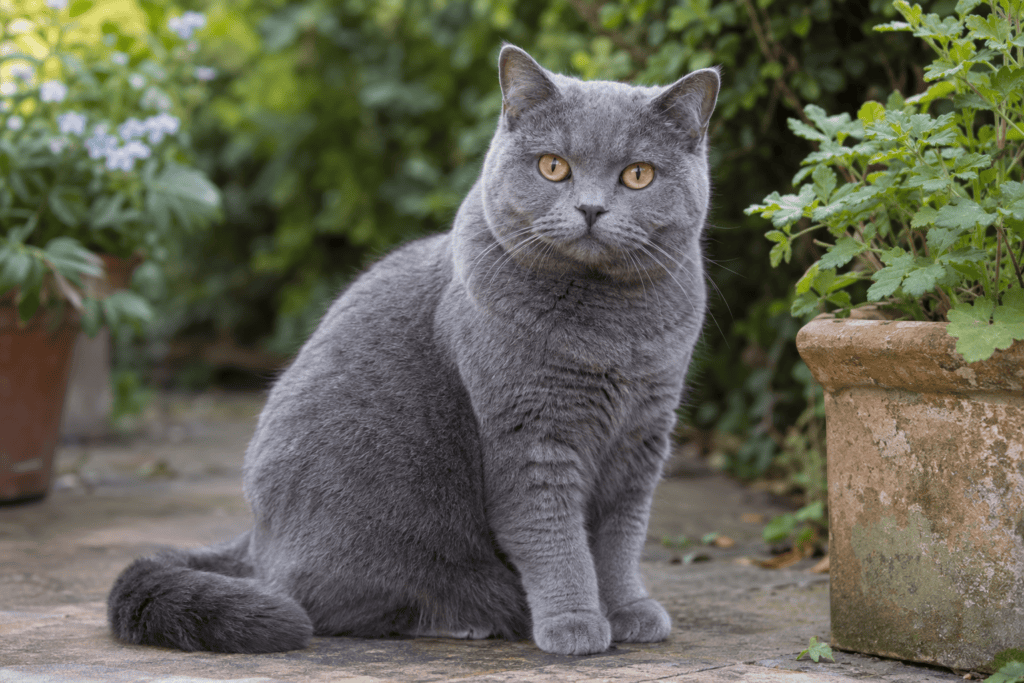
The Scottish Straight is easy to recognize and surprisingly easy to misunderstand. Its upright ears, rounded head and large eyes give it the familiar Scottish look, but appearance alone cannot establish that a cat is a Scottish Straight. The name depends on pedigree, breeding history and the registration system being used. For a prospective caregiver, that makes documentation part of choosing the cat—not merely a concern for exhibitors.
Quick Facts
| Feature | Practical summary |
|---|---|
| Build | Rounded, medium-sized Scottish type; body condition matters more than a target weight |
| Coat | Dense plush shorthair or semi-longhair that stands away from the body |
| Temperament | Often playful, observant and people-oriented, with individual differences in handling tolerance |
| Care | Weekly combing is a starting point; enrichment and respectful social contact are important |
| Estimated lifespan | Approximately 11–14+ years as a breed-type estimate, not a population life table |
Identity and recognition
Recognition changes with the registry, which is why sellers may use more than one legitimate-sounding name for a similar cat. TICA lists Scottish Straight Shorthair and Scottish Straight Longhair within the Scottish Breed Group. CFA places straight-eared cats within its Scottish Fold framework, while WCF uses Scottish and Highland terminology for straight-eared forms. The same individual may therefore be described as a Scottish Straight, a Scottish Fold with straight ears or a Highland Straight, depending on the paperwork and organization involved.
That variation does not make the identity meaningless, but it does make a pedigree important. A rounded head, upright ears or an appealing coat color can occur in cats without the claimed ancestry. Anyone buying a pedigreed cat should ask which registry issued or recognizes the pedigree, what name that registry uses, and how the parents are recorded. If registration, breeding rights or future showing matter, the governing rules should be checked before money changes hands. CFA’s Scottish Fold registration rules illustrate why the breeding structure and the straight-eared cat’s documentation matter.
History and relationship to the Scottish Fold
The Scottish Straight belongs to the same broader Scottish lineage as the Scottish Fold, but it has upright rather than folded ears. That distinction is not simply cosmetic. The folded-ear phenotype is associated with a known TRPV4 variant and with osteochondrodysplasia, a disorder affecting cartilage and bone development. Straight ears mean that the cat does not display the defining folded-ear phenotype, but they should not be treated as a general certificate of perfect health.
Small genetic studies found the known variant in folded-ear cats and did not find it in the tested straight-eared cats. Those findings support a narrow and useful conclusion: a straight-eared Scottish cat may avoid the specific mechanism linked to the folded-ear trait. They do not rule out every skeletal problem, inherited condition or ordinary feline illness. The relevant studies include research on the TRPV4 variant and later work examining the relationship between genotype and ear phenotype.
This is why responsible acquisition involves more than asking whether the ears are upright. A breeder should be able to explain the parents’ ear phenotypes, provide the pedigree and veterinary records, and discuss relevant TRPV4 testing where it is available and meaningful. The buyer should also observe the cat’s gait, tail flexibility and general movement. A test result can answer one genetic question; it cannot replace a veterinary assessment or establish the health of an entire family line.
Appearance, coats and color
The Scottish Straight has a rounded medium build, a rounded head, large round eyes, rounded feet and a short-to-medium neck. The ears stand upright and are separated from one another, with rounded tips rather than the forward fold associated with the Scottish Fold. TICA gives an approximate Scottish-type adult weight of 7–10 pounds, or about 3.2–4.5 kilograms. That figure is an orientation rather than a target: a lean, well-muscled cat outside that range may be healthier than a cat whose weight falls within it but whose body condition is poor.
The shorthaired coat is dense and plush. The longhaired coat is semi-long and tends to stand away from the body, and some organizations or breeders call this form a Highland Straight. That label is not used in exactly the same way everywhere, so the coat description and registry identity should be considered together rather than inferred from the marketing name alone.
Color and pattern possibilities are broad. Depending on the governing standard, Scottish cats may be solid, tabby, tortoiseshell, bicolor, van, shaded, smoke or color-pointed. Eye color depends partly on the coat pattern and the registry’s rules; pointed cats are generally expected to have blue eyes under the applicable standards. A color or eye shade can help describe the cat, but it cannot authenticate the breed.
The coat may feel light or silky on an individual cat and still leave hair around the home. There is also no evidence that the Scottish Straight is hypoallergenic. Someone with cat allergies should spend time with the particular cat, if possible, rather than assuming that short hair or a tidy-looking coat will prevent symptoms.
Temperament and life with a Scottish Straight
Playfulness and curiosity are common themes in descriptions of the Scottish Straight. The cat may follow household activity, investigate objects, watch from a nearby perch or turn an ordinary item into a toy. Interactive chase games, short sessions with a wand toy, puzzle feeders and opportunities to explore can give that interest a safe outlet. A quiet adult does not stop needing movement and choice; it may simply prefer several modest activities to constant handling.
People-oriented does not necessarily mean lap-oriented. Many caregivers describe cats that sleep beside someone, follow them from room to room, rub against them or ask for petting while resisting being carried. Some will climb onto a lap when they choose the moment but object when lifted. One cat may tolerate holding only in a particular supported position, while another may prefer to remain on the floor entirely.
This difference matters because “affectionate” can describe proximity rather than restraint. A caregiver who wants a companion that participates in household life and chooses contact may find the Scottish Straight rewarding. Someone specifically seeking a reliably cuddly cat that can be picked up by anyone may be disappointed if they rely on the breed label alone. Meeting an adult cat, watching how it responds to touch and asking its current caregiver about visitors and handling will reveal more than a general temperament description.
Shyness is also possible. Some cats settle into family routines but hide when unfamiliar people arrive; others are more vocal, social or persistent about requesting attention. Age, early handling, previous homes and the character of the household can all shape the relationship. These differences are not evidence against a broadly social breed description. They show why a suitable home should leave room for the individual cat to control distance and retreat.
Children, dogs and other pets
A Scottish Straight may fit well into a household with respectful children, another cat or a cat-friendly dog, but compatibility is a managed introduction rather than a breed guarantee. Children should learn not to chase, corner, carry or restrain the cat. A dog should be introduced gradually and prevented from turning the cat’s movement into a game.
Escape spaces are especially valuable for a shy or easily overwhelmed cat. High shelves, covered beds, separate rooms and routes around the home allow the cat to remain involved without being trapped. When introducing cats, begin with separate resources and gradual scent and visual contact rather than placing unfamiliar animals together and hoping they will resolve the relationship themselves.
The same caution applies to birds, rodents, reptiles and other vulnerable small pets. A gentle relationship with a dog or another cat does not establish safety with prey-sized animals. Secure housing and physical separation are necessary where appropriate.
Grooming and everyday care
Weekly combing is a useful starting point for the shorthair. The longhair generally needs closer attention because its semi-long coat is more likely to tangle, particularly around the trousers, belly, tail and behind the ears. The right schedule depends on the individual: a smooth coat may need less work, while a coat that sheds heavily or forms small knots may need combing more often.
Regular grooming is also a practical way to notice changes. While combing, a caregiver can become familiar with the cat’s skin, coat, body condition and tolerance for handling. Sessions should remain calm and brief enough that the cat does not learn to fear the comb. Nail care, dental care where tolerated, routine veterinary examinations and prompt attention to changes in appetite, movement or litter-box habits complete the ordinary care picture.
Daily life should include more than food and grooming. Scratching surfaces, climbing options, window views, safe hiding places and rotating toys help the cat make choices. Because some Scottish Straights enjoy following people without wanting continuous physical contact, enrichment can be placed near household activity so the cat can remain socially involved on its own terms.
Health, longevity and choosing responsibly
The folded-ear health concern deserves careful attention without turning every straight-eared cat into a presumed medical problem. Straight ears distinguish this cat from the visible folded-ear phenotype, and the known TRPV4 finding is relevant when discussing lineage and breeding. They do not eliminate the need to assess ordinary feline health, inherited risk, body condition or mobility.
Before purchasing, ask for veterinary records, the pedigree, the parents’ ear status, family health information and any available relevant genetic results. Look at the cat walking and turning. A flexible tail and comfortable movement are useful observations, although a brief visit cannot diagnose every condition. The important question is not whether a seller can offer one reassuring result, but whether the seller is transparent about the entire health picture.
TICA gives an estimated Scottish-type lifespan of approximately 11–14+ years. This should be read as an estimate rather than a Scottish Straight population life table. Genetics, preventive care, diet, environment and disease all affect an individual cat’s lifespan, so the figure is useful for planning a long commitment but not for predicting a particular cat’s future.
Price and availability
U.S. asking-price examples checked on October 2, 2026 ranged from about $799 to $2,200 USD. Separate listings showed approximately $799, $1,200–$1,500, $1,800–$2,200 and $2,200. These were asking prices rather than verified completed sales, and the terms differed: pedigree status, transport, registration and breeding rights may be included or excluded. Examples can be reviewed through listings such as this Scottish Straight kitten provider and this breeder listing site.
Retired-breeder rehoming examples in the United States included approximately $500 from one provider, which stated that sterilization and vaccinations were included, and a separate adoption-marketplace listing at $1,000. Those figures are examples, not a universal rescue or rehoming range. They also do not represent the continuing cost of food, veterinary care, insurance, grooming supplies and enrichment.
Availability is regional and changes quickly. On October 2, 2026, U.S. breeders and marketplaces listed kittens and adults, including Texas-area and national-delivery providers. Searching under Scottish Straight, Scottish Fold straight-ear and Highland Straight may produce different results, but every listing still needs verification of the cat’s actual pedigree and registration identity. A name that improves search results should not replace documentation.
Is a Scottish Straight a good fit?
The Scottish Straight is likely to suit a caregiver who enjoys an observant, playful companion and is comfortable allowing affection to develop on the cat’s terms. Its coat care is manageable, but the longhair requires more vigilance than the shorthair. Its social nature can make it a pleasant household companion, while its possible dislike of carrying means that respectful interaction is more important than expecting a permanently available lap cat.
The best match is built from three checks: verify the identity, investigate the health background and observe the individual temperament. Straight ears should not be used as proof of complete health, and a rounded face should not be used as proof of pedigree. Similarly, the word “affectionate” should not be treated as a promise of being held. A careful caregiver chooses the cat in front of them, supported by honest records and realistic expectations.
What owners and caregivers say
Owners and caregivers describe rewarding relationships built around proximity, play and routine rather than one fixed style of cuddling. A shy cat may follow household activity and play vigorous chase or hide-and-seek games for short daily periods while avoiding laps and being held. Another may sleep beside people, request petting or climb onto a lap voluntarily but object immediately when someone tries to pick it up.
Some cats are content to watch the home quietly, while others are more vocal or persistent about joining in. Caregivers have described cats that follow people from room to room, carry or steal small objects as toys and show strong chase instincts. These observations show what an individual Scottish cat may be like; they do not establish how common any one behavior is or prove that it belongs exclusively to the breed.
The most consistent practical lesson is about consent and observation. A Scottish Straight may be deeply attached without enjoying restraint, and a reserved cat may become a companion through predictable, low-pressure contact. Give the cat places to retreat, notice the forms of attention it seeks and judge handling tolerance from the individual rather than from its appearance or breed description.
 English