
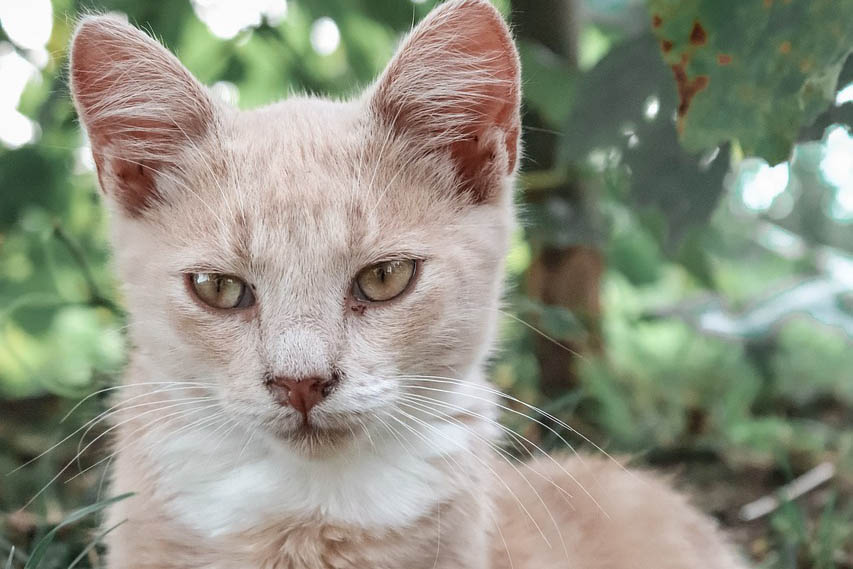
Serrade Petit is best approached as a name attached to a reported type of small French cat, not yet as a fully documented breed with predictable characteristics. Online profiles commonly describe a petite, shorthaired cat with prominent ears, large eyes and a relatively long tail, but the origin, founding population, breeding history and pedigree system have not been independently established. That distinction matters: a cat may possess the appearance associated with the name without belonging to a formally recognized breed.
Quick Facts
| Quick fact | What can responsibly be said |
|---|---|
| Type | Reported small to small-medium, shorthaired French cat type |
| Typical reported weight | About 6–9 lb (2.7–4.1 kg), although no verified adult range exists |
| Coat | Usually described as close, fine, soft or silky; shedding and hypoallergenic status are not established |
| Temperament | Descriptions include playful, curious, affectionate, sociable and sometimes vocal, but the label has limited predictive value |
| Health | No Serrade Petit-specific disease profile or validated screening program is established |
| Lifespan | Unknown; online estimates such as 11–17 years should not be treated as population-based life expectancy |
| Availability | Appears limited and inconsistent, with no reliable breeder market or established price |
Identity and recognition
Formal recognition is currently the largest gap in the Serrade Petit story. The name was not found in the CFA, TICA or FIFe breed materials reviewed on October 2, 2026, and WCF recognition could not be verified. This does not prove that no individual or organization uses the name; it means that a prospective caregiver should not assume the existence of a generally accepted standard, registry-backed pedigree or established breeding population.
FIFe lists the European as a separate recognized breed. No verified source establishes that Serrade Petit is another name for European, a variant of it or a line descended from it. A seller who uses those names interchangeably should therefore be asked to explain the relationship and provide independently checkable documentation rather than relying on the similarity of the descriptions.
Registration paperwork is meaningful only when the issuing organization, parentage and transfer history can be verified. A document bearing a breed name does not, by itself, establish formal recognition or prove that the cat belongs to a stable population. For a claimed pedigree, ask which registry issued it, whether that registry publishes its standards and registration rules, and whether the parents can be traced.
History and the question behind the name
The historical account is not developed enough to describe Serrade Petit as an established French landrace or carefully documented modern breed. The available material does not verify a founding breeder, foundation cats, breeding goals, geographic development or a sustained pedigree program. The name may be used for cats that share a look, for a developing project, or inconsistently for individual cats; the available evidence does not allow those possibilities to be separated confidently.
This uncertainty changes how the name should be used. It can be a useful starting point when asking about a particular cat, but it should not substitute for information about that cat’s parents, age, health records, behavior and living history. The individual matters more than the label here because the label does not yet carry a dependable package of inherited traits.
Appearance and coat
Size is usually part of the Serrade Petit appeal. Online figures commonly fall around 6–9 lb (2.7–4.1 kg), and descriptions range from small to small-medium. There is no verified adult weight range, sex-specific comparison, population measurement or reliable timetable for reaching mature size. A kitten advertised as small is not necessarily miniature, and a petite adult should not be underfed to preserve a target number. Body condition, growth and veterinary advice are more useful than an online figure.
Body shape is less settled than the name might suggest. Some descriptions present a fine-boned, delicate or elongated cat, while others suggest a compact or sturdier build. These accounts may reflect variation between individual cats, differences in description or inconsistent use of the label. Before adopting, look at the actual adult body rather than assuming that “Petit” guarantees fragility, narrowness or a particular silhouette.
The coat is most often described as short, close, fine, soft or silky. Reported colors and patterns include white, tan, orange, striped or tabby, bi-color and tri-color presentations. No accepted list of colors, patterns, eye colors or coat variants has been verified, so an individual should be described as it is rather than judged against an assumed standard.
A smooth, light-feeling coat may be easy to comb without being hair-free. Occasional to weekly combing may be reasonable for a close short coat, with the schedule adjusted for loose hair, density, tangles and the cat’s tolerance. Shedding, seasonal shedding, matting risk and hypoallergenic qualities have not been established. Anyone choosing the cat partly because of its coat should spend time with the actual animal and ask whether hair is noticeable on furniture and clothing.
Temperament and everyday companionship
Descriptions of Serrade Petit often make the cat sound engaging: playful, curious, affectionate, sociable, active and interested in people. Vocalization and attention-seeking are also reported. Those qualities may describe some individuals, but repeated commercial wording is not the same as independent observation across a documented breed population. The name therefore offers only a tentative suggestion, not a temperament guarantee.
Activity is best handled as a household planning question. Interactive toys, short play sessions, safe climbing or vertical areas, and places to hide can support a cat that enjoys running, jumping and investigation. Predictable food, water, litter and resting areas are useful whether the cat is highly active or more reserved. A small body does not eliminate the need for exercise, choice or environmental security.
Social behavior may vary in ways that matter more than the appealing adjectives. Some descriptions mention reserve with strangers, while others suggest strong sociability or a preference for being the only pet. Ask specifically how the individual responds to visitors, being picked up, nail trimming, brushing, transport and veterinary handling. “Affectionate” does not necessarily mean comfortable with restraint or with children carrying the cat.
Children, dogs and other cats can be suitable companions for an individual Serrade Petit, but the outcome depends on temperament, introductions and the home. Separate resources, escape routes, gradual scent and visual introductions, and adult supervision around children reduce avoidable pressure. An apartment can work when it offers play, climbing opportunities and secure resting places; a larger home does not guarantee compatibility if the introductions are rushed.
Long periods alone deserve particular attention if the cat is described as people-oriented or attention-seeking. Arrange enrichment and predictable interaction, and avoid assuming that sociability means the cat will tolerate constant handling. Meeting an adult cat and observing its response to ordinary household activity is more informative than relying on a profile description.
Care, feeding and veterinary planning
Routine care should be ordinary, not specialized. Provide a complete diet appropriate to the cat’s life stage, fresh water, clean litter facilities, opportunities for play and regular observation of appetite, weight, coat and behavior. Feeding should follow body condition and veterinary guidance rather than an advertised breed weight, especially while a young cat is growing.
Preventive veterinary care remains important because no Serrade Petit-specific health advantage or risk profile has been established. Examinations, vaccinations and parasite planning should be tailored to age, lifestyle and region. Dental monitoring also matters; regular veterinary assessment can identify oral disease before discomfort becomes obvious.
No inherited-condition registry, breed-specific screening panel, population health study or conformation-related welfare concern has been established for this name. That is not evidence that the cats are unhealthy, nor is it evidence of exceptional health. It simply means a buyer should rely on the individual’s medical history, parental information where available, veterinary records and sensible preventive care rather than on claims of a documented breed health profile.
Lifespan is unknown. Figures around 11–17 years appear online, but they are estimates rather than results from a defined Serrade Petit population. Good nutrition, preventive care, dental attention, safe housing and prompt treatment may support a long life, but no responsible source can promise a particular age for an individual cat.
Price, availability and buying carefully
There is no reliable breeder purchase price to quote for Serrade Petit. One dated example was a free-adoption listing for a female aged 0–6 months in Saint-Denis, France, posted on July 24, 2026. The listing described a single rehoming opportunity; it was not a sale, a typical adoption fee, a market valuation or proof of breed identity. The advertisement can be viewed here.
Availability appears limited and inconsistent, particularly in the United States, but a small number of listings cannot establish population size or prove that the cat is rare. Scarcity can reflect weak documentation, inconsistent naming or a very small market rather than a valuable established breed. A high asking price would not, by itself, resolve those uncertainties.
Before paying for a cat presented as Serrade Petit, ask for the seller’s full identity, veterinary records, vaccination and parasite history, parentage, family health information and written return arrangements. If registration is claimed, verify the issuing organization independently and check whether the parents and transfer records can be confirmed. A responsible seller should be able to discuss the cat’s actual behavior and care, not only its supposed breed label.
Who may find this cat a good fit?
Serrade Petit may suit someone who is drawn to a small, shorthaired cat but is prepared to assess the individual rather than purchase a guaranteed set of traits. A caregiver who can offer enrichment, ordinary preventive care, gradual introductions and patient observation may find the cat rewarding, particularly if the individual is playful and people-oriented.
It is a poor match for someone seeking guaranteed miniature size, hypoallergenic behavior, predictable sociability, a defined show standard, a known breed health advantage or a validated lifespan estimate. The most important decision rule is simple: meet the cat when possible, observe how it responds to visitors and handling, and review records before treating the name as meaningful evidence.
What owners and caregivers say
The direct caregiver record is very limited. The clearest individual account is a July 24, 2026 adoption listing from Saint-Denis, France, for a young female weighing 1 kg. The advertiser described her as active, curious, sociable, house-trained and responsive to her name. That is useful information about one kitten in one home-finding context, but it is not an independently verified review or evidence that Serrade Petit cats generally behave that way.
Commercial profiles add claims of playfulness, affection, vocal behavior, attention-seeking and, in some cases, reserve with strangers or a preference for being the only pet. Rather than treating those claims as a settled owner consensus, use them to form practical questions: Does this cat seek contact or simply remain nearby? How does it react to unfamiliar people? Does it vocalize throughout the day? Can it share space calmly? What happens during brushing, transport and veterinary care?
The most dependable experience will come from the individual cat in front of you. A prospective caregiver who observes an adult’s ordinary behavior, checks its records and plans the home around its actual needs is better placed to judge compatibility than someone choosing on the promise of a predictable breed personality.
Selected sources
Recognition and breed-list information can be checked through the CFA breed list, TICA breed list, TICA breed standards and FIFe breed list. FIFe’s separate European breed description is relevant when distinguishing that recognized breed from the Serrade Petit name.
General guidance on preventive care, feeding and dental health is available from the Merck Veterinary Manual and Cornell Feline Health Center.
 English