
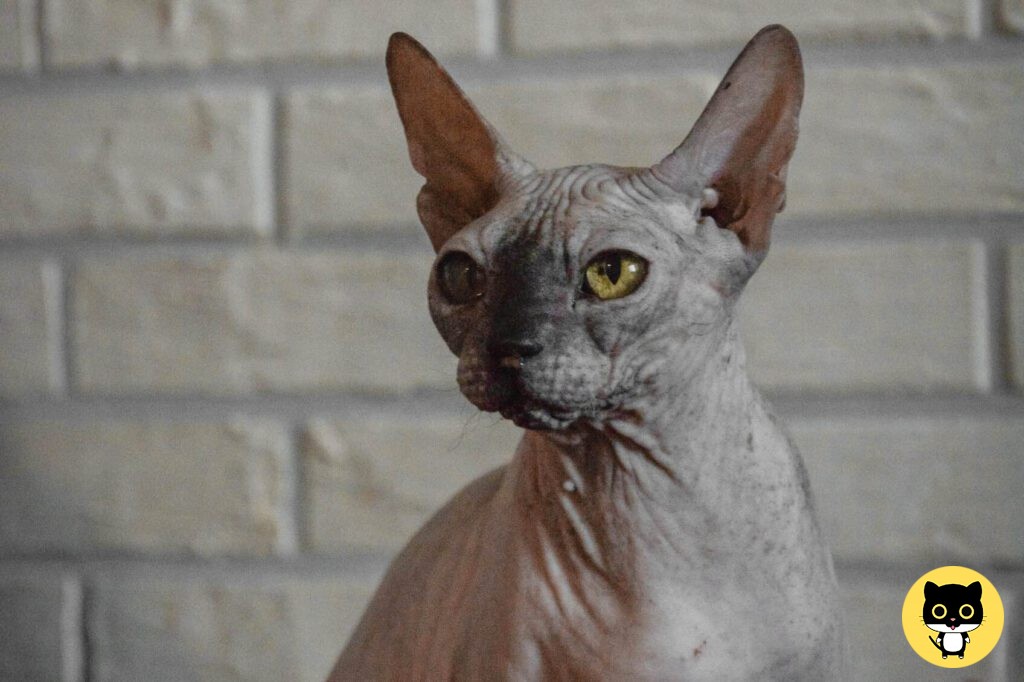
The Sphynx is striking for what it appears not to have: a conventional coat. That visual impression can suggest an unusually simple cat to live with, but the reality is more interesting. The breed often offers close companionship, playfulness and an intense awareness of household life, while replacing ordinary brushing with closer attention to skin, warmth, hygiene and cooperative handling.
Quick Facts
| Quick fact | Sphynx |
|---|---|
| Type | Recognized pedigree hairless breed, distinct from the Donskoy and Peterbald. |
| Adult size | Medium-sized, muscular and substantial for its appearance. |
| Coat | Hairless appearance with fine down possible; skin and coat expression vary. |
| Typical activity | Highly active, agile, playful and socially interactive. |
| Estimated lifespan | No single sufficiently robust breed-specific lifespan range is used here; individual health and screening matter more. |
A Sphynx can be an excellent companion for an interactive indoor household prepared to manage those details. It is a poor choice for someone seeking a hypoallergenic, maintenance-free or reliably cuddly cat. The right question is not simply whether you like the appearance, but whether you are comfortable learning what this particular cat needs.
Identity, recognition and history
The Sphynx is a recognized pedigree breed, distinct from the Don Sphynx or Donskoy and the Peterbald. The modern breed developed from naturally occurring hairless mutations in Canada and elsewhere in North America during the 1960s and 1970s. It is not an ancient Egyptian breed, despite the associations encouraged by its name and unusual appearance.
Major cat registries recognize the Sphynx, but they do not use entirely identical systems. CFA, TICA and FIFe differ in aspects of their standards, color terminology, registration treatment and breeding rules. Someone buying a registered cat should therefore ask which registry applies and what its documents actually mean, rather than treating “registered” as a single universal category. The CFA breed information, TICA standard and FIFe breed listings are useful starting points.
What a Sphynx looks like
The adult Sphynx is medium-sized but substantial, with a muscular body rather than a delicate one. Its head forms a modified wedge, framed by very large ears and prominent cheekbones. Lemon-shaped eyes, a strong chest, a rounded abdomen, a tapering tail and wrinkled skin contribute to the breed’s distinctive outline.
The coat is visually sparse, not necessarily absent. Fine down commonly gives the skin a soft or suede-like feel, and small amounts of hair may be more noticeable on the nose, ears, feet or tail. A light-feeling coat can still leave fine hair and skin material around the home, so “hairless” should not be interpreted as “nothing to clean.” Coated individuals can occur because the hairless trait is recessive; whether such a cat can be registered or shown depends on the relevant registry’s rules.
Color and pattern are more varied than the bare skin may initially suggest. Solid colors, tabbies, tortoiseshells, particolors and pointed forms are among the possibilities. TICA additionally uses Traditional, Pointed, Mink and Sepia categories, while CFA and FIFe use different terminology and registration approaches. Eye-color expectations also depend on the registry and color category: there is no single universal Sphynx eye-color rule.
Temperament and life with the breed
The typical Sphynx is active, curious, vocal and interested in people. Many want to follow household activity, investigate what their caregivers are doing and participate in play rather than remain a quiet observer. Interactive toys, climbing opportunities, puzzle feeding and regular social contact are sensible provisions, although there is no established breed-specific minimum schedule that guarantees satisfaction.
Warmth and attention often become part of the relationship. A Sphynx may seek a heated bed, a blanket, a sunny indoor place or physical proximity to a caregiver. That does not automatically make it a lap cat. Some express affection by staying nearby, following someone from room to room or demanding conversation, while others are more physically demonstrative. Sociability is not the same as a guaranteed preference for being held.
Handling cooperation also varies. A friendly cat may still dislike a bath, resist clothing or object to restraint for nail, ear or skin care. One caregiver’s experience of an easy routine should not be treated as a promise about another Sphynx. Meeting an adult cat, or observing how a kitten voluntarily approaches and responds to gentle handling, can reveal useful information about that individual, though it cannot guarantee future behavior.
Children, other cats and calm, carefully introduced dogs may be suitable companions for an individual Sphynx. Introductions should be gradual, with escape spaces and supervision rather than an assumption that an outgoing breed will tolerate every interaction. Small pets should remain securely separated. The Sphynx’s sociability does not justify assuming a reduced prey drive.
Coat, skin and everyday care
The sparse coat usually means less conventional brushing and little typical matting. It does not remove grooming from the household routine; it changes what grooming involves. Oil, dirt and residue can collect on the skin, in wrinkles, around the paws and ears, and on bedding or furniture. Some cats remain comparatively clean, while others leave noticeable marks or need frequent wiping.
Bathing frequency should follow the individual cat’s skin, environment and tolerance rather than a fixed breed timetable. Caregivers report routines ranging from occasional bathing to regular wiping between baths. Clean the cat only when needed, use a cat-safe product, rinse thoroughly and dry promptly with warmth. A newly rehomed cat may need time to settle before a bath is attempted; trust and gradual handling can matter more than imposing an immediate schedule.
Redness, pain, strong odor, crusting or recurrent infection calls for veterinary assessment, not increasingly aggressive home cleaning. Check the ears and paws as part of ordinary care, and maintain routine nail, dental and eye care. Short, reward-based sessions can help a cat learn that inspection and handling predict something pleasant. Voluntary retreat spaces are equally important, because cooperation is easier to build when the cat is not forced into every interaction.
Low visible shedding is not the same as low allergen exposure. Cat allergens occur in skin, saliva and other materials, not only in long or visibly shedding fur. The Sphynx should not be marketed as hypoallergenic. Anyone with allergies should spend meaningful time with the individual cat before committing, while recognizing that a trial visit cannot eliminate every future exposure issue.
Warmth, sunlight and the indoor environment
The sparse coat provides limited protection from cold and sunlight. An indoor home should offer warm, soft bedding and comfortable resting places, with particular attention to drafts and cool floors. Direct sun should be limited, and outdoor roaming is not appropriate protection for a cat whose skin lacks a normal insulating coat.
Clothing is an individual management choice rather than a universal requirement. A soft, well-fitting garment may help some cats in cold conditions, but another may resist it or develop irritation, stress or overheating. Warm beds and controlled room temperature are often simpler alternatives. If clothing is used, supervise the cat and remove it at the first sign of discomfort, restricted movement or excessive warmth.
Health questions worth asking
Hypertrophic cardiomyopathy, or HCM, is the most consequential documented breed-relevant concern in the available evidence. A French screening study identified 23 cases among 114 screened Sphynx. A New Zealand study reported HCM in 21.8 percent of cats at initial scanning and 40 percent after follow-up in its screened population. These are estimates from particular screened cohorts, not a worldwide prevalence figure or a prediction that any individual Sphynx will develop the disease.
Cardiac screening should therefore be part of a serious purchase conversation. Ask for dated echocardiography records for the parents and relevant family history, and ask who performed the examinations and what credentials that person holds. Screening can reduce uncertainty, but it cannot guarantee that a cat will remain free of HCM throughout life; a normal scan is evidence about that point in time.
A recessive COLQ-associated congenital myasthenic syndrome, also described as hereditary myopathy, has been documented in Sphynx and Devon Rex. This makes relevant genetic testing and family-history questions reasonable where available, without implying that the condition is common in every Sphynx. COLQ results should be interpreted with the breeder and a veterinarian in the context of the proposed pairing.
ALMS1 should not be treated as a standalone exclusion test for Sphynx HCM. The useful health conversation is broader: what screening is done, how often breeding cats are rechecked, what family history is known, and what support the breeder provides if a kitten later develops a significant condition.
Longevity and long-term commitment
A dependable Sphynx-specific population life-expectancy range has not been established. A 2024 UK life-table study questioned commonly repeated figures of around 15 years and called for further research. Longevity is therefore best treated as an estimate shaped by genetics, disease, preventive care, environment and chance, rather than as a breed guarantee.
The practical implication is not pessimism but planning. A caregiver should budget for routine veterinary care as well as the possibility of cardiac evaluation, specialist consultation or other individualized treatment. Good screening and attentive care are valuable forms of risk management, not promises of lifelong health.
Price, adoption and availability
US breeder price examples dated October 2026 place many Sphynx kitten asking prices at approximately USD 1,500–3,500, while some guides report roughly USD 1,800–4,500. Breeding or show quality may cost more. These are asking-price guides rather than verified completed-sale data, and the figure can change with age, sex, lineage, registry, health documentation and location.
Adoption and rehoming fees should not be merged with breeder prices. There is no defensible regional US range from the available examples: isolated 2026 reports extend from ordinary shelter-level fees to about USD 950 for an adult. An adoption fee may reflect the policies of one organization or the circumstances of one cat, not the market value of the breed.
Availability also varies locally. Breeders may have waiting lists, adult cats may be less common than kittens, and import requirements can affect both timing and cost. Registry directories such as the TICA breeder listings can help locate breeders, but a short wait or a low price is not evidence of strong health practices. Documentation, transparency and the opportunity to discuss adult cats and breeding decisions matter more than speed.
Is a Sphynx a good match?
The Sphynx is best suited to an indoor caregiver who wants an involved relationship and is willing to observe rather than generalize. That means accepting that skin care may be more relevant than brushing, that warmth and sun protection are ongoing responsibilities, and that the cat may be both highly social and inconveniently opinionated about baths or restraint.
It may be a poor match for someone who wants a cat that leaves no household residue, causes few allergy concerns, cooperates automatically with grooming or reliably curls up on demand. The breed’s affectionate reputation should not obscure the work involved in maintaining skin, learning handling preferences and investigating cardiac health before purchase.
Acquisition quality is part of suitability. A price of USD 1,500–4,500 describes a possible breeder-market transaction, not the quality of the health program behind it. Prospective caregivers should use the price and waiting period as prompts to ask about echocardiography, family history, COLQ risk, contracts and after-sale support. Meeting the adult cats, where possible, can also provide a more meaningful impression than photographs alone.
What owners and caregivers say
Owners and caregivers often describe the Sphynx as an unusually intimate household companion. One caregiver portrayed a cat that followed daily activity, sought warmth and attention, and made ordinary life feel closely shared. The same relationship included regular cleaning, illustrating the central bargain of the breed: physical closeness can make both affection and maintenance more noticeable.
Care routines differ substantially between individual cats. Some caregivers wipe frequently or notice oil on blankets and clothing, while others bathe only a few times a year and report a comparatively clean cat. Those experiences are compatible rather than contradictory. Oil production, skin condition, climate, bedding and handling tolerance can all change what ownership feels like.
Bathing is not necessarily an easy extension of the Sphynx’s friendliness. An owner described a cat that continued to dislike baths despite early exposure, while an adopter emphasized allowing a newly rehomed cat to settle before attempting one. These experiences point toward gradual, reward-based care rather than a fixed promise that the breed will accept necessary handling.
Warmth preferences are equally individual. Some caregivers use warm beds or carefully supervised clothing in colder conditions; another described a cat that resisted clothing. A warm environment is a sound provision, but the form it takes should be chosen with the cat’s comfort in mind.
Affection may arrive through proximity, attention and participation rather than constant lap contact. Playful curiosity about household activity can make the Sphynx entertaining and deeply engaging, but it can also mean that a quiet, hands-off home feels understimulating. The most rewarding relationship is likely to be the one in which the caregiver welcomes both sides: an unusually connected companion and a cat whose skin, warmth, health and handling needs deserve deliberate care.
 English