
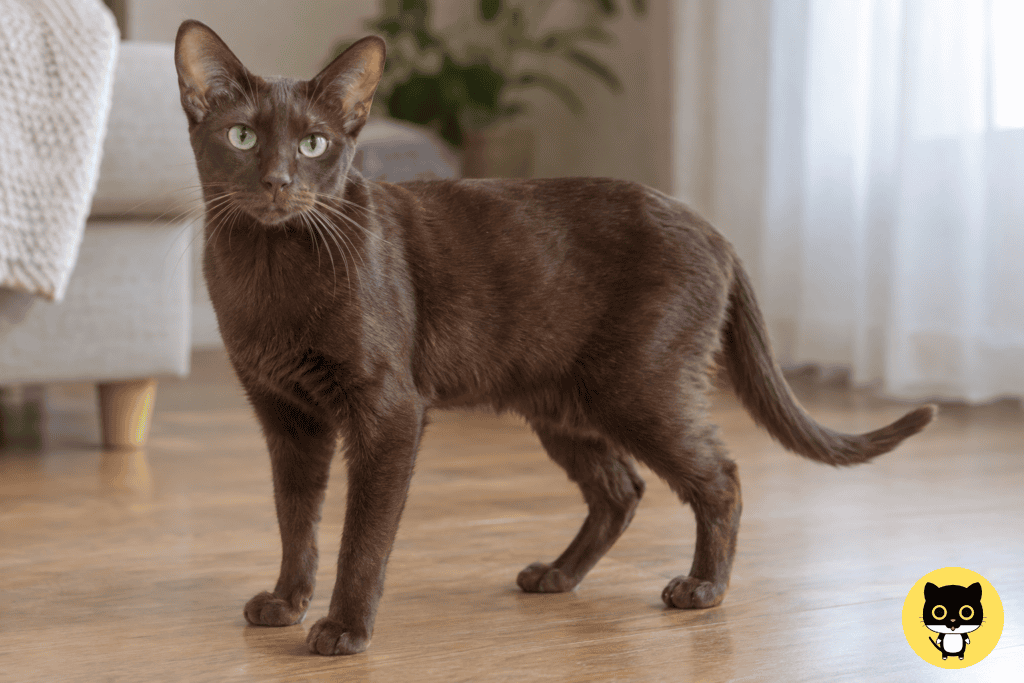
The Suffolk is a distinctive, long-lined cat with a strong social presence and a surprisingly important paperwork trail. It developed from traditional Havana-related breeding, but it is not simply another name for every brown or chocolate cat. For a prospective caregiver, that combination matters: the cat may appeal through its elegant appearance and engaging temperament, while its relatively uncommon status makes pedigree verification and breeder transparency especially important.
Quick Facts
| Feature | Suffolk at a glance |
|---|---|
| Recognized identity | A distinct breed recognized by the GCCF |
| Adult size | Approximately 6–11 lb (2.7–5.0 kg); females are often around 3 kg and males around 4–5 kg |
| Coat | Short to medium, single, smooth and lustrous |
| Recognized colors | Chocolate, lilac, cinnamon and fawn |
| Typical lifespan estimate | About 10–15 years |
| Best suited to | A home able to provide interaction, climbing opportunities and thoughtful introductions to people and animals |
Identity and recognition
The Suffolk has a specific registry identity rather than being a general label for a Havana-type cat. The GCCF accepted the breed for registration in 2014, gave it Preliminary status in 2016 and granted Championship status from June 2018. Recognition is registry-specific: the comparisons and official materials checked do not establish Suffolk as a separate breed entity in CFA, TICA or FIFe.
That distinction is practical when buying or registering a cat. Suffolk developed through Havana-related breeding, but a Suffolk pedigree should identify the issuing registry and should not automatically be relabeled as Havana Brown, Havana or Oriental Chocolate. Those names may describe related histories or similar coloring in some contexts, but they do not automatically carry the same standard, registration route, show eligibility or breeding policy. A buyer should ask to see the actual pedigree rather than relying on a color description or an informal breed name.
The breed’s recognition history also helps explain why its documentation deserves attention. GCCF materials include both a breed standard and rules concerning permitted breeding relationships and outcrosses. A responsible breeder should be able to explain how a kitten’s parents fit those rules, which registry will issue the pedigree and whether any permitted outcrosses appear in the family tree.
Appearance, size and coat
The Suffolk is intended to look graceful without being fragile or exaggerated. Its desired type is balanced, muscular and foreign in outline, with a moderately long head, large ears that tilt forward, vivid green almond-shaped eyes, long elegant limbs, oval paws and a tapering tail. The standard’s emphasis on balance is significant: this is a refined-looking cat, not one whose appeal depends on deliberately extreme structure.
Adult size is usually described as about 6–11 lb, or 2.7–5.0 kg. Approximate figures place females near 3 kg and males around 4–5 kg, but a number on a scale is only part of the assessment. A sound body condition, appropriate muscle and a frame that suits the individual cat are more useful than trying to make every Suffolk fit the top or bottom of a published range.
The coat is short to medium in length, single, smooth, sleek and lustrous. Current GCCF material lists chocolate, lilac, cinnamon and fawn; cinnamon and fawn were identified as effective from June 27, 2026. Slight tabby markings may be visible in kittens and can resolve as the coat matures, so early coloration should not always be judged as the final adult appearance.
A smooth, light-feeling coat can make routine grooming straightforward, but it does not mean that the home will be hair-free. Occasional brushing or combing can be adjusted to the amount of loose hair, the condition of the coat and the cat’s tolerance for handling. The coat is not evidence of hypoallergenic suitability. Anyone managing allergies should spend time with the individual cat rather than relying on breed color or coat texture.
Temperament and everyday companionship
The Suffolk is described as playful, curious, socially engaged and devoted to its people. Some are also talkative, and fetching or greeting visitors are given as examples of the breed’s possible behavior. These traits suggest a cat that may enjoy being included in household life rather than one that is content with occasional attention and little environmental change.
In practical terms, a Suffolk home should offer interactive play, scratching surfaces, places to hide and sturdy vertical equipment. Long limbs and an exploratory temperament make secure climbing options more useful than leaving the cat with floor space alone. This does not prove that every Suffolk will be highly active, retrieve toys or demand constant company; it means that a caregiver should be prepared to discover and support those interests.
Sociality should also be interpreted carefully. A cat can be people-oriented without being a lap cat, comfortable with prolonged handling or happy to spend every day in a busy room. Breed descriptions do not establish how an individual will respond to children, dogs, visitors, travel or long periods alone. Meeting an adult Suffolk is especially useful because it allows a prospective caregiver to observe that cat’s boundaries, communication and preferred forms of affection. With a kitten, detailed breeder observations can provide a better guide than a general promise that the breed is friendly.
The Suffolk is described as patient with children and compatible with other cats and dogs, but compatibility is built through management rather than assumed from breed identity. Children need supervision and instruction, while new animals should be introduced gradually. Separate food, water, litter and resting resources reduce competition, and escape spaces give a cautious cat somewhere to retreat. A sociable breed still needs the ability to say no.
Care and home setup
Routine care is relatively uncomplicated, but “low grooming” should not be confused with “no care.” Occasional combing, nail care, dental attention, litter hygiene, parasite prevention and regular veterinary checks remain part of responsible ownership. Starting handling gently while the cat is young can make later examinations and claw care less stressful.
The Suffolk has no documented requirement for unrestricted outdoor access or a special skin, eye or ear-care regimen. General safeguards remain important: secure windows and balconies, shade in warm weather, warmth in cold conditions, fresh water and daily enrichment. If outdoor access is offered, a supervised or enclosed arrangement provides exploration without requiring the cat to navigate traffic, predators or other hazards.
A useful home is one that combines companionship with choice. Interactive toys can provide shared activity, while shelves, cat trees and hiding places let the cat control distance and retreat when it needs quiet. That arrangement is likely to serve a socially interested but individually variable cat better than either constant handling or a home with no opportunities for engagement.
Health, testing and veterinary questions
The Suffolk breeding policy discusses possible or unconfirmed concerns associated with Oriental and Siamese ancestry, including mast-cell tumors, mediastinal or thymic lymphoma, amyloidosis, mucopolysaccharidosis VI and progressive retinal atrophy. These are ancestry-based cautions, not evidence that these conditions are common Suffolk diseases. They should neither be presented as a routine disease list nor dismissed as irrelevant.
The most useful response is careful family-history work. A prospective buyer should request the pedigree, details of permitted outcrosses, known health information in the family, veterinary records and any relevant genetic-test documentation. If progressive-retinal-atrophy testing has been used in the lines, the breeder should explain which cats were tested and provide the records rather than offering a verbal assurance. The checked material does not establish a universal Suffolk screening panel, so a veterinarian can help interpret what is relevant to the individual kitten, its parents and its planned lifestyle.
Ordinary preventive care still matters more than a breed label alone. Weight, body condition, appetite, mobility, dental health and changes in behavior should be monitored over time. When the cat’s ancestry is unusual or includes documented outcrosses, giving the veterinarian the pedigree and available family information can make health discussions more specific.
Lifespan, cost and availability
The GCCF gives the Suffolk an estimated lifespan of 10–15 years. That is useful for thinking about a long-term commitment, but it is an estimate rather than a dated Suffolk mortality or population life-expectancy study. A caregiver should plan for the ordinary financial and emotional responsibilities of a cat that may remain part of the household for well over a decade.
No qualifying Suffolk purchase price or adoption fee can be stated responsibly from the available material because there is no verifiable example with a region, currency, date and clear asking, sale or rehoming basis. Breeders set their own prices. In practice, a prospective owner should budget for acquisition only after confirming what is included—such as registration, vaccinations, microchipping, neutering arrangements and veterinary records—and should also allow for insurance or emergency savings, routine care and equipment.
Availability is likely to vary sharply by location because the Suffolk is described as a minority breed. There is no reliable global breeder census, waiting-time dataset or current supply estimate. A buyer may therefore need to contact breeders well in advance and be willing to wait for an appropriately documented litter. Scarcity should not be used to excuse vague paperwork, pressure to pay quickly or claims that a cat’s rarity guarantees quality.
Is the Suffolk a good fit?
The Suffolk may suit someone who wants an elegant, interactive companion and is prepared to provide play, climbing opportunities, safe exploration and regular social contact. Its single coat can simplify grooming, while its registry-specific identity gives a careful buyer a clear reason to examine pedigrees, outcross information and breeder records closely.
It may be less suitable for someone seeking a guaranteed lap cat, a completely quiet companion, a cat that can be left without enrichment or a breed whose health and behavior can be predicted from its name alone. The strongest choice is based on several pieces of information together: the individual cat’s temperament, the breeder’s observations, the household’s ability to manage introductions and the quality of the available documentation.
For this breed especially, attractive appearance and friendly descriptions are only the beginning. A sound decision comes from treating the Suffolk as a potentially engaging, relatively easy-coated cat while allowing the individual animal, its pedigree and its family history to carry more weight than promotional certainty.
What owners and caregivers say
There is not enough attributable individual owner material here to claim a settled owner consensus about lap preference, vocalness, time spent alone, handling tolerance or life with children and other pets. That absence makes a personal meeting, or detailed observations from someone who has raised the particular kitten’s parents, more valuable than a broad temperament promise.
The practical picture remains clear enough to guide a visit: expect a cat that may enjoy interaction, play and participation in household life, and prepare the home with vertical space, scratching options, hiding places and predictable routines. Then watch the individual. A Suffolk that seeks conversation and shared activity may thrive in an involved household, while a more reserved cat may need slower introductions and greater control over contact. In either case, careful paperwork and attention to the cat in front of you are better guides than assuming that every member of a relatively uncommon breed will behave alike.
Useful breed information
GCCF Suffolk breed information, including recognition, appearance, temperament, care and lifespan guidance.
Suffolk breed standard and breeding policy for type, permitted breeding considerations and health-related questions.
 English