
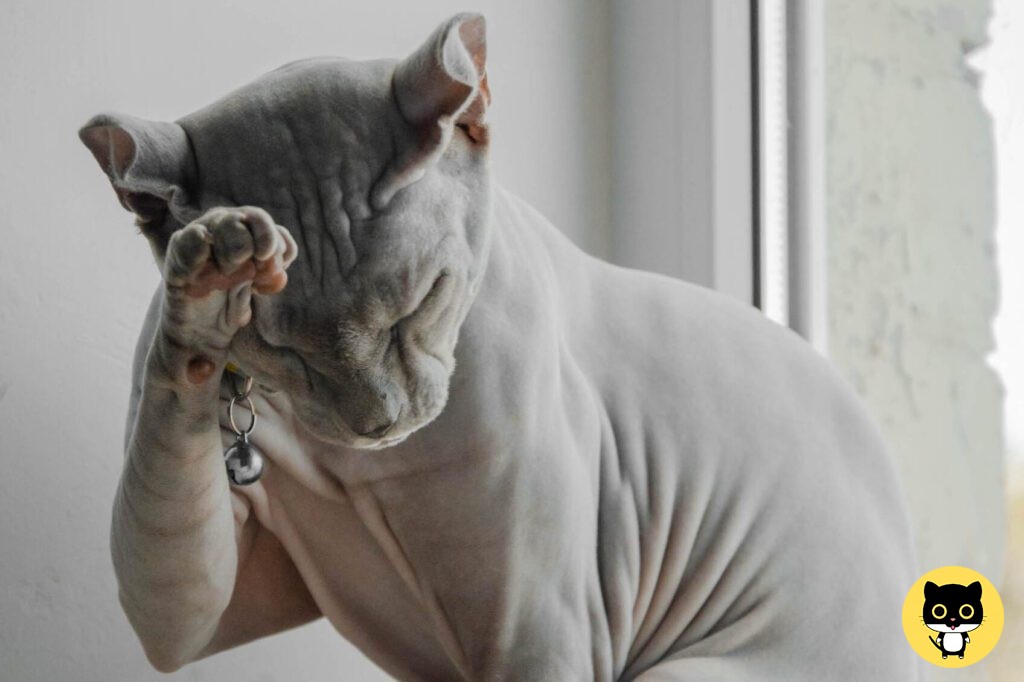
The Ukrainian Levkoy is an unusual indoor companion whose appeal comes from two immediately recognizable features: ears that fold forward and a body that may be hairless, lightly fuzzed or sparsely coated. Those traits create a cat with a distinctive silhouette, but they also make practical care and responsible buying more important than appearance alone. A prospective caregiver needs to consider the individual cat’s coat, social needs, ancestry, health records and living environment rather than treating the breed name as a complete prediction.
Quick Facts
| Breed type | Modern Ukrainian cat type with folded ears and variable hairlessness |
|---|---|
| Development | Early 2000s, associated with Scottish Fold-type and Donskoy or Don Sphynx lines |
| Typical presentation | Medium-sized, slender but muscular, angular-headed and long-legged |
| Coat | Hairless, fine flock-like fuzz, sparse coat or straight hair |
| Reported weight | Approximately 8–12 lb (3.6–5.4 kg), an informal estimate rather than a requirement |
| Estimated lifespan | Published estimates range from about 9–15, 12–15 or 13–17 years; these are planning estimates, not measured breed-wide life expectancy |
Identity, history and recognition
The Ukrainian Levkoy is a modern type rather than an old naturally established breed. Historical breed material places its development in Ukraine in the early 2000s and connects its ancestry with Scottish Fold-type cats and Donskoy or Don Sphynx lines. The result combines a folded-ear appearance with the reduced or absent coat associated with hairless lines. That combination is central to the cat’s identity, but it also means that variation is part of the type’s history.
Recognition is not uniform internationally. Historical material associates the Ukrainian Levkoy with ICFA RUI, also known as Rolandus, and with regional or independent documentation. It was not listed on the CFA, TICA or FIFe breed lists checked for this guide. Independent registration can document a cat within that organization’s system, but it should not be presented as equivalent to championship recognition by those major registries. Anyone buying a supposedly registered kitten should ask which organization issued the registration and what that registration actually confirms.
The breed’s developing status has a practical consequence: terminology, accepted variants and breeding practices may differ between organizations and countries. A pedigree may therefore be useful evidence of ancestry without guaranteeing a particular health outcome, coat type or degree of recognition elsewhere.
What a Ukrainian Levkoy looks like
The head gives the Ukrainian Levkoy much of its characteristic expression. It is described as an angular modified wedge or pentagonal shape, with prominent cheekbones and eyebrows, a relatively long profile and large almond-shaped eyes. The ears are large and fold forward or downward. They do not necessarily lie tightly against the head, so a Levkoy’s ear carriage can look more like a forward bend than a completely flattened ear.
The body is intended to be medium-sized, muscular yet slender, with relatively long legs and a long, tapering tail. Online profiles commonly give an adult weight of about 8–12 lb (3.6–5.4 kg), but this is best used only as orientation. A healthy weight depends on the cat’s frame, age, sex and body condition; a scale number should not replace assessment of muscle, waist and overall fitness.
The coat is more variable than the word “hairless” suggests. One cat may appear almost unclothed, another may have fine flock-like fuzz, and another may be sparsely coated or straight-haired. Straight-eared individuals are also reported. This variation matters when choosing a cat: two Ukrainian Levkoys may have noticeably different grooming, warmth and skin-care routines.
Color and pattern descriptions include solid, tabby, bicolor and pointed forms. Gold and green eyes are commonly reported, although the complete accepted color and eye-color categories depend on the registry and variant, and the full set of categories is not consistently verifiable from an accessible official standard. Buyers should ask how a breeder labels a particular color rather than assuming that one organization’s terminology applies everywhere.
Temperament and daily companionship
The Ukrainian Levkoy is commonly described as playful, curious, people-oriented and fairly interactive. In everyday life, that can mean a cat that wants to investigate rooms, follow household activity and participate in play rather than simply sleep in a distant corner. Daily interactive play, climbing or exploration opportunities, comfortable resting places and varied enrichment are sensible provisions.
Social language should be treated as a starting point rather than a guarantee of a lap cat. Some caregivers describe Levkoys that greet them, follow them through the home, seek warmth under blankets or dislike being alone for long periods. Those experiences suggest that a close, proximity-seeking relationship is possible, but they do not establish reliable handling tolerance, lap preference, stranger response or child compatibility for the breed as a whole.
An adult meeting can therefore be more informative than a temperament label. Watch how the individual responds to approach, lifting, grooming, unfamiliar people and a brief interruption of play. A prospective caregiver who wants a highly tactile cat should ask specifically about that cat’s preferences rather than relying on “affectionate” in an advertisement.
The same caution applies to other animals. There is no breed-wide evidence establishing dependable hunting behavior or safety with small pets. Introductions should be gradual, with escape spaces and supervision. Vulnerable animals should be separated whenever the household cannot actively manage the interaction.
Coat care, skin and the home environment
A hairless appearance usually reduces brushing, but it does not make the Ukrainian Levkoy maintenance-free. The right routine follows the individual coat. A genuinely hairless cat may need little conventional brushing, while a fuzzed or coated cat may benefit from occasional grooming to remove loose material and prevent tangles. Even a fine or light-feeling coat can leave hair, dander and skin material around the home, so visible shedding is not a reliable allergy test.
Skin care becomes more important as the coat becomes sparser. Hairless or minimally coated cats may accumulate skin oils and have more direct exposure to cold, sunlight and environmental irritants. Depending on the individual, care may include gentle wipe-downs or occasional bathing with cat-appropriate products. Over-cleaning can irritate skin, so the routine should be guided by the cat’s condition and veterinary advice rather than by a fixed bathing schedule.
Temperature and sunlight are everyday management issues. An indoor home with stable temperatures, warm resting places and access to shade is the safer default, especially for an unclothed cat. Free outdoor roaming is a poor fit for a cat with limited protection from cold, ultraviolet exposure and surface hazards. If outdoor time is offered, a secure enclosure or direct supervision is preferable.
Allergies require particular honesty. The absence of a conventional coat does not make the Ukrainian Levkoy hypoallergenic. Cat allergens are present in skin, saliva and other materials, and an individual household may react even when little hair is visible. An allergy-sensitive caregiver should spend time with the actual cat and discuss the decision with an allergist before committing.
Folded ears deserve regular observation. Check for excess wax, odor, redness or signs of discomfort, but do not repeatedly clean an inflamed or painful ear at home instead of seeking veterinary assessment. Nail trimming, dental care, vaccination, parasite prevention and routine examinations remain ordinary cat-care responsibilities regardless of coat or ear shape.
Health questions and responsible buying
The folded ear is not only an aesthetic feature; it raises a legitimate welfare question. Research into Scottish Fold cats has linked a dominant TRPV4 variant with osteochondrodysplasia affecting cartilage and bone. That evidence comes from Scottish Fold research and does not establish the prevalence or severity of the same condition in Ukrainian Levkoys. It does, however, make questions about parentage, mobility and breeding decisions especially important.
A buyer should ask to see veterinary records and a pedigree, and should learn whether each parent has folded or straight ears. Useful questions include whether the parents have shown stiffness, abnormal gait, reduced tail mobility, difficulty jumping or other movement problems. Skin and ear history should also be discussed. If cardiac, orthopedic, genetic or other testing has been performed, the buyer should request the actual documentation and understand what that test can and cannot show.
No validated Ukrainian Levkoy-specific screening protocol or robust breed-wide health survey establishes a complete health profile for the type. That uncertainty should not be turned into a prediction that every cat will be unhealthy, but it does make vague assurances inadequate. A breeder who cannot explain the ancestry, health history and veterinary care of the parents is asking the buyer to accept more risk than the appearance alone justifies.
Reported longevity figures range from approximately 9–15, 12–15 or 13–17 years. These are estimates collected from breed profiles, not a measured population life expectancy. Genetics, veterinary care, diet, indoor safety and environmental conditions will influence the individual cat’s lifespan.
Availability and purchase cost
Finding a Ukrainian Levkoy may be difficult, particularly in the United States and Australia. A U.S. marketplace page checked for this guide showed no available kittens, while Australian material describes specialist import networks. An empty listing does not prove that no private breeder has cats available, but the broader picture is one of limited supply and specialist contacts rather than a readily available mainstream breed.
No dependable Ukrainian Levkoy purchase-price range or breed-specific adoption fee could be verified. One U.S. marketplace page displayed $10 USD, but it did not show an available kitten or evidence that the figure represented a genuine breeder asking price or completed sale; its date was not established in the available record. It should not be used as a market estimate. A real quote may vary substantially with country, import arrangements, age, sex, coat and ear variant, breeding rights, registry documentation and health records.
Limited availability can encourage rushed decisions, especially when a buyer has already become attached to the unusual appearance. Take time to verify the breeder, view the living conditions, confirm the identity of the parents and inspect veterinary paperwork. Be cautious of sellers who use a rare-breed label to justify immediate payment while avoiding questions about ancestry or health.
Is the Ukrainian Levkoy a good fit?
The Ukrainian Levkoy may suit someone who wants an involved indoor cat and is comfortable providing enrichment, warmth, shade, skin observation and individualized grooming. It may also suit a caregiver who finds the breed’s unusual appearance appealing but is prepared to investigate provenance rather than treating rarity as proof of quality.
It is a less obvious match for someone seeking a completely hypoallergenic pet, a cat that can live outdoors with little protection, or a low-effort companion whose care is simplified by having little hair. Less brushing may coexist with more attention to skin and climate. Likewise, a sociable description may coexist with an individual cat that dislikes restraint, visitors or prolonged handling.
The most responsible choice depends on the individual cat, documented history and caregiver readiness. Meet the cat if possible, preferably more than once; ask to see the parents or reliable records about them; observe movement and tail use; and discuss the coat and ear-care routine you would actually be taking on. The breed is recognizable and genuinely distinctive, but its developing recognition, limited availability and incomplete direct health evidence make careful evaluation part of owning one.
What owners and caregivers say
Owners and caregivers describe rewarding, close relationships with some Ukrainian Levkoys. Australian testimonials portray cats that follow their caregivers, greet them when they return, seek warmth beneath blankets and dislike being alone for long periods. These stories fit the broader impression of an interactive companion, while still leaving room for substantial individual variation.
An owner who cared for a straight-eared Ukrainian Levkoy boy described him as sweet and reported no health problems at that point. That experience is encouraging, but it also illustrates why the label should not be treated as a promise: the cat’s straight ears and personal history were part of what made that account specific to him.
Individual appearance can be distinctive in small details as well. One caregiver highlighted unusually long whiskers, a memorable feature of that particular cat rather than a confirmed breed-wide characteristic. Such differences are a reminder to assess the cat in front of you, not an imagined standard example.
Caregivers also describe the difficulty of finding Ukrainian Levkoys outside specialist networks. That scarcity may be frustrating, but it is a reason to slow down rather than to accept weak documentation. A good match is not simply the rare cat that becomes available first; it is an individual whose history, health information, social needs and care requirements are compatible with the home.
Selected sources
Historical and appearance information is documented in the Rolandus breed material and its Ukrainian Levkoy standard. Registry listings can be checked through the CFA, TICA and FIFe breed lists. The Scottish Fold cartilage and bone concern is discussed in published research, including this TRPV4 study. Allergy information is available from the American College of Allergy, Asthma & Immunology.
 English