
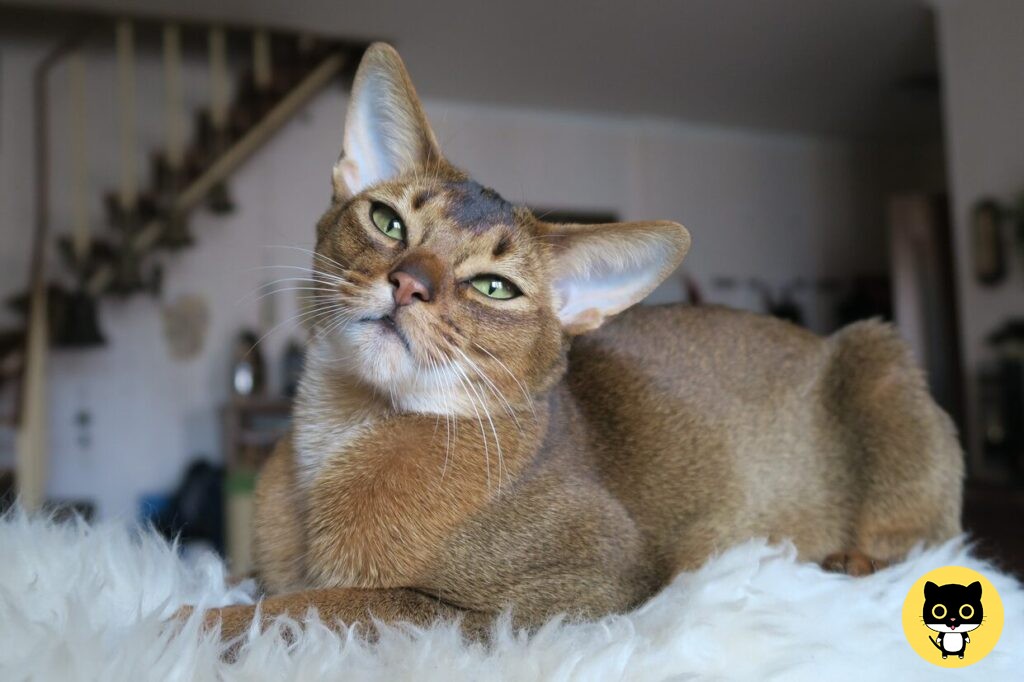
The Abyssinian is best understood as an interactive, athletic companion rather than a decorative short-haired cat. It may follow household routines, investigate every change in its environment and ask to participate in whatever its people are doing. That involvement can feel wonderfully companionable, but it can also mean climbing, vocal requests, food theft or escape attempts when the home does not offer enough constructive activity.
Quick Facts
| Quick fact | Abyssinian |
|---|---|
| Type | Recognized shorthair breed |
| Adult size | Approximately 6–9 lb for females and 7–12 lb for males, with individual frame and body condition more important than the range |
| Coat | Short to medium, fine, dense, resilient and ticked |
| Typical activity | High; climbing, hunting-style play, exploration and social involvement are prominent |
| Estimated lifespan | About 14–17+ years; some are reported to live into their twenties |
Identity, recognition and the look of an Abyssinian
The Abyssinian is a formally recognized breed in CFA, TICA and FIFe. Its most important visual feature is not simply short fur, but agouti ticking: individual hairs carry alternating lighter and darker bands, giving the coat a softly shimmering, finely patterned appearance rather than obvious stripes across the body. The related Somali has the longer coat, while the Abyssinian retains the close-lying shorthair outline.
Its body is medium-sized, lithe and muscular rather than broad or cobby. The head forms a modified wedge, with large cupped ears, almond-shaped eyes and a purposeful, alert expression. Fine but strong legs end in compact oval paws, and the tail tapers from the body. The overall impression is of a cat built for balance, climbing and quick movement rather than heavy impact.
Adult weight ranges are useful only as rough orientation. TICA gives approximate figures of 6–9 pounds for females and 7–12 pounds for males, but a healthy Abyssinian should be assessed by muscle, proportion and body condition rather than by reaching a particular number. A narrow, athletic frame should not be mistaken for underweight, and a larger-framed cat should not be pushed toward a breed stereotype.
Color terminology depends on the registering organization. CFA lists ruddy, cinnamon, blue and fawn, while TICA and FIFe use color systems that include silver varieties and may translate or group colors differently. Silver is a color division within the breed, not a separate breed. Anyone buying a pedigreed cat or evaluating a show claim should ask which registry’s terminology and standard apply; color names are not interchangeable across organizations.
Eye color can be gold or green under CFA’s description, while TICA also includes amber. Eye color alone does not establish that a cat is an Abyssinian and does not diagnose health. Pedigree, conformation and documented history carry much more meaning than an attractive eye shade.
What living with one can feel like
Curiosity is one of the breed’s defining household qualities. Abyssinians are often active, athletic and interested in high vantage points, moving through the home as observers and participants. A cat tree, wall shelves, window perches and secure observation points can turn that instinct into satisfying indoor activity. Without suitable outlets, the same intelligence may be directed toward cupboards, countertops, doors and anything that makes an interesting sound.
Social interest does not necessarily mean prolonged lap sitting. An Abyssinian may show attachment by following someone from room to room, supervising chores, rubbing against legs, head-butting, requesting scratches or appearing whenever food is prepared. Some caregivers describe intense cuddling and lap sleeping; others describe a cat that seeks close contact but leaves the lap quickly. Both patterns fit the broader idea of an engaged companion whose preferred form of affection varies by individual.
This distinction matters when choosing a cat. Someone wanting a quiet lap cat that is content to be handled for long periods may be disappointed by an Abyssinian who prefers motion and participation. Someone who enjoys a clever cat that initiates interaction may find the same behavior delightful. Meeting an adult cat is especially useful: observe whether it seeks contact in a way the household enjoys, accepts ordinary handling, recovers from novelty and can settle after play.
Vocality and persistence also vary. Caregivers report cats that meow repeatedly, get underfoot, steal food, climb and demand attention while people are busy. These behaviors are not proof of a badly behaved cat; they may reflect an energetic animal whose social and investigative needs have not yet been given a better channel. Regular play before predictable household pressure points, puzzle feeding and reward-based training can make those channels clearer.
Exercise, enrichment and the home environment
Daily interactive play is a practical necessity for many Abyssinians. Wand toys, chase games, short training sessions and toys that require problem-solving can help satisfy the sequence of stalking, pursuing and catching. Rotating toys keeps novelty available without requiring a large collection. Puzzle feeders can make meals more engaging, provided food intake and body condition remain monitored.
Vertical territory often matters more than floor area. A smaller home can suit an Abyssinian when it offers climbing structures, safe windows, elevated resting places, social contact and regular play. A large home with little stimulation may be less satisfying than a compact but thoughtfully arranged one. This is an inference from the breed’s athletic and investigative tendencies, not a promise that every individual needs the same amount of activity.
Escape prevention deserves deliberate planning. Some caregivers describe repeated attempts to accompany people outdoors or investigate open doors. Free roaming is unnecessary and exposes a cat to traffic, disease, predators and other hazards. A secure catio, enclosed garden area or supervised harness use can provide outdoor novelty when the individual cat accepts it. Door routines, window screens and household cooperation are particularly important for an inventive escape artist.
Relationships with children, dogs and other cats depend on the individual cat, early socialization, introductions and management. An Abyssinian’s energy may suit confident older children who can play appropriately, but a sensitive adult cat may need a quieter home. A rescue organization described an adult male named Rudy as loving and food-motivated but easily stressed, recommending a calm adult home without children or dogs. That example is a reminder to match the actual cat rather than treating the breed label as a guarantee.
Small animals require a stricter boundary. Birds, rodents, reptiles and other vulnerable animals should have secure enclosures and separation from the cat. Sociability toward people or familiar dogs does not remove a cat’s capacity to hunt.
Coat care and ordinary health routines
The Abyssinian’s short, close-lying coat is usually simpler to maintain than a long-haired coat. Occasional brushing, perhaps weekly as a starting point, can remove loose hair and provide a chance to check the skin. Adjust the routine if the individual sheds more or develops tangles. A fine, light-feeling coat can still leave hair on furniture, clothing and floors; short hair does not mean non-shedding or hypoallergenic.
People with allergies should spend time with the individual cat before committing. Coat length and the amount of visible hair do not establish how a person’s allergy will respond. The relevant experience is the person’s response to that particular cat in the kind of home contact they expect to have.
There is no established Abyssinian-only diet, bathing schedule, dental protocol or climate requirement. Feed complete, balanced nutrition appropriate to life stage, monitor body condition and provide normal feline nail, dental and veterinary care. Regular preventive examinations are more useful than adding special routines simply because the cat is pedigreed.
Inherited-health conversations are still important. Pyruvate kinase deficiency is the clearest Abyssinian-associated condition for which genetic testing is directly useful; a breeder should be able to provide documented results or explain the relevant parentage. Mutation-specific testing also exists for some forms of progressive retinal atrophy. Renal amyloidosis and patellar luxation are reported concerns, but they call for careful family-history questions and veterinary interpretation rather than a simple claim that every Abyssinian is at risk.
When considering a kitten, ask for the relevant PK results, retinal testing where available, veterinary records and family history involving kidney disease, blindness, anemia and orthopedic problems. Read the contract’s health guarantees, return provisions and obligations carefully. A normal genetic panel is valuable information, but it cannot exclude every possible disease or replace ongoing veterinary care.
Acquisition, price and availability
Established breeders and occasional purebred rescues are the main routes to an Abyssinian. Availability can involve a waitlist, travel or limited choice of sex, color and timing. Current listings show that the breed can be found through more than one route, but they do not establish a national supply level or a typical waiting period.
Published United States figures from 2026 place many responsibly bred companion kittens at approximately US$900–$2,800. Some marketplace or show-tier examples list cats at around US$3,200–$4,000 or more. These are published asking-price examples rather than a verified national sale-price average. Pedigree, breeding rights, color, location, transport, veterinary work and breeder policies can all change the quote. A high price is not proof of health or quality.
Adoption prices can be much lower but vary with the organization and the cat’s circumstances. A documented United States rescue example checked in 2026 listed a three-year-old Abyssinian at US$300 in Wisconsin. Another shelter listing showed fees of US$25–$125 plus tax. These are individual adoption examples, not a breed-wide fee range. With a rescue cat, medical records, behavior history and the support offered after adoption may matter more than the fee itself.
A responsible choice therefore involves more than finding the right color or paying the expected number. Ask how the cat was raised, what handling and household experiences it has had, how it responds to other animals, and what support exists if the placement fails. For kittens, review the parents’ health information and observe how the breeder manages socialization. For adults, pay close attention to recovery from unfamiliar sounds, play style, boundaries and comfort with the proposed home.
Lifespan and long-term commitment
TICA gives the Abyssinian an estimated life expectancy of 14–17 or more years and notes that some live into their twenties. This is a registry estimate, not a population life table or a guarantee for an individual cat. Genetics, preventive care, accidents, environment and ordinary disease all influence lifespan.
A long-lived, active cat also creates a long period of responsibility. The household should be prepared for years of enrichment, dental and veterinary care, changing activity levels and possible adjustments as the cat ages. The same cat that needs climbing and vigorous play as a young adult may later need easier access to resting places and closer monitoring of weight, mobility and appetite.
What owners and caregivers say
Owners and caregivers often describe Abyssinians as unusually present in household life. One owner described a cat that followed people from room to room, learned daily routines and appeared to remind the household about food, brushing and outdoor time. Another caregiver described repeated efforts by a cat to accompany its person outside. These stories help translate “people-oriented” into something concrete: companionship may look like supervision and participation rather than quiet waiting in one favorite spot.
Affection can be equally varied in form. Some caregivers report lap sleeping, purring, head-butting and intense cuddling. Others describe a cat that stays close, requests scratches and follows people but leaves when lifted or after only a brief lap visit. The useful question is not whether Abyssinians are affectionate in the abstract, but whether this cat’s preferred distance and handling boundaries suit the household.
Shedding reports also differ. Some people notice very little hair, while others describe substantial or seasonal shedding even with brushing. A silky coat can feel almost weightless in the hand and still be visible around the home. If shedding or allergies are major concerns, meet the individual cat in person rather than relying on the breed’s short-haired label.
The more demanding accounts usually involve energy and persistence: meowing during busy periods, getting underfoot, taking food, climbing, seeking attention or trying to get through doors. These behaviors are compatible with a bright, active cat that has strong social interest. They become easier to live with when the home provides predictable play, food puzzles, vertical territory and secure boundaries; they can become exhausting when the caregiver wants a low-interaction pet.
Fear-related behavior should be interpreted in context. One caregiver described biting, scratching and avoidance in a cat whose household had not consistently provided play and whose people sometimes frightened him. That account does not establish a breed-wide aggression pattern. It does show why gentle handling, predictable interaction and opportunities to retreat matter, and why a prospective adopter should ask how a cat behaves when uncertain rather than relying on a reputation for friendliness.
An Abyssinian is likely to suit a caregiver who wants an alert, athletic and socially involved cat and is willing to organize the home around play, climbing, routine and safe exploration. The breed may work in a smaller home, but not as an excuse to provide less stimulation. It may be affectionate without being a dependable lap cat, easy to groom without being non-shedding, and sociable without being comfortable with every child, dog or household pace. The strongest match comes from welcoming that active form of companionship while choosing the individual cat on the evidence of its history, boundaries and behavior.
 English