
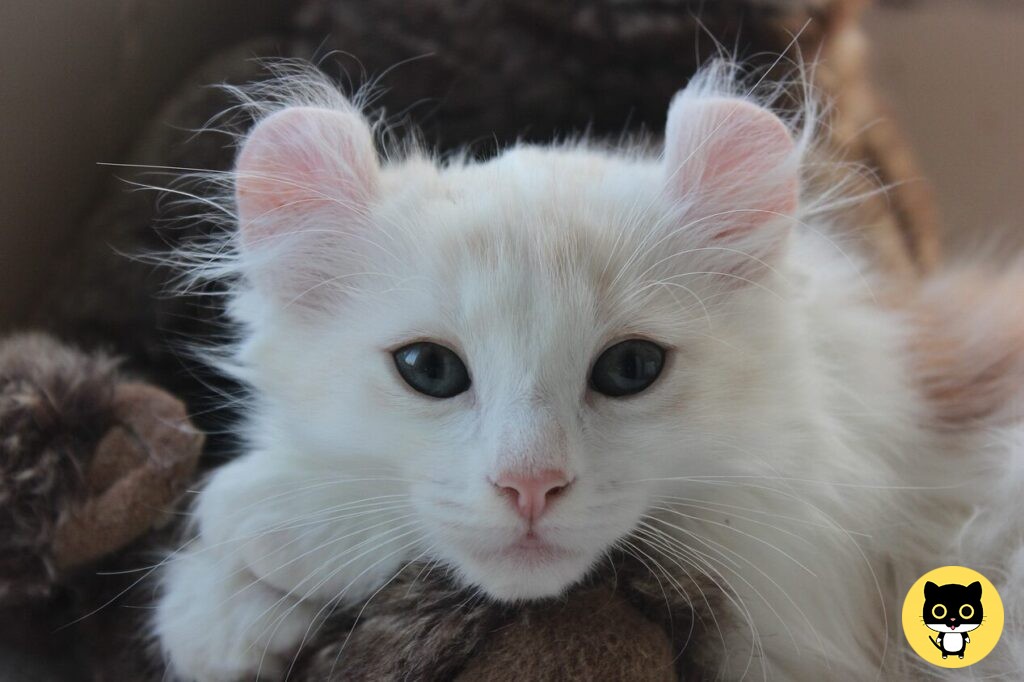
The American Curl is a distinctive companion for someone who wants an involved, observant cat rather than a purely decorative pet. Its backward-curving ears attract attention, but the more important day-to-day question is whether you want a cat that may follow household activity, investigate new things and expect regular play. The breed is often manageable to groom, yet its social and curious nature can require more interaction and environmental planning than its elegant appearance suggests.
Quick Facts
| Origin | California, first documented in 1981 |
|---|---|
| Recognizing feature | Ears that curve backward from an open, erect base |
| Coat | Shorthair and longhair varieties; many colors and patterns |
| Typical standard range | Females 5–8 lb; males 7–10 lb |
| Estimated lifespan | 10–20 years, as a planning estimate rather than a population life table |
| Grooming baseline | Combing about two or three times per month, adjusted for the individual coat |
Identity, history and recognition
The American Curl began with a naturally occurring ear mutation first documented in California in 1981. The trait was reported as autosomal dominant, and Curl kittens are born with straight ears. The ear begins to curve backward during the first several weeks, with its final position generally settling by about four months. This means a very young kitten may not yet display the feature that defines the adult breed.
The Curl’s ears are not folded forward. They rise from an erect, open base and sweep backward in an arc, making them genetically and structurally different from the folded ears of a Scottish Fold. The distinction matters: concerns associated with Scottish Fold osteochondrodysplasia should not be transferred to American Curls simply because both breeds have unusual ears. At the same time, the amount of curl is a conformation feature, not proof of superior health, affection or pedigree quality.
Formal breed identity depends on documentation as well as appearance. An individual with curled ears may be a pedigreed American Curl, a Curl mix or a cat whose background is simply unknown. CFA recognizes American Curl shorthairs and longhairs, while TICA uses American Curl and American Curl Longhair terminology. FIFe lists American Curl Longhair as ACL and American Curl Shorthair as ACS. Their terminology, classification and registration requirements are not interchangeable, so a prospective buyer should ask which registry’s rules and records apply.
A pedigree should show more than a sales label. Before committing to a kitten, ask to see registry and parentage records, veterinary and vaccination documentation, parasite history, family health information, details of any outcrossing, socialization practices and the breeder’s written return or rehoming agreement. No universal American Curl genetic test or mandatory screening panel was established for this guide, which makes transparent records and responsible breeder practices especially useful.
Appearance beyond the ears
The American Curl has a moderately muscled, elegant body with a semi-foreign or rectangular outline. Medium legs, rounded feet and a tail approximately as long as the body give it a balanced rather than heavy appearance. The head is a modified wedge, and the eyes are large and walnut-shaped. CFA’s adult standard ranges are 5–8 pounds for females and 7–10 pounds for males, although an individual’s healthy weight depends on build, age and body condition.
The coat comes in two lengths. A shorthair has a short, resilient coat, while a longhair has a semi-long coat and a plumed tail. Both are described as fine or silky, flat-lying and relatively light in undercoat. That texture can make the coat feel less bulky and may reduce the amount of undercoat that mats, but it does not make the cat hair-free or hypoallergenic. Visible loose hair can still appear on furniture and clothing.
Color and pattern are not narrowly restricted. The breed can appear in a broad range of colors and patterns, including colorpoint forms. Under the CFA standard, blue eyes are required for colorpoint classes; eye-color expectations therefore depend on the coat classification and the applicable registry standard. A buyer comparing a show prospect with a companion kitten should ask which standard is being used rather than assuming that every registry evaluates the same details identically.
Temperament and life with an American Curl
Curiosity is one of the breed’s most practical characteristics. American Curls are commonly described as active, playful, people-oriented and interested in what the household is doing. They may greet people, investigate objects, carry toys, climb onto shoulders or communicate with small trills and coos. These qualities support the image of an interactive companion: a Curl may want to participate in the room even when it is not asking to be held.
People-orientation does not guarantee lap behavior. A cat can seek proximity, follow a caregiver, sleep beside someone or initiate a game while disliking prolonged restraint. One owner’s male Curl, for example, accepted a few head pets and then gently signaled that handling should stop. That is not a contradiction of sociability; it is a reminder that affection can be expressed through choice and proximity rather than passive tolerance.
For that reason, a Curl may suit an attentive household better than one looking for a completely hands-off pet. Daily interactive play, scratching surfaces, rotating toys, secure vertical territory and quiet retreat areas give the cat appropriate ways to use its energy. An apartment can work as well as a larger home when the environment offers climbing, observation and play. There is no established minimum floor area for the breed; behavioral richness is more relevant than square footage alone.
Curiosity also creates ordinary household safety work. Secure cords, small swallowable objects, unstable high furniture, accessible cabinets and unscreened windows. A high resting place is valuable, but it should be stable and positioned away from hazards. If the cat will live with children, dogs or other cats, introductions should be gradual, with separate food, water, litter and resting resources and escape routes that cannot be blocked. Adult supervision is appropriate when children and a new cat are learning one another’s boundaries.
Grooming, ears and routine care
The coat is usually not an onerous grooming project. A practical starting point is brushing or combing about two or three times per month, then adjusting according to loose hair, coat length and tangles. A longhaired Curl may need more frequent attention, as may any individual whose coat mats easily. The light feel of the coat should not be mistaken for an absence of shedding; combing removes hair before some of it reaches the home.
The ears need observation rather than manipulation. Look periodically for odor, discharge, redness, tenderness, persistent scratching or head shaking. These signs warrant veterinary advice. Do not force the ear into a different position, repeatedly bend it to test flexibility or automatically perform deep cleaning. If cleaning is recommended, a veterinarian can advise on a suitable method; the ear’s unusual shape is a reason for gentle handling, not for routine aggressive care.
Regular preventive veterinary care remains appropriate even when a breed is generally described as healthy. Vaccination, parasite control, dental care, weight monitoring and age-appropriate examinations should be based on the individual cat’s needs. Feed a complete and balanced diet suited to life stage and health status. There is no supported American Curl requirement for grain-free food, a mandatory wet-food diet or a special feeding plan based solely on the breed. Measuring portions can help when needed, while body condition is more informative than an assumed breed tendency.
Health expectations and lifespan
No confirmed American Curl-specific inherited disease predisposition was established in the reviewed evidence. A statement that no known genetic health issues are associated with the breed is useful reassurance, but it is not a guarantee that every Curl will remain healthy or that the population has been exhaustively characterized. The sensible middle position is to avoid importing Scottish Fold skeletal-disease claims while still evaluating each cat as an individual.
Routine care and a clear medical history are therefore more valuable than marketing claims about a “problem-free” breed. Ask what illnesses have occurred in close relatives, what veterinary examinations the parents and kitten have received, whether ear problems have occurred and how the breeder responds if a kitten cannot remain in the original home. A long-term caregiver should also budget for ordinary illness and aging rather than relying on the breed label as a health prediction.
A lifespan of 10–20 years is given as an American Curl estimate. It is useful for planning a potentially long relationship, but it is not a measured breed-wide life table and should not be read as a promise. Housing changes, nutrition, preventive care, inherited factors and chance all influence an individual cat’s longevity.
Availability, adoption and price
Availability can require patience. Breeder access may involve geographic searching, transport arrangements or a waitlist, while rescue appearances are sporadic and may include cats whose pedigrees are unverified. A rescue listing that calls a cat an American Curl may accurately describe its appearance without proving formal registration, so adopters should treat pedigree and breed identity as separate questions.
U.S. breeder asking-price examples checked on October 1, 2026 were approximately US$1,000–$2,500 in a PetMD example and about US$1,000–$3,000 or more from Curl Essence. These are asking prices, not completed-sale data. Location, pedigree, registration, breeding or show potential, transport, included veterinary care and breeder reputation can all change the figure. A documented pedigree is not directly comparable with a rescue adoption fee.
For comparison, two U.S. rescue examples checked on the same date listed a Curl-labeled kitten in Illinois with a US$125 adoption fee and a nine-month-old medium-haired American Curl in Virginia with a US$180 fee. Those figures describe particular listings, not a standard rescue price. Adoption fees and availability change, and a rescue cat may need additional examination, testing or treatment after adoption.
Is the American Curl a good fit?
The American Curl is a strong match for someone who values play, observation and participation in household life. The grooming routine is often modest, and an enriched apartment can work well, but the cat still benefits from daily engagement, safe vertical space and opportunities to investigate. A caregiver who wants a cat that is always content to be carried, handled or left without stimulation may be disappointed.
The most reliable suitability test is an individual conversation, not the ear shape. Meet an adult when possible and ask whether the cat seeks contact, how it responds when touch stops, how it handles visitors, whether it enjoys being picked up and how it has lived with children, dogs or other cats. The breed gives useful expectations about appearance and a general interactive style; it cannot promise a particular lap preference, tolerance for restraint or social arrangement.
What owners and caregivers say
Caregivers often describe the American Curl as a cat that joins in. One breeder’s account of Donatello portrays an affectionate cat who greeted people, slept on them, learned to sit for treats and became fascinated with ice after living with dogs. The enjoyable curiosity had a practical side too: ice play created water and floor mess. That combination captures an important part of life with an inquisitive cat—engagement is rewarding, but it can be untidy.
Other reports emphasize proximity rather than constant touch. Curls have been described as greeting people at the door, sleeping beside caregivers, investigating or carrying objects and using quiet trills. Those behaviors fit an interactive companion without proving that every Curl wants to be a lap cat. A cat that chooses when contact begins and ends may be affectionate while still requiring respectful handling.
Individual histories also vary. A caregiver who lived with a Curl mix for roughly two decades reported early ear infections, later ear-mite treatment and cancer in old age. That account illustrates one cat’s medical life, not a breed rate or a predictable sequence. Similarly, rescue caregivers describing Curl-mix sisters who merely tolerated one another during a change in weather show why living with another cat is an individual relationship rather than an automatic breed trait.
The useful overall picture is a visually distinctive, moderately demanding companion. The curled ears explain why the breed stands out, while the cat’s actual success in a home depends more on enrichment, consent-aware handling, preventive care and a careful match between the individual’s temperament and the caregiver’s expectations.
Selected sources
Breed overview and lifespan estimate; CFA breed description and standard; FIFe ACL and ACS standard; early research on the American Curl ear mutation.
dated U.S. breeder price example; breeder asking-price example and caregiver account; rescue listing example.
 English