
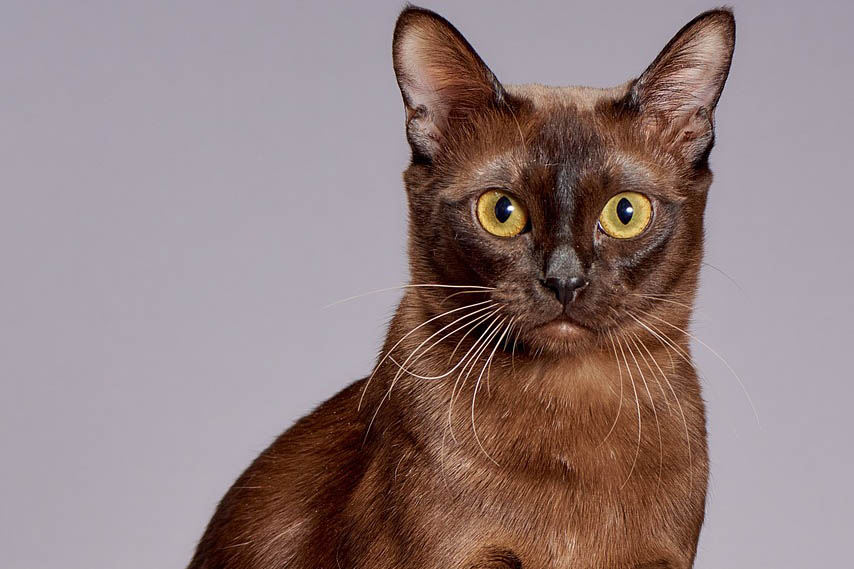
The Burmese is best understood as an interactive companion rather than simply a short-haired, easy-care cat. Its glossy coat is relatively simple to maintain, but many Burmese want to take part in household life: following people, investigating activity, playing, and communicating. That social energy can be deeply rewarding when a household has time and interest for it. It can also become frustrating if the cat is expected to be decorative, independent, or continually willing to be handled.
Quick Facts
| Quick fact | Burmese |
|---|---|
| Recognition | Recognized by CFA and TICA; FIFe lists Burmese as a fully recognized Category 3 breed |
| Coat | Short, fine, glossy and close-lying, with little or almost no undercoat |
| Typical social profile | People-oriented, playful, curious and often strongly involved in household activity |
| Grooming | Usually about weekly brushing, with routine nail, dental and veterinary care |
| Life-expectancy estimate | 12 or more years in a broad breed-profile estimate; individual outcomes vary |
| United States price examples | About $600–$1,500 USD for a reputable-breeder companion kitten; about $2,500–$3,000 USD for show-quality or European-line kittens, based on a 2026 asking-price guide |
Identity and recognition
“Burmese” does not describe one perfectly uniform appearance everywhere. CFA separately recognizes American Burmese and European Burmese, while FIFe recognizes Burmese in Category 3 and applies its own standard. TICA also recognizes the breed. These distinctions matter when interpreting a pedigree, expected head shape, body type or accepted color.
Formal identity comes from pedigree and registry records, not from appearance alone. A cat with a Burmese-like coat or body is not thereby a registered Burmese, and a registered Burmese may not match the proportions a reader has seen in another country. Anyone buying a pedigree kitten should ask which registry is involved, which Burmese type is being represented, and what documentation will accompany the cat.
History and relationships
The modern Burmese developed through relationships between cats from Southeast Asia and breeding programs in the West. Over time, different breeding directions produced the compact, rounded American type and the more moderate, elegant European type. The relationship between these forms explains why photographs can make “Burmese” look like two related but noticeably different cats rather than one fixed template.
Those differences are not merely cosmetic if someone is choosing a show prospect or trying to predict what a kitten will look like as an adult. A breeder should be able to explain the lines, registry and standard behind the litter. For a companion home, temperament, health documentation and compatibility may be more important than whether the head is especially rounded or wedge-influenced.
Appearance, coat and colors
American Burmese are compact, muscular and rounded, with a broad, short muzzle and considerable substance for their apparent size. European Burmese and Burmese described under the FIFe standard are generally more moderate or elegant, with more wedge-influenced head proportions. Across these standards, the breed should feel substantial rather than fragile, but there is no dependable breed-wide adult weight range that should be used as a target.
The coat is short, fine, glossy and close to the body. It is described as having little or almost no undercoat, which gives the Burmese its sleek, almost polished appearance and makes routine grooming less laborious than grooming a long-haired cat. It does not make the home hair-free, however. A light-feeling coat can still shed onto clothing, furniture and bedding, and it is not evidence that the breed is hypoallergenic.
Weekly brushing with a rubber brush is a practical starting point. The brush can remove loose hair and help preserve the coat’s shine, while also making it easier to notice skin changes, parasites or areas of tenderness. Some cats may need more frequent attention during heavier shedding or if they accumulate loose hair; the individual coat and the cat’s tolerance should guide the routine.
Color terminology depends strongly on the registry and Burmese type. CFA’s American Burmese standard lists sable, champagne, blue and platinum. CFA’s European Burmese standard uses a broader ten-category system that includes red, cream and tortoiseshell forms. FIFe lists brown, blue, chocolate, lilac, red, cream and four tortoiseshell varieties. Eye color can range from yellow through gold or amber depending on the wording of the standard; FIFe gives preference to golden yellow. One exact shade should not be used to authenticate every Burmese.
Temperament and daily life
Curiosity is one of the breed’s most useful defining traits for a prospective caregiver. Burmese often want to know what people are doing, investigate changes in the home and turn ordinary events into opportunities for play or attention. Interactive toys, food puzzles, scratching posts, stable climbing furniture, window perches and elevated observation points give that interest somewhere constructive to go.
Social involvement does not necessarily mean constant physical contact. A Burmese may follow a person from room to room, vocalize during household activity or insist on being included, yet choose to sleep separately while that person works. This distinction helps explain why a cat can be affectionate without being a lap cat, and why a caregiver should ask about the particular cat’s preferred form of closeness rather than relying on the label “cuddly.”
Handling tolerance is a separate question from affection. A Burmese may enjoy company but dislike being lifted, restrained, brushed for too long or approached noisily. Children, visitors and dogs can be suitable companions when adults supervise interactions, provide escape routes and teach respectful contact; sociability should never be treated as permission for unwanted handling. Before adoption or purchase, ask specifically how the cat responds to a carrier, veterinary examination, grooming, children, dogs, visitors and time alone.
Is a Burmese suitable for an apartment?
Apartment size is less informative than the quality of the cat’s daily environment. A Burmese can live successfully in an apartment when the household provides regular interaction, opportunities to climb and observe, safe resting places and predictable attention. A larger house can be a poor match if the cat spends much of the day isolated and without play or social contact.
There is no validated minimum room size, daily exercise quota or universal number of hours that every Burmese can safely spend alone. The practical question is how the cat will experience the household’s schedule. Someone working from home may offer abundant company but still need planned play and enrichment; someone working long shifts may need to arrange reliable interaction and consider whether the individual cat has previously enjoyed living with another animal.
A second cat can help a Burmese that actively seeks feline company, but it is not a universal requirement. Some Burmese play and sleep happily with other cats, while others become territorial, are bullied, show conflict or prefer to be the only pet. Introductions should begin with separate rooms and progress gradually. Food, litter boxes, resting areas, hiding places and escape routes should be distributed so that neither cat must compete for essentials.
The resident cat’s history matters as much as the Burmese’s breed. A cat that has always lived alone may need a different plan from a young Burmese accustomed to feline companions. If the cat is being adopted, ask what happened in previous homes, how it responded to other animals and whether any changes in appetite, weight or behavior followed a move or a new pet.
Care, feeding and enrichment
Grooming is usually a modest part of Burmese care, but companionship is the larger commitment. Schedule interactive play rather than assuming that access to toys will be enough. Wand play, chasing games, puzzle feeders and short training sessions can provide mental activity, while scratching surfaces and vertical furniture allow normal movement and territory-marking behavior indoors.
Feed a complete diet appropriate to the cat’s life stage and monitor body condition rather than pursuing a supposed Burmese target weight. A muscular cat can feel heavier than its appearance suggests, while gradual weight gain may be easy to miss beneath a compact body. Regular veterinary examinations, dental care, nail care and prompt attention to changes in appetite, thirst, mobility or behavior remain more useful than breed stereotypes.
Introduce a carrier, gentle handling and brief grooming sessions early and positively. This preparation has practical value when the cat needs veterinary care. It also gives the caregiver a chance to distinguish ordinary resistance from pain or fear: a cat that suddenly objects to mouth handling, brushing or lifting may need medical assessment rather than firmer training.
Health questions to discuss
Burmese hypokalemia is a recognized autosomal-recessive disorder that can cause episodes of low blood potassium and muscle weakness. A validated genetic test is available. A breeder should provide documented results for both parents and explain whether each is clear, a carrier or affected. A carrier is not the same as an affected cat, so the terminology and the mating plan should be explained rather than reduced to a vague claim that a litter is “health tested.”
Feline orofacial pain syndrome has been disproportionately represented in a retrospective series of 113 clinical cases, 100 of them Burmese cats. The series cannot predict the likelihood for an individual cat, but unexplained mouth discomfort, pawing at the mouth, tongue injury or repeated episodes of oral distress warrant veterinary assessment.
Studies from England and Australia have reported increased diabetes risk in some Burmese populations. One English primary-care dataset reported diabetes in 2.27% of Burmese cats compared with 0.58% of crossbred cats, with adjusted odds of 3.0. Geographic, genetic and registry differences mean that this finding should guide sensible questions about family health, body condition and preventive care—not be treated as a prediction that every Burmese will develop diabetes.
A broad breed-profile estimate gives Burmese a life expectancy of 12 or more years. That is an estimate, not a population median or a promise. Genetics, preventive care, disease, body condition and living conditions all influence an individual lifespan, and a caregiver should regard the estimate as a planning horizon rather than a guarantee.
Availability and cost
In the United States, Burmese kittens are generally findable, although a particular color, sex or breeding line may require waiting. European Burmese may be more regionally limited. Availability should be checked directly with breeders and rescue organizations because listings, travel requirements and waiting times change. A current breeder directory such as the Burmese Cat Society directory can be a starting point, but it does not replace checking records and asking questions.
A 2026 Petful guide gives approximately $600–$1,500 USD as a reputable-breeder companion-kitten asking-price estimate in the United States. It gives approximately $2,500–$3,000 USD for show-quality or European-line kittens. These are dated secondary-market asking-price estimates, not verified completed-sale data, and they do not include travel, supplies, insurance or veterinary care.
A 2026 Adopt a Pet guide gives an approximate United States rescue or shelter adoption-fee range of $100–$300 USD. The fee can vary with location, age, medical treatment, sterilization and vaccination. Actual Burmese listings may be scarce or may involve mixed-breed cats, so a lower adoption fee should not be interpreted as evidence that a pedigreed Burmese is commonly available through shelters.
Who is likely to enjoy living with a Burmese?
A Burmese is a strong candidate for a household that wants an involved relationship with a cat and can provide dependable daily interaction. The breed may suit apartment living, families and multi-pet homes when introductions, supervision, enrichment and escape spaces are planned around the individual animal. It is less suitable for someone seeking a cat that can routinely be ignored, left without stimulation or handled whenever a person chooses.
The most reliable suitability test is interactional rather than visual. Meet an adult when possible, or obtain detailed records from a breeder or rescue. Ask how the cat behaves when picked up, placed in a carrier, approached by children, introduced to dogs, left alone, exposed to visitors and asked to share territory. These answers are more useful than assuming that every Burmese will be equally vocal, attached, tolerant or companionable.
What owners and caregivers say
Owners and caregivers describe Burmese as highly individual within a broadly social breed. One owner living with four Burmese described one cat as intensely attached, another as independent but attentive to children, and two younger cats as strongly bonded to each other. The same household saw differences in vocality and willingness to be picked up. Those contrasts reinforce a practical point: “people-oriented” predicts a tendency to engage, not one fixed personality or handling preference.
Some Burmese make themselves part of nearly every household activity. Caregivers describe cats that follow people, travel well, investigate what is happening and seek regular conversation or play. A clingy cat may still sleep independently while its person works, which suggests that social need can be met through reliable involvement rather than uninterrupted physical contact.
Other experiences call for a quieter transition. One shy adult hid after adoption but gradually responded to gentle attention. A breed reputation for confidence should not lead a new caregiver to expose a frightened cat to the whole household at once. A small safe room, predictable meals, hiding options and voluntary contact can give the cat control while trust develops.
Living with another cat can be equally variable. Some Burmese play and sleep with feline companions, and some younger cats appear to seek near-constant company. Other caregivers describe bullying, territorial conflict, noise sensitivity or a Burmese that is happiest as the only pet. One account of a 16-year-old Burmese reported substantial weight loss after the cat was placed with other pets, a reminder that age, history and the stress of a particular arrangement matter more than a general promise that Burmese always need a companion.
Taken together, these experiences do not undermine the breed’s sociable reputation; they give it a more useful meaning. A Burmese often wants a place in household life, but that place may involve play, observation, conversation or proximity rather than being carried or sharing territory with another cat. The best home is therefore not simply the one with the most space or the desire for a cuddly cat. It is the one prepared to offer engagement, respect limits, manage introductions carefully and learn what this particular Burmese is asking for.
 English