
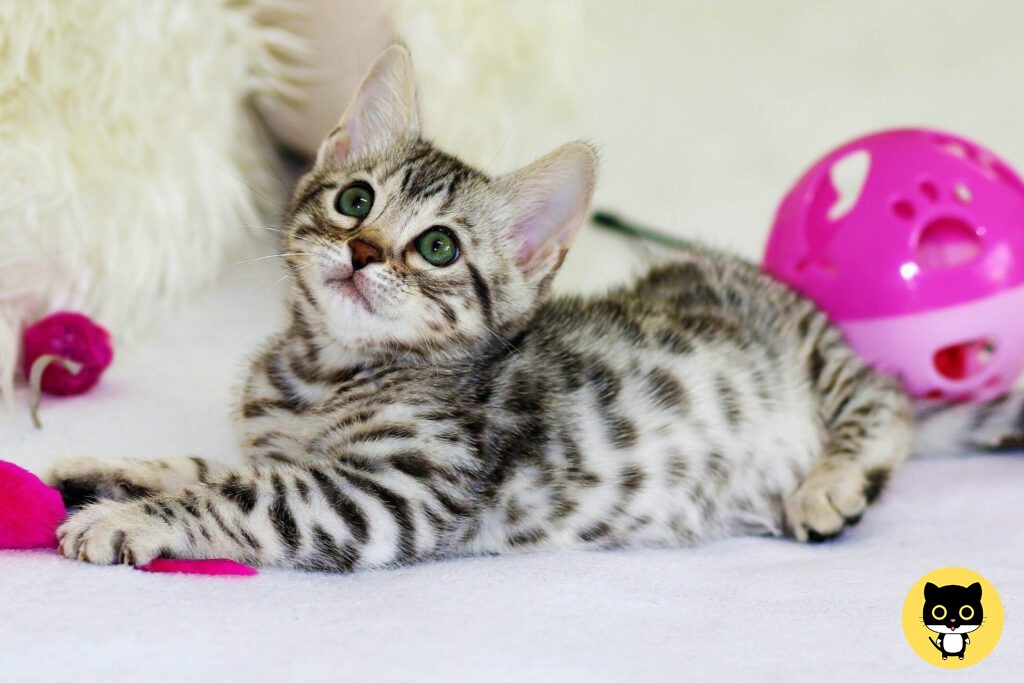
The Egyptian Mau is a striking cat to look at, but its spots are not the whole story. This is a standardized pedigreed breed with documented ancestry, not a general label for any spotted cat with Egyptian associations. A shelter cat, a domestic shorthair with a spotted coat, and a registered Egyptian Mau may look similar while differing substantially in provenance, price, predictable breed characteristics and breeder accountability.
Quick Facts
| Quick fact | Egyptian Mau |
|---|---|
| Type | Standardized pedigreed breed |
| Recognized show colors | Silver, bronze and smoke |
| Coat | Short to medium, close-lying and generally manageable |
| Typical activity | High; climbing, jumping, play and exploration are important |
| Adult eye color | Characteristically gooseberry green, with development continuing in young cats |
| Expected lifespan | About 10–15+ years according to a registry estimate, not a guarantee |
Life with an Egyptian Mau is usually most rewarding when a caregiver appreciates both sides of the breed: an athletic, curious companion that may form a powerful bond, and an individual cat that can remain cautious about strangers, noise or unwanted handling. Its suitability depends less on owning a particular “look” than on providing daily engagement while respecting the cat’s need for choice and retreat.
Identity, recognition and the meaning of “Mau”
Pedigree is the defining distinction. A cat does not become an Egyptian Mau solely because it has random spots, green eyes, a long-legged stance or a connection with Egypt. Those features may suggest the breed, but registry identity depends on documented lineage and registration requirements.
The modern breed has been accepted through established registration systems over several decades. The Cat Fanciers’ Association accepted the Egyptian Mau for registration in 1970 and for championship competition in 1977; The International Cat Association recognizes it from 1979, and FIFe lists MAU as a fully recognized Category 3 breed. These systems are not interchangeable, so a buyer should ask which registry applies, whether the parents are registered, and what paperwork will accompany the kitten. The relevant standards can be compared through the CFA breed information, TICA breed information and the FIFe breed listings.
This distinction matters especially when choosing between a breeder-raised kitten and a rescue cat described as “Mau” or “Mau mix.” A rescue may be an exceptionally good companion without having verifiable pedigree. DNA breed estimates and visual resemblance can also be interesting clues rather than proof of registry identity. The responsible question is not whether an unregistered cat is “really” a Mau based on appearance, but what provenance and care history can actually be documented.
Appearance: athletic structure beneath the spots
The Egyptian Mau is medium-sized, muscular and built for movement. Its hind legs are proportionally longer than its front legs, and a loose flap of skin extends from the flank toward the hind leg. Together, these features contribute to the breed’s distinctive tiptoe-like stance and support powerful acceleration. The stance is normal breed morphology, not by itself a sign of a mobility disorder.
The head has a slightly rounded wedge shape, with large almond-shaped eyes and medium-to-large ears. The tail is ringed and the limbs are barred. Males tend to be larger than females, but there is no defensible universal adult weight range to use as a target. Muscle, age, sex, body condition and veterinary assessment tell a caregiver more than an invented breed average.
The coat pattern is one of the breed’s most recognizable features. Egyptian Mau spots are distinct and irregularly distributed rather than arranged in a uniform tabby pattern. The face may show characteristic forehead and cheek markings, the neck broken necklaces, and the back a dorsal stripe. Recognized show colors are silver, bronze and smoke. Solid black and dilute cats may be registrable in some systems, including CFA, but they are not among the standard show colors.
Green eyes also develop over time. Adult eyes are characteristically gooseberry green, but kittens should not be judged against the finished color too early. CFA allows developmental change until approximately 8–18 months, while FIFe permits an amber cast in young adults up to 18 months. This makes the age of the cat important when assessing eye color.
Coat care and everyday maintenance
The close-lying short-to-medium coat is generally manageable rather than demanding. Silver and bronze coats are described as denser or more resilient, while smoke coats may feel finer and silkier. A light or silky coat can still leave hair on furniture and clothing, so “low maintenance” should not be confused with non-shedding or hypoallergenic. No cat breed should be promised as hypoallergenic.
Combing can remove loose hair, reduce swallowed hair and give a caregiver a chance to notice changes in the skin or coat. The right schedule depends on the individual cat’s shedding and tendency to tangle rather than on a rigid breed rule. Routine nail care, dental care, ear checks and veterinary examinations are appropriate, but no distinctive Egyptian Mau bathing, skin, eye, ear, dental or dietary protocol has been established.
A complete, balanced diet suited to the cat’s life stage, along with monitoring of body condition, is a sensible foundation. One caregiver reported difficulty changing a Mau’s food and eventual use of prescription food, but that is an individual dietary experience, not evidence that the breed requires a special diet. A veterinarian should guide therapeutic feeding.
Temperament: attached without necessarily being outgoing
Attachment is often a central part of the Egyptian Mau relationship. Many descriptions portray the breed as devoted to familiar caregivers, observant of household activity and interested in following, watching or participating in daily routines. Affection may appear as nearby companionship, play, vocal interaction or selective cuddling rather than constant lap sitting.
Stranger confidence is a separate question from attachment. An Egyptian Mau may be deeply bonded to one person yet shy with visitors or reluctant to be picked up. An adopter described exactly that combination in a shelter cat: intense affection toward the caregiver alongside extreme reserve around other people. This does not contradict the breed’s reputation for companionship; it shows why “friendly” needs to be defined more carefully.
Many Maus are active, curious and quick to investigate changes in their surroundings. They may climb, jump, chase toys and learn routines rapidly. Vocal behavior can include trills, chirps, chortles and conversational sounds, although some descriptions emphasize a quieter voice. Individual variation is more reliable than a promise of either constant noise or unusual silence.
Sensitivity can coexist with energy. Sudden loud or unpleasant noises may unsettle some cats, and a busy home should provide somewhere quiet to withdraw. A prospective caregiver who wants a cat that welcomes every visitor, tolerates prolonged restraint and remains relaxed amid commotion may be disappointed. Someone who values a close relationship with an intelligent, expressive cat may find the same selectiveness appealing.
Home life, exercise and enrichment
Vertical territory is more important than a large empty floor area. A secure cat tree, shelves, window perches and sturdy climbing routes allow an Egyptian Mau to use its athletic body safely. The structure should be stable enough for vigorous jumping and positioned so the cat can observe the household without being trapped in the center of activity.
Daily interactive play helps turn hunting energy into a manageable household routine. Wand toys, chase games, food puzzles and short training sessions can provide both movement and mental work. Safe exploration matters too: rotating toys, offering boxes or tunnels, and creating controlled access to different parts of the home can be more useful than simply buying more passive toys.
A smaller home can suit an Egyptian Mau when its layout offers height, activity and choice. Square footage alone is a poor measure of suitability. The more meaningful questions are whether the cat can climb, play, retreat, observe and rest without being repeatedly disturbed.
Children can be compatible when they are respectful and supervised. Adults need to prevent chasing, cornering and forced handling, and they should teach children that a cat’s attempt to leave is a request for space. Carefully introduced, cat-friendly dogs may also work, provided the Mau has escape routes and the dog cannot pursue it. There is no established universal breed-level preference for living with other cats. Small prey animals should remain physically separate.
Health questions worth asking
Focused health caution is more useful than a long list of speculative breed disorders. The strongest breed-relevant concerns located for the Egyptian Mau are urate urolithiasis, a type of urinary stone disease, and inherited pyruvate kinase deficiency, an enzyme disorder. The available findings come from clinical or submitted-case material and cannot be converted into a lifetime probability for every Mau.
A prospective buyer should ask a breeder whether parents and relevant relatives have documented testing for pyruvate kinase deficiency, and whether the family has a history of urinary stones. Those questions do not imply that most Egyptian Maus develop either condition. They are reasonable checks because responsible breeding decisions depend on knowing the health history behind a kitten.
Urinary warning signs deserve prompt attention in any cat, including straining, repeated unsuccessful attempts to urinate, blood in the urine, pain or lethargy. A history of urinary stones in the breed does not justify placing every Mau on a prescription urinary diet. Diet, hydration and treatment should be individualized with veterinary guidance. Background information on the urinary findings is available in these clinical research findings and this pyruvate kinase study.
With appropriate care, TICA gives the Egyptian Mau an expected lifespan of 10–15+ years. That is a registry estimate, not a population-based life table or a guarantee for an individual cat. Preventive veterinary care, vaccination decisions, parasite control, dental attention, a balanced diet and maintaining a healthy body condition remain more useful than treating the estimate as a promise.
Buying, adopting and checking the evidence
Availability can require patience. Demand may exceed the number of breeders, and a prospective owner may need to join a waiting list. Rescue listings appear intermittently, and a rescue cat’s Mau identity is often unverified even when the resemblance is convincing.
U.S. prices also vary too much to treat a few listings as a market average. A pet female advertised in North Carolina on May 6, 2026, was listed at $1,400 USD; a North Carolina cattery gave approximately $1,500–$2,800 USD for CFA/TICA-registered males and females, accessed October 2, 2026. These are asking examples, not confirmed market-wide sale prices. Registration, breeding rights, age, color, veterinary work, location and breeder reputation can all change the figure. The dated examples can be checked through the North Carolina kitten listing and the cattery’s pricing information.
Rescue costs are different in both meaning and scale. Examples accessed October 2, 2026, included $200 and $250 for cats identified as Egyptian Mau or Mau mix. Such labels may reflect appearance or an intake description rather than pedigree documentation. The adoption fee should therefore be weighed alongside the cat’s temperament, medical records and ongoing needs, not as evidence of breed certainty.
Paperwork and early care deserve as much attention as the kitten’s appearance. Buyers should see registration information, vaccination and veterinary records, the parents’ health documentation, and a clear contract. They should be cautious about pressure to pay quickly or explanations for missing records. One buyer described a cattery experience involving fearfulness, ringworm, ear infections and missing registration paperwork; later comments raised concerns about that same cattery. This is a warning about checking a particular seller, not evidence that Egyptian Maus as a breed are generally unhealthy or fearful.
When possible, meeting the actual kitten or adult is the best way to assess social style. Notice whether the cat recovers from ordinary handling, seeks contact, prefers proximity to cuddling, reacts to unfamiliar people and has a comfortable place to retreat. A pedigree can document ancestry, but it cannot guarantee a universally outgoing personality or compensate for poor socialization.
Is the Egyptian Mau a good fit?
The Egyptian Mau is a strong match for a caregiver who wants an athletic, involved companion and can provide daily play, climbing opportunities and patient social boundaries. It may suit apartment life or a larger home if the environment is thoughtfully arranged. Its coat usually does not create a major grooming burden, but ordinary shedding remains possible.
The breed is less suitable for someone seeking a uniformly sociable cat that enjoys being handled by anyone, settles without enrichment or treats a noisy household as irrelevant. The key distinction is not affectionate versus aloof. An Egyptian Mau may be highly attached while still being selective, noise-sensitive or uncomfortable with restraint.
Before committing, a caregiver should verify the pedigree and records separately from judging the cat’s appearance, ask targeted questions about pyruvate kinase testing and urinary history, meet the individual when possible, and assess whether the home can support safe movement and daily interaction. Those steps make room for the breed’s genuine appeal without turning spots, price or registry status into guarantees.
What owners and caregivers say
Owners and caregivers describe relationships that can be unusually close, but not always socially uncomplicated. One adopter found a shelter cat deeply affectionate with its primary caregiver and extremely shy with other people. That combination is worth taking seriously: a Mau may choose one person as its secure base while remaining cautious about visitors.
Another caregiver described a Cairo-born rescue as energetic, playful and cuddly. The cat’s uncertain pedigree means the story cannot establish a breed-wide temperament, but it illustrates the kind of lively, affectionate relationship some caregivers experience. A cat’s origin story can be compelling; its observed behavior and current welfare are still the more useful guides to adoption.
These experiences fit a practical picture of the Egyptian Mau as a cat that may want participation rather than passive ownership. Play, proximity and communication can matter more than prolonged holding. Meeting the actual cat remains the best way to learn whether its preferred version of affection suits the household.
 English