
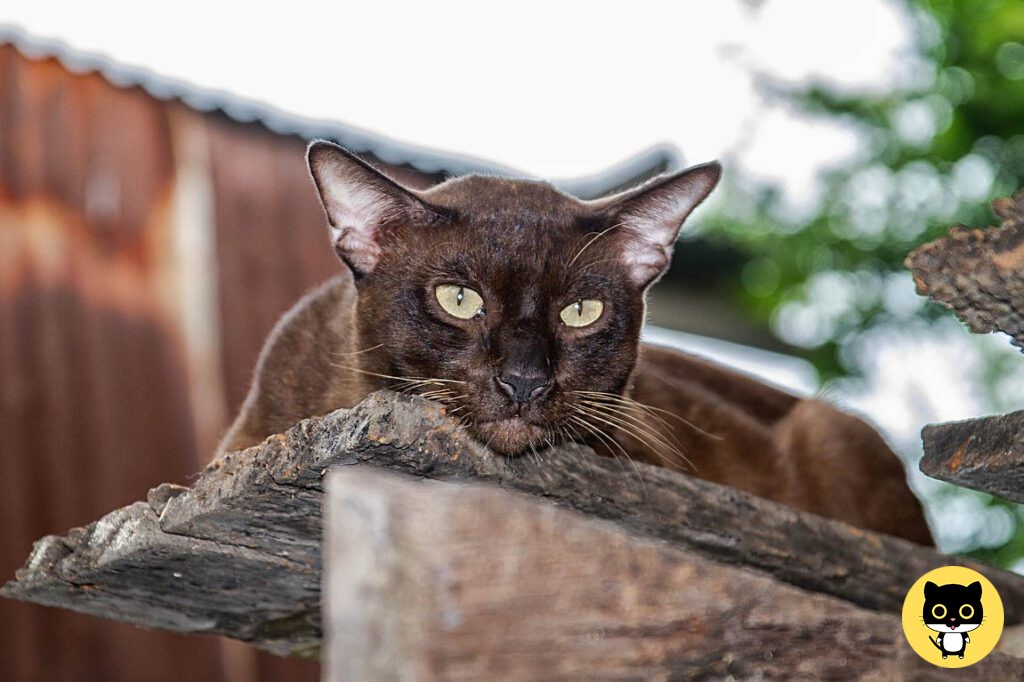
The Havana Brown is best understood as a socially involved, shorthaired companion rather than a decorative cat that happens to have an unusual coat. It tends to notice what people are doing, investigate its surroundings and turn ordinary household life into an opportunity for play or contact. Grooming is relatively straightforward, but the more important daily commitment is participation: interactive attention, safe places to climb and observe, and a predictable relationship with its caregiver.
Quick Facts
| Quick fact | Havana Brown |
|---|---|
| Typical type | Medium-sized, muscular and semi-foreign, with a slender outline |
| Adult profile weights | Females approximately 6–8 lb (2.7–3.6 kg); males 8–10 lb (3.6–4.5 kg) |
| Coat | Short, smooth, soft and glossy |
| Commonly described temperament | Curious, playful, people-oriented and moderately active |
| Published longevity estimates | Approximately 8–13+ years, 13–17 years or 15–20 years, depending on the source |
| U.S. breeder asking-price example | $500–$1,500 per kitten in a PetMD profile updated August 21, 2023 |
Identity, recognition and the name
The name does not identify one universally identical cat in every country. In North American registry usage, CFA uses Havana Brown, while TICA uses Havana. British usage may use “Havana” for a brown Oriental Shorthair, so a brown cat advertised under that name may not correspond to the North American breed.
CFA recognizes the Havana Brown as a championship breed, with championship status effective July 1, 1964. TICA recognizes Havana in chocolate and lilac categories. The breed was not listed on the FIFe recognized-breeds page checked October 1, 2026. These differences matter when comparing advertisements, pedigrees or breed descriptions across countries.
A solid chocolate-colored coat is an introduction to the possibility, not proof of identity. A prospective buyer should ask which registry category applies, review the pedigree and registration records, and have the breeder explain any permitted breeding arrangements or outcrossing. Coat color by itself cannot authenticate a pedigreed Havana Brown.
Appearance and coat variations
The North American Havana is a medium-sized, muscular, semi-foreign cat: substantial without looking stocky, with relatively long legs and a slender tail. Its head is longer than it is wide, with large ears that tilt forward, a pronounced whisker break and an almost-square muzzle. The overall effect is alert and refined rather than round-faced or heavily built.
The classic appearance is a solid, even warm or mahogany-brown coat paired with rich green eyes. The recognized color range is not identical everywhere, however. Chocolate and lilac categories are accepted under TICA’s Havana standard, and eye color may continue developing until about one year of age. Lilac cats may also carry a somewhat fuller coat. A reader comparing photographs should therefore check which standard or registry category the photograph represents rather than assuming every accepted Havana must look exactly the same.
The coat feels short, smooth, soft and glossy. CFA describes it as lacking an apparent undercoat, which helps explain why it is usually less demanding than a long or woolly coat. It is still a real cat coat: loose hair can appear on clothing and furniture, especially during periods of increased shedding. Occasional brushing is generally practical, with more frequent combing if hair accumulates or the individual develops tangles.
The Havana Brown is not established as hypoallergenic. A sleek coat or modest visible shedding does not demonstrate lower allergen production. In an allergic household, spending time with the particular cat before committing is more useful than relying on the breed name.
Temperament and everyday companionship
Curiosity is one of the breed’s most useful defining ideas. A Havana may want to inspect a new object, follow household activity, investigate a person’s hands or turn a quiet room into a small expedition. Interactive toys, food puzzles, scratching surfaces, elevated observation points and vertical territory give that curiosity somewhere safe to go.
Moderate activity does not mean a fixed exercise requirement or a need for constant entertainment. It does mean that a home with little opportunity for play or exploration may feel unstimulating. Short, regular sessions with wand toys, retrieving games or treat puzzles can fit more naturally into life with this cat than expecting it to exercise independently. Some individuals may also enjoy positive-reinforcement training, fetch or carefully introduced harness work.
People-oriented behavior can take several forms. One cat may seek a lap; another may follow a caregiver from room to room, sit within reach, sleep beside someone or make frequent paw contact without wanting prolonged holding. “Affectionate” should therefore be read as social involvement, not as a guarantee of constant cuddling. Meeting an adult cat is the best way to assess its actual lap preference, handling tolerance and response to unfamiliar people.
Vocal behavior is often described as soft, chirpy or trilling, but individual volume can differ substantially. One owner described an attentive, playful Havana that demanded affection and meowed unusually loudly. That experience does not overturn the general description; it gives a prospective caregiver a useful warning not to treat “soft-voiced” as a promise of silence.
A socially engaged cat may also need help managing change. The history of an individual cat matters especially when it has experienced bereavement, isolation or repeated moves. Familiar bedding, a quiet retreat, predictable routines and gradual access to the rest of the home can make a transition easier. Sociability should not be confused with emotional invulnerability, and a breed reputation should not replace attention to the cat’s actual history.
Children, dogs, cats and small pets
A Havana Brown may live successfully with respectful children, other cats or a cat-safe dog, but compatibility is created through introductions rather than guaranteed by breed. Give each animal separate food, water, litter and resting resources at first. Use scent exchange, barriers and short supervised meetings, and provide escape routes so the cat can leave an interaction without being cornered.
A friendly response to a dog does not establish safety around prey animals. No Havana-specific hunting profile has been established, so birds, rodents, reptiles and other small animals should be protected by secure physical separation. A cat can be affectionate with people and relaxed around a dog while still posing a serious risk to a smaller animal.
Care, feeding and home life
Routine care is usually more important than a specialized Havana Brown regimen. Feed a complete and balanced diet, portion food sensibly, monitor body condition and arrange ordinary veterinary examinations. Dental care, parasite prevention and prompt attention to changes in appetite, weight, mobility, grooming or behavior are appropriate parts of responsible ownership.
No distinctive Havana-specific nutritional or dental routine has been established. The adult weight figures often published for the breed—approximately 6–8 pounds for females and 8–10 pounds for males—are profile ranges, not feeding targets or health thresholds. A muscular cat can be healthy outside a quoted range, while a cat within the range can still carry too much body fat.
Indoor living with enrichment, supervised outdoor access or a suitable enclosure is preferable to assuming that a pedigreed cat should free-roam. A secure indoor environment also makes it easier to control exposure to traffic, infectious disease, parasites and territorial conflict. No special Havana-specific climate or outdoor-survival requirement has been established.
Health, records and longevity
No well-established Havana Brown-specific disease predisposition was verified. That is not the same as proof that the breed is free of inherited disease, nor does it remove the ordinary health responsibilities that apply to every cat.
A genetic study found a frequent ARSB variant described as an MPS VI modifier in sampled Havana Browns, while the severe disease-associated variant was scarce and absent from that sample. This finding should not be inflated into a claim that MPS VI is common in the breed. It is a reason to value transparent breeding records and accurate interpretation of genetic information, not a reason to assume that every Havana carries or develops the disease.
When acquiring a pedigreed kitten or adult, request the pedigree and registration records, veterinary records, and health histories for the parents and close relatives. Ask which tests were actually performed and for copies or clear explanations of the results. No mandatory Havana-specific testing panel was verified, so a breeder’s general promise of “health tested” is less useful than knowing the tests, dates and animals involved.
Longevity figures are estimates rather than a population life expectancy. Published profiles give approximately 8–13-plus years, 13–17 years or 15–20 years, depending on the source. Differences of that size are a reminder to treat lifespan as a planning range, not a guarantee for an individual cat. Preventive care, inherited factors, nutrition, environment and chance all influence how long a particular Havana lives.
Finding and budgeting for a Havana Brown
Availability can be limited and highly regional. A prospective caregiver may need to contact breeders outside the immediate area, join a waiting list or budget for transport. CFA provides a breeder-finder service, but a listing does not replace verification of records, conditions or the identity of the advertised cat.
A PetMD profile updated August 21, 2023, gave a U.S. breeder asking-price example of $500–$1,500 per kitten. This is a dated regional example, not a current national market price, and it should not be confused with an adoption fee. Transport, registration, veterinary care and waiting-list arrangements may add substantially to the cost.
Before paying a scarce-breed price, compare the advertisement with the documentation. Confirm whether the cat is registered as Havana Brown or Havana, check that the pedigree belongs to the kitten being offered, and ask how the breeder distinguishes the cat from an unrelated brown-coated cat. A careful transaction may take longer, but the paperwork is more informative than color alone.
Is the Havana Brown a good fit?
The strongest match is a caregiver who wants an interactive companion and is willing to provide daily opportunities for play, investigation and contact. The breed’s short coat can make grooming manageable, but easy coat care should not be mistaken for a hands-off lifestyle. A caregiver seeking a cat that is present in household life, notices people and participates in routines may find the Havana especially rewarding.
A first-time cat owner can also be a reasonable match. No special expertise has been established as necessary, provided the caregiver is prepared to learn feline body language, use gradual introductions and create a home with safe retreats, scratching options and vertical space. The less suitable match is someone wanting a reliably quiet, guaranteed lap-oriented, hypoallergenic or entirely independent cat.
The most useful decision is therefore personal rather than categorical: can you support a cat that may want your attention in different ways, from nearby companionship to active play or persistent vocal contact? If possible, meet the actual adult or visit the breeding environment. That encounter can reveal more about the individual’s sociability, vocal intensity, comfort with handling and response to strangers than a breed label can.
What owners and caregivers say
Owners and caregivers describe Havana Browns as rewarding because the relationship feels active. A breeder describes cats that seek laps or nearby human presence, sometimes play fetch and dislike being left without companionship. These are useful examples of the breed’s social image, but they are not a promise that every Havana will want the same amount or style of contact.
An owner who lived with a Havana described an attentive, playful cat that strongly demanded affection but also meowed much more loudly than the usual soft or trilling description suggests. The practical lesson is to ask about the individual’s voice and habits rather than assuming that a profile adjective predicts volume.
A rescue caregiver’s account of Hershey, a two-year-old Havana Brown, shows a different aspect of social attachment. After his owner died, prolonged isolation and repeated placement changes reportedly left him highly stressed. Once settled in a test home, he formed a close friendship with a resident Rottweiler. That story does not establish that Havana Browns are generally fragile or unable to cope alone. It does suggest that a socially capable cat may still need stability, a careful transition and time to recover from major disruption.
Taken together, these experiences point to interactive companionship rather than a universal “Velcro cat.” Paw-based investigation, physical closeness, attention seeking, variable lap use and variable vocal intensity can all fit within life with the breed. The best preparation is not expecting one fixed personality, but making room for contact, play, retreat and the individual preferences of the cat in front of you.
Sources for key details
Recognition and standards: CFA Havana Brown breed profile, TICA Havana breed profile and FIFe recognized breeds.
Health and care context: PetMD Havana Brown profile, genetic study of the ARSB variant and VCA breed overview.
Individual experiences: Pet Connect Rescue’s account of Hershey and Mokolea’s breeder information.
 English