
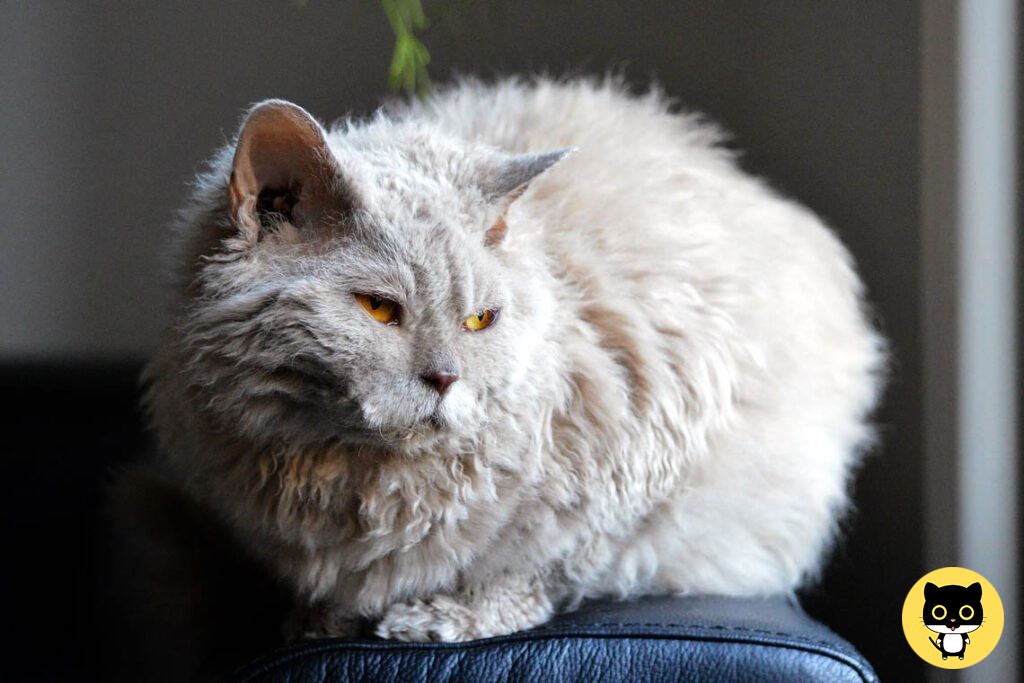
The Lambkin is appealing because it combines two conspicuous features: shortened legs and a coat that may be wavy or curly. Those traits also shape the practical responsibility of living with one. A Lambkin is not simply a small cat with an unusual silhouette; its home, body condition, grooming routine and movement deserve closer observation than a breed label alone can provide.
Quick Facts
| Type | Munchkin–Selkirk Rex-derived cat type |
|---|---|
| Coat | Short or long; straight, wavy or curly textures may occur |
| Legs | Shortened, with individual variation in proportions and mobility |
| Recognition | Limited and registry-dependent; not currently presented as a fully recognized championship breed by TICA, CFA or FIFe |
| Best suited to | A caregiver willing to adapt the home and monitor coat, weight, movement and grooming access |
What the Lambkin is
The Lambkin is generally understood as a Munchkin–Selkirk Rex-derived cat type. The Munchkin side explains the shortened limbs, while the Selkirk Rex connection explains why some Lambkins have a curly or wavy coat. That background matters because related names are not automatically interchangeable. Nanus Rex, Lambkin Dwarf, Minuet and Napoleon may overlap in breeding history or appearance, but a name alone does not establish the same pedigree or registry identity. A buyer should ask which cats are behind the individual kitten and how the breeder or registry defines the name being used.
Recognition is limited and has changed over time. Historical material from TICA listed the Lambkin as experimental, while TICA’s 2025 annual meeting minutes recorded the termination of that experimental status. The current breed listings checked for TICA, CFA and FIFe do not present the Lambkin as a fully recognized championship breed. This does not determine whether an individual cat can be a good companion, but it does mean that terms such as “official,” “rare” or “registered” need to be tied to a particular organization and documented pedigree.
Appearance and coat variation
The typical Lambkin has a low-slung, moderate-bodied appearance created by shortened legs rather than by a reliably established miniature body size. Individual cats can differ in head shape, ear set, tail and overall proportions. There is no dependable adult male or female weight range, height range or fixed maturation schedule that should replace ordinary assessment of body condition and veterinary health.
The coat is one of the breed type’s most variable features. Lambkins may be shorthaired or longhaired, and the texture may range from loosely wavy to tightly curly or only subtly textured. The breed standard consulted allows all colors and patterns. It describes eye color as independent of coat color, with clear and intense colors rather than a single eye shade required across the breed. These are allowances of that particular standard, not a universal chart shared by every registry or breeder.
A curly or light-feeling coat should not be mistaken for a low-maintenance coat. Hair can remain caught in curls, and longer or denser coats can tangle, especially in areas the cat cannot easily reach. Inspect the coat regularly and comb according to what you find. A cat that stays comfortable with occasional combing may need much less help than one with a dense long coat, but neither curl nor fine texture makes the cat allergy-safe or guarantees little hair around the home. The Lambkin breed standard is useful for understanding the range of accepted appearance, while the individual cat should determine the grooming plan.
Short legs and everyday welfare
Shortened limbs are not merely a cosmetic detail when planning a home. They may affect how easily a cat jumps, climbs, reaches food and water, uses a litter tray, grooms difficult areas or escapes from a threat. These possibilities do not prove that every Lambkin is painful, immobile or unable to climb. They do mean that essential activities should not depend on repeated high jumps or difficult stretches.
Place litter, food and water where the cat can reach them comfortably. Stable trays with an accessible entry, low or intermediate resting places, reachable scratching surfaces and ramps or steps can make a home easier to use. A secure enclosure or supervised outdoor access is more defensible than free roaming: a low-slung cat may be at a disadvantage around traffic, fences, predators and other escape hazards. An indoor home does not need to be large if its important resources are easy to reach and distributed so that the cat is not forced into constant competition or climbing.
Body condition deserves particular attention. Keeping a Lambkin lean reduces unnecessary mechanical demand on shortened limbs and may make movement and grooming easier. Rather than accepting stiffness, reluctance to jump, reduced play, altered grooming, difficulty reaching resources or a change in gait as “just the breed,” arrange a veterinary assessment. The welfare concerns associated with dwarf-cat conformation are real enough to justify practical precautions, but the severity and frequency of specific problems have not been established for Lambkins as a population. Observation of the actual cat is therefore more useful than either blanket reassurance or a diagnosis based on appearance alone. The welfare review of current and emerging feline breeding practices provides relevant context for that cautious approach.
Temperament and life with a Lambkin
A Lambkin may be an engaging companion, but its label cannot reliably predict whether it will be quiet, talkative, highly playful, cuddly or independent. Descriptions of activity, curiosity, sociability and adaptability vary, and there is no representative behavioral study establishing a typical Lambkin personality. Offer ordinary feline enrichment—prey-like toys, scratching, hiding places, food puzzles and opportunities to choose contact—then let the individual cat show how much activity and interaction it wants.
Accessibility should shape play rather than eliminate it. Floor-level toys, short chase games, sturdy low platforms and ramps can provide interest without making every activity a test of jumping ability. Watch whether the cat moves freely between play, rest, food and litter areas. A cat that is affectionate but avoids certain routes may be communicating a physical difficulty rather than a preference for inactivity.
Families can sometimes make a successful match, but there is no breed-wide guarantee around children, dogs or other cats. Socialization, the resident animals’ behavior, the introduction process and the availability of separate resources matter more than the Lambkin name. Use gradual introductions, provide escape spaces and supervise interactions with children and dogs. A breeder’s report that kittens were raised around English bulldogs is evidence about that particular socialization setting, not proof that all Lambkins will welcome dogs.
Small pets require a separate judgment. Friendliness toward people or familiarity with dogs does not establish safety with birds, rodents, reptiles or other prey-sized animals. Secure separation is the responsible default.
Grooming and routine care
Coat care should be based on tangling, density, length and the cat’s tolerance rather than on a fixed promise about the breed. Run your hands through the coat and inspect the armpits, belly, behind the ears and around the hindquarters. A long or dense coat may need frequent assistance, while a shorter coat may be manageable with less intervention. Begin gently and pair combing with rewards so that care remains a cooperative routine where possible.
Self-grooming is worth observing alongside coat appearance. A cat that cannot comfortably reach part of its body may develop mats, debris or skin irritation. A sudden decline in grooming, new hairballs, vomiting, constipation or a coat that becomes greasy or clumped warrants veterinary advice. Hairballs in one adult should not be treated as evidence of a Lambkin-wide tendency or automatically attributed to a particular food.
Routine feline care remains important: balanced nutrition, weight monitoring, dental care, parasite prevention and regular veterinary examinations. No Lambkin-specific recurring-cost estimate has been established, and the extra expense of care will vary with coat type, veterinary needs and the adaptations a particular home requires.
Health questions and responsible acquisition
There is no established Lambkin-specific epidemiological health profile, validated screening panel or measured longevity dataset. That absence should not be turned into either a claim of exceptional health or a list of confirmed breed-wide diseases. It does, however, make careful questions especially valuable.
Ask to see veterinary records, vaccination information, the parents’ identities and any available family history. Discuss mobility, joints, spinal health, grooming access and body condition. Because Selkirk Rex lines may include Persian-related ancestry, it is reasonable to ask whether documented parentage makes PKD1 testing relevant, and to ask about cardiac screening information and other health records in the family. These are due-diligence questions, not proof that every Lambkin has polycystic kidney disease, heart disease or an orthopedic disorder. Selkirk Rex-specific testing information is available through the UC Davis Veterinary Genetics Laboratory.
Meet the adult cats when possible, not only the most appealing kitten. Look at how they walk, turn, climb, groom and respond to handling. Ask whether the parents tolerate combing, how they use litter trays and whether any have shown stiffness or difficulty reaching resources. A direct assessment cannot predict every future health outcome, but it can reveal whether a breeder is open about the practical consequences of the type being produced.
Price, availability and longevity
Availability appears limited, but no representative population count, regional breeder survey or reliable waiting-list measure establishes how rare Lambkins are. Marketing language should not substitute for identity or welfare information. Verify the actual location of the cat, parentage, registration claims, health records, contract terms and local rules governing breeding, sale or import.
One United States asking example checked on October 2, 2026, listed Lambkin/Minuet/Munchkin kittens in Albion, Michigan at USD 1,600. This was an asking price rather than a confirmed sale, and it did not establish a universal pure-Lambkin price, pedigree, sex, breeding status or transport costs. The dated listing is best understood as one regional example, not a market range.
Lifespan figures for Lambkins remain estimates rather than measured breed statistics. Ranges such as 12–15 years or 13–17 years are sometimes quoted, but they should not be presented as expected survival for the breed. Genetics, conformation, weight, veterinary care and environment will influence the individual. A caregiver should plan for a normal long-term feline commitment while accepting that the evidence does not support a precise Lambkin life-expectancy figure.
Is a Lambkin right for you?
A Lambkin may suit someone who is drawn to an unusual appearance and is prepared to pay attention to the cat behind it. The commitment is not necessarily intensive every day, but it is observation-heavy: keep the cat lean, make resources accessible, inspect the coat, notice changes in movement and arrange veterinary help when grooming or mobility changes.
The breed is a less suitable choice for someone seeking predictable temperament, a guaranteed low-shedding coat, a fixed adult size or a cat whose short legs require no environmental consideration. It is also a poor fit when a seller relies on rarity and cuteness while avoiding questions about parentage, health records, breeding rationale or the parents’ movement.
The most responsible decision is conditional rather than absolute. A healthy individual with comfortable movement, a manageable coat and a well-adapted home may be a rewarding companion. The responsible caregiver should make that judgment from the actual cat and its documentation—not from the Lambkin name, a promised personality or a single price claim.
What owners and caregivers say
Owners’ experiences make the individual variation especially clear. One caregiver who adopted a nearly six-year-old longhaired female described hairballs that had initially occurred about monthly, then appeared weekly for three weeks after a food change and the addition of wet food. The caregiver was brushing her daily or nearly daily when she tolerated it and was appropriately considering whether veterinary evaluation was needed. This is a useful reminder that coat maintenance and digestive concerns can become practical issues in an adult home, but it does not establish a Lambkin-wide hairball pattern or prove that the diet caused the change.
Another owner described a Lambkin named Ripley as the only cat in a group willing to lie still long enough to receive affection. That account offers a pleasant possibility: an individual Lambkin may be unusually still, tolerant and easy to handle. It cannot establish that Lambkins generally prefer laps or remain comfortable with all forms of handling. A meeting with the adult cat remains the better way to assess affection, restraint tolerance and communication style.
Reports of successful contact with other animals should be read in the same individual way. A breeder’s listing described kittens raised around English bulldogs, which may indicate a useful early socialization environment. It does not guarantee that every Lambkin will enjoy living with dogs, and it says nothing about safety with small prey animals. Gradual introductions, separate resources and supervised contact remain necessary.
Taken together, these experiences support a practical expectation rather than a breed stereotype: the Lambkin may be affectionate, manageable and adaptable, but the caregiver must discover how that particular cat moves, grooms, communicates and copes with household life.
 English