
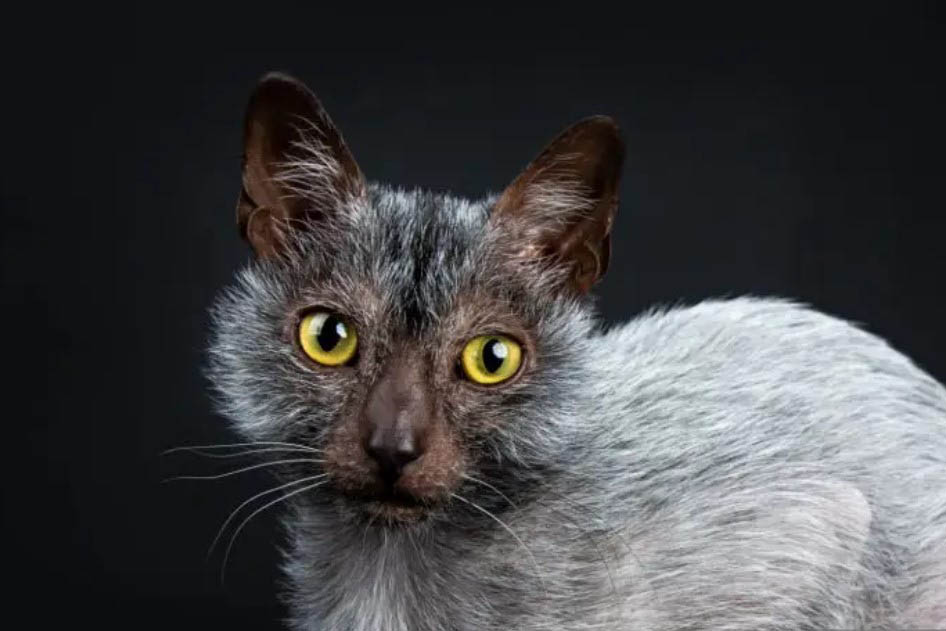
The Lykoi is a domestic cat with an appearance that can look almost otherworldly: a narrow, expressive face, large ears, a partially bare coat and a roaned mixture of pale and pigmented hairs. That unusual look is not the result of wild-cat ancestry, Sphynx breeding or a Rex coat mutation. The breed developed from naturally occurring sparse-coat mutations followed by controlled breeding and outcrossing. A small dermatology study also found that the examined Lykoi did not carry the known rexoid variants associated with the Sphynx, Devon Rex and Cornish Rex.
Quick Facts
| Quick fact | What it means in daily life |
|---|---|
| Size | Approximately 6–9 lb (2.7–4.1 kg) for females and 7–12 lb (3.2–5.4 kg) for males; condition and muscle matter more than a target number. |
| Coat | Short, sparse and partially hairless, with little or no undercoat and a roaned mixture of pigmented and unpigmented hairs. |
| Activity | Curious, playful and prey-oriented; interactive enrichment is usually more suitable than a passive environment. |
| Outdoor life | Unrestricted outdoor access is a poor default, particularly during near-bald phases. |
| Longevity | Published estimates range from about 12–15 years to “well into the late teens”; these are estimates, not validated life-expectancy figures. |
The important practical question is not whether a Lykoi is “hairless.” It is not. The more useful question is how comfortable a caregiver is with a coat that can change, shed and require observation. A Lykoi can be a rewarding, highly involved companion, but its unusual appearance should not be mistaken for effortless care or guaranteed good health.
Identity and recognition
Recognition depends on the registry being considered. The Cat Fanciers’ Association and The International Cat Association present the Lykoi as a championship-recognized breed, while FIFe lists it as a preliminary recognised breed in Category 4 for the 2023–2027 period. That distinction matters to someone showing or registering a cat: a breed can have an established identity while still having different eligibility, classification or breeding rules in different systems.
Standards also use somewhat different terminology for parts of the body and coat. A prospective buyer should therefore ask which registry’s rules apply to a particular pedigree, especially if show eligibility matters. Accepted colors, patterns, longhair treatment and eye-color requirements should be checked against that registry’s current standard rather than inferred from photographs or from another organization’s rules. The [TICA breed standard](https://tica.org/breed/lykoi/) and [FIFe preliminary standard](https://fifeweb.org/app/uploads/2023/10/PRELIM.pdf) illustrate why those details should be treated separately from the broader description of the breed.
What the Lykoi looks like
The Lykoi has a lean, muscular, medium-boned body rather than a fragile one. Its head is wedge-shaped, the ears are large and set high, the legs are medium in length and the tail tapers. The face has a characteristic sparse mask, with reduced hair around areas such as the eyes, nose and muzzle. The overall impression is angular and alert, but the cat should still have useful muscle and a sound body condition.
The coat creates the breed’s most recognizable feature. Short hairs are mixed with unpigmented hairs to produce a roaned effect, and the sparse coverage reveals portions of the skin. There is little or no undercoat. Black roan is the principal show presentation in CFA and TICA, while other color, pattern and longhair provisions depend on the registry and category.
Coverage is not fixed. A Lykoi may move from a fairly well-coated stage to a dramatically sparse or nearly hairless stage during molt and regrowth, then grow back more coverage. Some individuals retain substantial coat, and one owner described a Lykoi that had never completely molted. This variation is one reason a single photograph—or a kitten seen at one point in its cycle—cannot fully predict the adult coat.
A coat that feels light can still leave hair around the home. Owners have described shedding during both ordinary and dramatic molts, sometimes finding the change alarming because it resembles acquired hair loss. A normal coat cycle should not be used to explain away itching, pain, redness, crusting, discharge or persistent worsening. Those signs require veterinary assessment.
Living with the coat
Grooming is usually flexible rather than elaborate. Gentle brushing or combing a few times a week is a reasonable starting point, but the right routine depends on how much hair the individual currently has, whether it tangles, how oily the skin becomes and how well the cat accepts handling. Sparse hair does not prevent oil, debris or localized tangles. Some caregivers also pay attention to nail beds, where debris can accumulate.
Bathing should be occasional and purposeful rather than automatic. A cat with noticeable oiliness or debris may need advice about a suitable feline product and frequency, while frequent unnecessary bathing can create its own skin problems. Persistent comedones, papules, cyst-like changes or crusting deserve a veterinarian’s opinion instead of a home-care experiment.
Temperature and sunlight become more important when the coat thins. A Lykoi needs warm resting options during a near-bald phase, along with shade and protection from intense heat and prolonged direct sun. A secure enclosure or supervised outdoor arrangement is more sensible than free roaming, both because exposed skin has fewer natural protections and because ordinary outdoor dangers remain unchanged.
Allergy expectations also need to be realistic. Sparse hair does not establish lower allergen exposure, and the breed should not be treated as hypoallergenic. Someone with allergies should spend time with the particular cat, ideally more than once, and judge their own response rather than relying on the breed label.
Skin and general health
The Lykoi’s unusual coat reflects differences in follicles and skin structures, so skin observation is part of responsible ownership. Small veterinary studies have documented follicle and coat-structure differences and have reported an emerging cutaneous adnexal polycystic syndrome involving findings such as papules, comedones and cystic changes. These findings justify informed questions and attentive monitoring; they do not show that every Lykoi will develop skin disease or that the breed has a uniformly poor prognosis.
Look for changes rather than trying to memorize a particular “normal” appearance. A bald phase may be ordinary for one cat, while a new bald patch accompanied by itching, pain, redness, crusting or discharge may signal a separate problem. Veterinary examination is especially important when a change is localized, persistent or worsening.
There is no established universal Lykoi screening panel or breed-specific diet that replaces ordinary feline healthcare. A sound diet should be chosen with the cat’s age, condition and veterinarian’s advice in mind. Routine preventive care, parasite control, dental care and weight monitoring remain relevant even when the coat attracts most of the attention.
Reported longevity is best treated as an estimate. TICA says Lykoi may live well into their late teens, while secondary care material gives an estimate of 12–15 years. Neither figure guarantees an individual outcome, particularly in a developing breed with limited long-term population data.
Temperament and household fit
Curiosity is central to the Lykoi experience. Breed descriptions and caregiver observations commonly emphasize stalking, pouncing, object-focused play, problem-solving and close interest in familiar people. A home with climbing options, vertical resting places, puzzle feeders, safe exploration and daily interactive play is more likely to meet this cat’s needs than a home expecting it to entertain itself quietly.
People-oriented behavior does not necessarily mean lap-oriented behavior. A Lykoi may follow a person from room to room, supervise household activity and seek frequent interaction while resisting prolonged carrying or restraint. Other individuals may be notably cuddly or vocal. These are compatible experiences: affection can appear as proximity and involvement rather than stillness.
That distinction matters for grooming and veterinary care. Someone who wants a cat that readily tolerates being held should assess the individual adult rather than assume that a social breed will enjoy restraint. Meeting an adult can reveal lap preference, handling tolerance, sociability and reactions to household activity more reliably than a general breed description.
Prey-style play also affects introductions. Birds, rodents, reptiles and other small pets require secure separation, because an affectionate relationship with people does not remove hunting behavior. Children, dogs and unfamiliar cats may be compatible in some homes and stressful in others. Supervision, escape routes, gradual introductions and separate food, water, litter and resting resources are more useful than assuming that breed identity guarantees harmony.
Buying, adopting and availability
Availability appears to depend heavily on region, and there is no honest universal Lykoi price to quote from the available dated evidence. No qualifying, dated regional examples of breeder asking prices, sale prices or adoption fees were verified here. A current figure should therefore be obtained directly from breeders or rescues and stated with its currency, location, date and whether it is an asking price, completed sale price or adoption fee. Transport, import paperwork, registration and veterinary costs can materially change the total.
Scarcity claims also deserve caution. Instead of treating the breed as a novelty purchase, contact recognized breeder resources, ask about waiting lists and clarify whether a kitten is being sold for companionship, breeding or showing. The relevant registry may affect pedigree documentation and show eligibility, but it does not by itself establish the health of an individual cat.
A careful breeder conversation should include vaccination and parasite records, pedigree information, the parents’ and relatives’ skin history, previous comedones or cysts, coat-cycle history and any available genetic or veterinary documentation. Ask to see current photographs or the cat itself in good light. If the coat is currently sparse, ask how it has changed across previous molts rather than assuming that the present appearance will remain.
Is the Lykoi a good match?
The Lykoi suits a caregiver who enjoys an active, involved cat and is prepared for visible variation. This is a companion for someone willing to provide play, observe the skin, adjust grooming as the coat changes and manage temperature, sunlight and introductions thoughtfully. The breed may be especially satisfying for a household that values a cat’s personality and engagement as much as its unusual appearance.
It is a less suitable choice for someone seeking a reliably low-shedding, hypoallergenic or maintenance-free cat, or for someone uncomfortable with uncertain coat changes and the possibility of dermatology costs. The central commitment is not constant medical treatment; it is attentiveness. A Lykoi’s care burden may be modest at one stage and more involved at another, which makes the cat’s history, family background and current condition important parts of the decision.
What owners and caregivers say
Owners and caregivers describe affection through following, proximity and intense involvement, as well as through more conventional cuddling. One account of an adult Lykoi emphasized substantial coat coverage and no major skin problems while still mentioning nail-bed cleaning, darkening of the belly after prolonged heating-pad contact and concern about sun exposure. Other caregivers describe cats that are vocal, especially cuddly or constantly interested in what their people are doing.
Coat experiences vary just as sharply. Some caregivers have seen dramatic near-bald molts, while others report that their cats never completely lose their coat. Shedding can continue even when the cat looks almost hairless, so the breed’s appearance does not predict a hair-free home. The practical lesson is to ask about the individual’s coat history and to learn the difference between that cat’s usual cycle and a genuinely abnormal change.
Skin observations range from oiliness and nail-bed debris to blackhead-like marks and cyst-like concerns. Some changes have been watched at home; others have prompted veterinary attention. That range does not make every dark spot alarming, but it does make dismissal unwise when a change is painful, itchy, inflamed, persistent or accompanied by discharge.
Overall, the Lykoi is best understood as a distinctive domestic cat whose sparse coat creates variable rather than automatically extreme care. The right caregiver is not someone expecting a miniature werewolf with no grooming or shedding, but someone ready to enjoy an investigative, people-focused companion while allowing the individual cat’s coat, skin and boundaries to guide daily care.
 English