
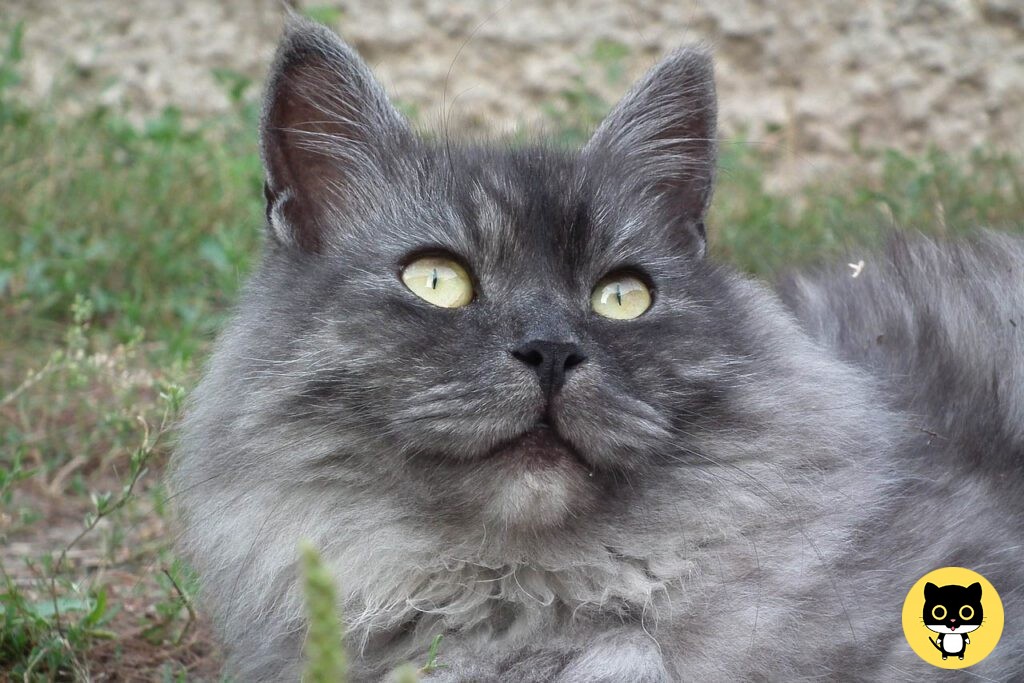
The Nebelung is a cat for someone who likes quiet companionship with a little mystery attached. Its blue, misty-looking coat is memorable, but appearance is only the beginning of the decision. Living successfully with one may involve waiting for trust, learning how that particular cat accepts handling, and treating grooming as a relationship rather than a quick maintenance task.
Quick Facts
| Origin and type | Modern blue, semi-longhaired breed related to the Russian Blue |
|---|---|
| Typical adult size | Approximately 8–16 lb (3.6–7.3 kg), with males generally heavier |
| Coat | Dense, silky, medium-length blue coat with lighter or silver-tipped guard hairs |
| Eyes | Yellowish-green through green |
| Estimated lifespan | Published estimates commonly fall around 11–18 years |
| Daily life | Playful and intelligent, often reserved with unfamiliar people and devoted to familiar caregivers |
What the Nebelung is—and what it is not
The Nebelung is a modern blue, semi-longhaired breed closely related to the Russian Blue, but it is not simply a longhaired Russian Blue. Its development is traced to foundation cats named Siegfried and Brunhilde, and TICA records championship recognition for the breed in 1997. The name refers to a mist-like quality that suits its soft, silvered coat.
Recognition is not the same everywhere. TICA lists the Nebelung as a championship breed. FIFe places NEB non in a non-recognized category, and the current CFA recognized-breeds list does not include the Nebelung. A breeder’s registration claims therefore need to be checked against the specific registry being used, rather than treated as interchangeable evidence of status.
A gray, longhaired cat may resemble a Nebelung without being one. Breed identity depends on traceable pedigree or other reliable registration documentation, not on color and coat alone. This matters particularly when a rescue or advertisement describes any attractive blue domestic longhair as a Nebelung.
Appearance: a blue coat with specific details
The pedigreed Nebelung has a medium-sized, long-bodied, muscular build with a relatively refined, semi-foreign outline. Long limbs, a long plumed tail, relatively large ears and rounded paws with tufts contribute to the breed’s elegant appearance. An adult may look substantial because of its coat without being heavily built.
The accepted coat is solid blue, with lighter or silver-tipped guard hairs that can create the characteristic shimmering effect. The coat is dense, silky and medium in length on the body, while the tail carries more length and plume. Seasonal fullness and individual coat development can alter the impression considerably, and there is no precise breed-specific timetable that tells a caregiver exactly when a mature coat will arrive.
The desired eyes range from yellowish-green through green. White patches, tabby patterns, blue eyes and copper eyes are not supported as desired Nebelung features in the reviewed standard. Weight figures are similarly best used as orientation rather than a feeding target: an approximate adult range of 8–16 lb (3.6–7.3 kg) has been published, but muscle, body condition and veterinary assessment should guide diet decisions.
Temperament: close bonds without automatic compliance
Selective sociability is one of the most useful ways to understand the Nebelung. Many descriptions portray a cat that becomes deeply attached to familiar people while remaining cautious, hidden or slow to approach when visitors arrive. A Nebelung may follow its caregiver from room to room, chirp or trill, and settle nearby without wanting to be the center of attention.
Affection should not be confused with a guaranteed preference for laps or lifting. A cat can seek proximity while objecting to being picked up, restrained or brushed. That distinction has practical importance: the person imagining a quiet companion at their feet may be delighted, while someone wanting a reliably handleable lap cat may be disappointed. Meeting an adult cat is especially valuable because it can reveal whether that individual seeks lap contact, side-by-side companionship or mostly observation from a safe distance.
Strangers and young children may be harder for a reserved Nebelung than familiar adults. This does not make the breed unsuitable for a family, but it does make control over introductions important. The cat should have places to retreat, and children should be taught to wait for contact rather than pursue, corner or carry it. A calm home with predictable routines is generally a better fit than a constantly noisy or unpredictable one.
Playfulness remains part of the picture. Interactive wand play, retrieving games, food puzzles, climbing opportunities and elevated lookout points can give a Nebelung appropriate outlets for intelligence and energy. It may entertain itself for periods, but that should not be turned into a promise that long, regular absences are harmless. Companionship, play and observation of the individual cat’s behavior are more useful guides than a fixed “safe alone” number of hours.
Living with children, cats and dogs
Compatibility with other animals is individual rather than guaranteed by breed. Some caregivers describe Nebelungs that cuddle with dogs, groom them or play fetch, while other households have seen growling, swatting and avoidance. Similar variation appears with other cats: one Nebelung may form a close sleeping and grooming partnership with a companion, while another may be bullied, defensive or unable to share the home comfortably.
Introductions should therefore be slow and reversible. Use separate starting areas, scent exchange, controlled visual access and supervised meetings. Provide duplicate food, water, litter and resting resources, along with escape routes and high places. A second animal may eventually become a valued companion, but it should not be acquired on the assumption that every Nebelung needs or will welcome one.
Coat care is partly a handling question
A dense semi-long coat needs regular attention even though it feels silky and relatively light in the hand. A gentle steel-comb session about once a week is a reasonable starting point, with more frequent work if the individual coat tangles easily. The tail, chest, hindquarters and areas affected by friction deserve particular attention.
Visible hair around the home is plausible. Seasonal changes and the individual coat affect how much appears, and the breed’s shedding has not been quantified in a way that supports a precise expectation. A light-feeling coat can still leave hair on furniture and clothing, so “silky” should not be interpreted as “low-shed.”
The harder part may be cooperation. A cat that dislikes brushing can develop a chest or hindquarter mat despite a caregiver’s good intentions. Short sessions, rewards, a quiet setting and gradual handling practice can help, but not every cat will become an enthusiastic grooming partner. If a cat becomes highly distressed or severe mats develop, veterinary advice is preferable to forceful home restraint.
Nebelungs are not hypoallergenic. All cats produce Fel d 1, and visible shedding does not reliably predict allergen exposure. Someone with allergies should spend meaningful time with the individual cat and seek appropriate medical guidance before committing to adoption or purchase.
Health, veterinary care and longevity
There is no robust evidence establishing a distinctive Nebelung disease-prevalence pattern or a mandatory breed-specific genetic screening panel. That is a reason for measured care, not for assuming the breed is either unusually fragile or guaranteed healthy. Routine veterinary examinations, vaccination, parasite prevention, dental assessment and weight monitoring remain the foundation of care.
A breeder should be able to discuss the health history of the parents and provide clear records, contracts and identification information. For an adopted cat, the available veterinary history may be incomplete; that makes a prompt baseline examination especially useful. Good preventive care also helps distinguish an individual cat’s emerging needs from claims made in general breed marketing.
Published lifespan figures are estimates rather than a validated population life table. Different breed profiles place expected longevity at about 11–18 years, including a TICA-linked estimate of 11–16 or more years. Those numbers are useful for planning a long commitment, but they do not predict how long a particular cat will live.
Price, availability and verifying a Nebelung
Availability can be limited, particularly in the United States. Secondary sources have described few catteries and the possibility that a prospective buyer may need to consider import arrangements. A generic advertisement for a blue longhaired kitten is not evidence of scarcity, pedigree or authenticity.
A January 5, 2026 U.S.-oriented cost guide gave approximate breeder asking prices of $600–$1,200 USD and estimated adoption fees of $50–$300 USD. These are dated asking or fee examples, not verified completed-sale figures or dependable market averages. Pedigree level, veterinary records, transport, deposits, contracts and import expenses may change the total substantially.
Before paying a deposit, verify the breeder’s current registry information, the parentage, registration documents, vaccination and veterinary records, and the terms covering health, return and ownership. Seeing the kitten with its mother and littermates, or meeting an adult cat where possible, can reveal temperament and living conditions that photographs cannot. A rescue cat that resembles a Nebelung may be an excellent companion, but it should be described honestly as a domestic longhair unless its pedigree can be established.
Is the Nebelung a good fit?
The Nebelung may suit a caregiver who wants an intelligent, playful but often quiet companion and who appreciates trust that develops gradually. It can work in a small home if that home offers stable routines, retreat spaces, vertical territory and daily enrichment; square footage alone is less important than noise, predictability and resource management.
The less suitable home is one that expects immediate sociability, constant handling or effortless grooming. A prospective caregiver should assess two separate qualities: how the cat relates to people and how willingly it accepts care. Those traits may not match. A devoted cat may still resist brushing, travel or being picked up.
The most responsible choice is therefore based on the actual cat, reliable identity information and a realistic grooming plan—not on the silvered coat or a generalized promise of cuddliness. For a shy individual, patience and consent-based handling may produce a deeply rewarding relationship. For a household that cannot accommodate hiding, gradual introductions or ongoing coat work, the breed’s appearance may be more attractive than its daily requirements.
What owners and caregivers say
Caregivers often describe the Nebelung relationship as something that deepens with time. One person who adopted a seven-year-old shelter cat describes a shy, skittish and gentle animal that became highly affectionate and particularly attached to one person. That story gives useful shape to selective trust: a reserved beginning did not prevent a close bond, but the bond developed on the cat’s terms.
Other caregivers describe cats that follow family members, make trilling or chirping sounds, play fetch-like games and become intensely affectionate after a slow start. These behaviors can make daily life feel interactive without requiring the cat to be socially bold with everyone who enters the home.
Grooming stories highlight a different side of the same temperament. One adopter reports a cat that accepts affection mainly when she initiates it and resists brushing enough for a chest mat to form. Another describes a six-year-old female becoming extremely stressed by car travel and grooming, making even brief brushing difficult. These experiences do not establish a universal response, but they show why “affectionate” and “easy to handle” should be evaluated separately.
Relationships with other animals can be equally varied. In one home, a Nebelung and an adopted tabby became a bonded pair that groomed and slept together; the companion also appeared to help the Nebelung accept a dog that had previously been disliked. In another household, hissing, avoidance and bullying led caregivers to divide access between cats. The useful lesson is not that Nebelungs need a companion or reject one, but that history, introductions, space and individual preferences decide the outcome.
Accounts of dogs range from cuddling, mutual grooming and fetch to growling, swatting and avoidance. That range supports careful introductions and supervision rather than a breed-wide claim about dog compatibility. A caregiver choosing a Nebelung should be prepared to let the cat retreat, observe its signals and build trust gradually.
 English