
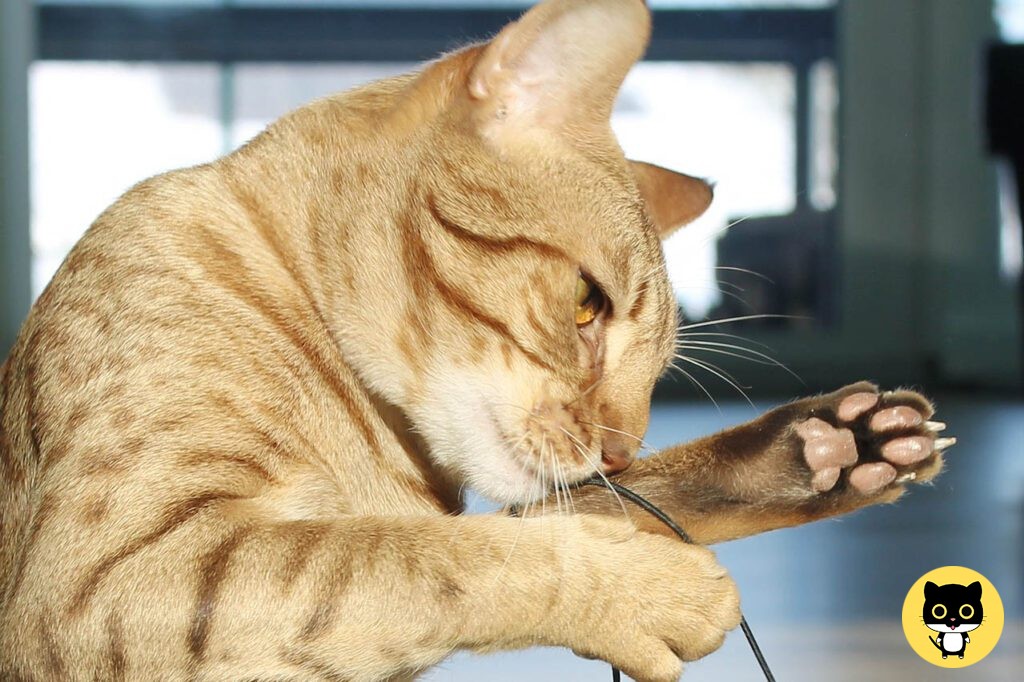
The Ocicat is a domestic cat with a wild-looking coat and an engaged, athletic way of living. Its spots resemble those of an ocelot, but the breed has no wild-cat ancestry. It was selectively developed from Abyssinian, Siamese and American Shorthair foundation lines, and it is distinct from both the Bengal and the Egyptian Mau despite their shared spotted appearance.
Quick Facts
| Feature | Typical description |
|---|---|
| Build | Medium to large, solid, muscular and lithe |
| Coat | Short, close, sleek and usually silky or dense, with a spotted tabby pattern |
| Recognized color families | Tawny, chocolate, cinnamon, blue, lavender, fawn and their silver versions |
| Mature profile | Approximately 9–14 lb (4.1–6.4 kg) for males and 6–9 lb (2.7–4.1 kg) for females |
| Activity level | High; climbing, interactive play and investigation are important parts of daily life |
Identity and recognition
The Ocicat is recognized for championship competition by the Cat Fanciers’ Association and The International Cat Association, while FIFe lists OCI as a fully recognized breed. The World Cat Federation publishes an Ocicat standard as well, although that document should not be assumed to establish the same current recognition status as the organizations that explicitly list the breed for competition. These distinctions matter mainly to pedigree buyers, exhibitors and breeders; for a companion home, the individual cat’s health, socialization and household fit matter more than the label alone.
The name can encourage mistaken assumptions. The spotted pattern is an intentional domestic-breed feature, not evidence of recent wild ancestry, unusual legal requirements or a temperament comparable to a wild species.
History and relationships to other spotted cats
The Ocicat’s history is a story of planned domestic breeding rather than conservation or hybridization with a wild cat. Its early foundation lines combined Abyssinian, Siamese and American Shorthair characteristics, producing a cat with a dramatic spotted appearance while retaining the domestic relationship expected of a companion animal.
The resemblance to other spotted breeds is therefore mostly visual. Bengals descend from Asian leopard cat hybrid programs, while Egyptian Maus have their own historical development and naturally occurring spotted pattern. An Ocicat’s appearance should not be used to predict either of those breeds’ ancestry, care requirements or temperament.
Appearance, coat and eye color
The Ocicat has a substantial but agile body. Its head is a modified wedge with a broad, slightly square muzzle; almond-shaped eyes, moderately large ears, medium-length legs and a tapering tail complete the balanced outline. The tail normally ends in a dark tip. A muscular frame should not be confused with heaviness: the breed is designed to look capable of movement, and body condition is more useful than trying to make an adult cat reach a published weight range.
The coat is short, close-lying and sleek, with banded hairs that contribute to the spotted tabby effect. Color families include tawny, chocolate, cinnamon, blue, lavender and fawn, each with a corresponding silver form. The number and wording of recognized varieties differ between registries; CFA, for example, lists 12 varieties. Someone buying for showing or breeding should check the relevant breed standard rather than assuming that every organization uses identical color terminology.
Eye-color rules also vary. CFA permits every eye color except blue and states that eye color does not correspond to coat color. The WCF standard likewise excludes blue but connects permitted eye colors with coat color. This is a registry question, not a reason to judge a companion cat’s quality. If pedigree registration or exhibition is important, ask the breeder which standard governs the cat and verify the details directly.
Temperament and everyday companionship
Energy is one of the Ocicat’s defining household characteristics. This is often an athletic, curious and playful cat that may leap onto high furniture, investigate changes in the home and turn ordinary objects into opportunities for movement. A caregiver should plan for activity rather than hope that the cat’s attractive coat will be the main feature of life together.
Social interest often appears as participation rather than constant cuddling. Ocicats may follow people from room to room, sleep nearby, fetch toys, tug at interactive games or supervise household activity. That closeness can be deeply affectionate without meaning that every individual wants to be carried or sit on a lap. The useful distinction is between wanting contact and wanting control over the form of that contact.
Handling preferences are individual. One cat may enjoy being picked up, while another prefers to remain beside a person or engage through toys. Meeting an adult cat is especially informative when possible; otherwise, detailed information about the parents, early socialization and the cat’s previous home can tell a prospective caregiver more about visitor response and handling comfort than the breed name can.
Trainability can make life with an Ocicat rewarding. Many are interested in reward-based learning, toy retrieval and simple household routines. Training should be cooperative rather than coercive, using food, play and praise to channel curiosity. An intelligent cat that receives too little appropriate activity may invent its own projects, such as opening cupboards, climbing inaccessible shelves or repeatedly demanding attention.
Home suitability and social needs
Home size is less important than what the home offers. An enriched apartment can suit an Ocicat if it contains sturdy vertical space, safe climbing routes, interactive play and places to investigate. Conversely, a large home can be unstimulating if the cat has little opportunity to move, forage or interact.
Daily play is practical equipment, not an optional extra. Wand toys, chase games, food puzzles, rotating toys and supervised foraging can help turn physical and mental energy into acceptable behavior. Tall cat furniture should be stable enough for a muscular, leaping cat, and windows, balconies and other elevated areas need appropriate safety measures.
A socially engaged Ocicat may not thrive with a household that is routinely empty for long periods, but there is no established breed-specific rule defining how many hours one can safely spend alone. Some cats protest separation, some settle with feline company and some become more comfortable after an adjustment period. Predictable routines, enrichment and—when personalities are compatible—another animal may help, but a second pet is not a guaranteed solution. The individual cat’s history and response should guide the decision.
Many Ocicats can live successfully with respectful children, compatible cats or cat-safe dogs. Gradual introductions, supervised interaction, separate food and toileting resources, and escape routes allow the cat to withdraw when needed. Small mammals, birds and reptiles require secure separation: an interested, prey-directed cat should not be assumed safe simply because it is friendly with people or other cats.
Secure outdoor access, such as a catio or carefully supervised harness time, can provide additional stimulation without requiring unrestricted roaming. Indoor living does not deprive an Ocicat of a suitable life when climbing, exploration, play and social contact are deliberately provided.
Grooming and routine care
Grooming is comparatively simple. Occasional use of a rubber brush or chamois, or roughly weekly brushing, can remove loose hair and keep the short coat looking polished. The coat may feel light and shed less conspicuously than a long-haired cat’s coat, but it can still leave hair on furniture and clothing. “Light shedder” does not mean non-shedding.
Companion Ocicats ordinarily do not need routine bathing. Regular feline care still includes nail checks, dental care, vaccinations and parasite prevention as advised by a veterinarian. There is no established special Ocicat routine for climate, skin, eyes or ears beyond ordinary preventive care.
The breed should not be marketed as hypoallergenic. Less visible hair does not demonstrate lower allergen exposure, so people with allergies should spend time with the actual cat and consider their own medical advice before committing.
Health questions and responsible acquisition
Health screening deserves more attention than the easy-care coat. CFA identifies hypertrophic cardiomyopathy, amyloidosis affecting the kidney or liver, and progressive retinal atrophy as concerns associated with Ocicats or their foundation lines. These concerns justify careful questions, not the conclusion that every Ocicat has a predictable disease risk.
Progressive retinal atrophy evidence needs particularly careful interpretation. A Finnish survey grouped Abyssinian, Ocicat and Somali cats when examining a PRA association, so its result cannot be converted into an Ocicat-only prevalence or risk percentage. A DNA result can be useful, but a negative result cannot exclude every relevant eye, kidney, liver or cardiac condition.
A prospective buyer should request the pedigree and veterinary records, ask about kidney, liver, heart and eye disease in close relatives, and obtain the exact PRA variant tested and the laboratory that performed the test. It is also reasonable to ask what cardiac or ophthalmic evaluations have been completed and to discuss the records with a veterinarian. Good documentation is more useful than broad assurances such as “the line is healthy.”
No authoritative Ocicat-specific lifespan estimate or population-based longevity range is established here. Individual longevity depends on genetics, preventive care, environment, nutrition, disease detection and chance, so a universal number should not be presented as a breed fact.
Price and availability
Availability is generally workable, although a particular sex, color or breeding may involve a wait. Regional supply, rescue fees and ongoing ownership costs vary too much to combine into one meaningful universal figure.
For a concrete but limited example, a Canadian breeder listing dated May 15, 2026, asked CA$2,500 for a registered Ocicat kitten. That is a Canadian asking price at a particular date, not evidence of a completed-sale average or a United States price range. Buyers should compare what the quoted price includes—registration, vaccinations, microchipping, pedigree documentation, health guarantees and altering arrangements—rather than comparing the number alone. The listing can be checked at this dated price example.
Is an Ocicat a good fit?
An Ocicat is a strong candidate for an engaged caregiver who wants an athletic, trainable and socially present cat. The best match is usually someone prepared to provide daily interactive play, climbing opportunities, environmental variety and respectful companionship. A small but thoughtfully arranged home may work very well.
The breed is a weaker fit for someone seeking a quiet, minimally interactive cat or a companion guaranteed to tolerate frequent carrying and prolonged lap time. Its affection may be expressed through following, investigating, playing and settling nearby. That can be an intimate relationship, but it is not the same promise as constant cuddling.
The most responsible decision combines the breed profile with the individual. Meet the cat when possible, observe how it responds to handling and unfamiliar people, ask how it behaves when play ends, and examine family health information before being persuaded by spots alone.
What owners and caregivers say
Owners and caregivers commonly describe the Ocicat as intelligent, playful and closely involved in household life. Reports of cats following people, sleeping near them, fetching toys or seeking out activity fit the breed’s energetic and social profile. The recurring impression is participation: the cat wants to know what is happening and may prefer to be part of it.
That participation does not produce one fixed cuddling style. A caregiver may have an Ocicat that stays close to their feet, enjoys being carried around the house or actively seeks physical contact, while another may be affectionate mainly through proximity and play. Accounts of an extremely active, “squirrel-like” young cat sit comfortably alongside reports of a cat with a strong attachment to its person. These are differences in expression, not necessarily contradictions.
Adjustment also varies. Experiences associated with particular breeding lines describe cats settling into new homes and relationships at different speeds, while other caregivers report changes in comfort after relocation or social integration. An adopter should therefore allow a transition period, begin with a manageable space, preserve familiar routines where possible and introduce people and animals gradually.
Some caregivers describe cats that object when left alone; others report that feline company helps, or that their cat settles well once a routine is established. These experiences support planning for social contact without proving that every Ocicat develops separation difficulties. The practical question is whether the individual cat’s needs can be met through predictable interaction, enrichment and a suitable household rhythm.
The most useful expectation is a flexible one: an Ocicat may be a lively companion that wants to follow, learn, play and observe, while still choosing when and how to be touched. Caregivers who respect that choice and build an interesting, secure home are likely to get the best from the breed’s distinctive combination of spotted appearance, athletic ability and social presence.
 English