
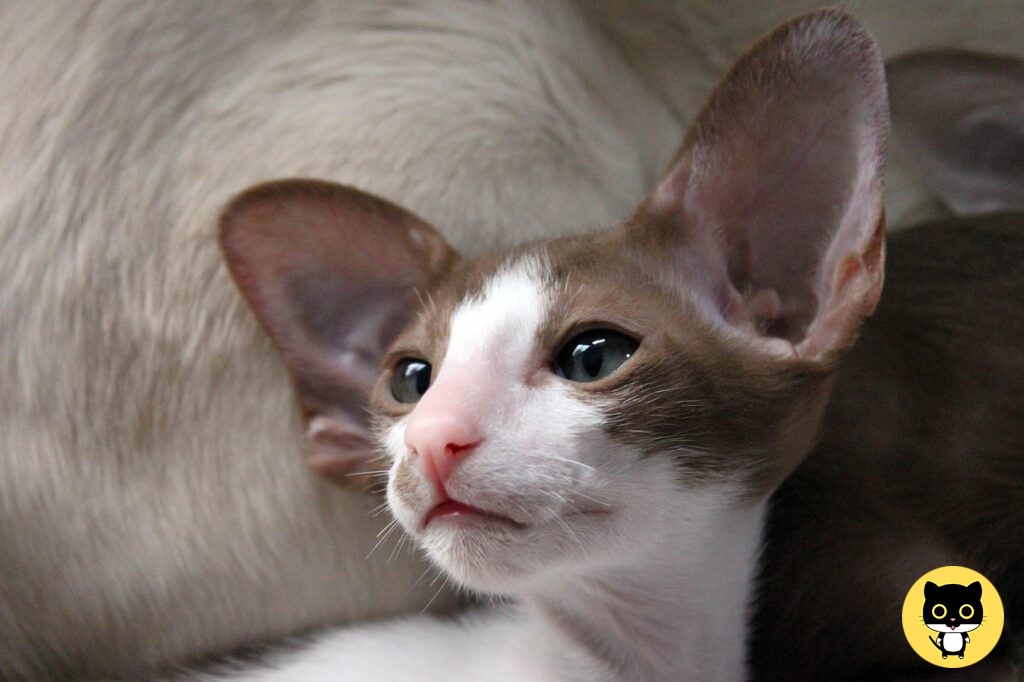
The Oriental Shorthair is easy to underestimate. Its fine coat does not demand the grooming time of a longhaired cat, and its medium-sized frame can make it look almost delicate. Daily life often asks more of a caregiver than that first impression suggests: this is an active, curious, vocal and socially engaged cat that may want play, conversation, company and access to the highest safe point in the room.
Quick Facts
| Feature | Oriental Shorthair at a glance |
|---|---|
| Relationship | Siamese-related breed |
| Size | Medium; approximately 5–8 lb for females and 8–12 lb for males as adult reference ranges |
| Coat | Very short, fine, close-lying and glossy or satin-like |
| Typical activity | High; daily interactive play and climbing opportunities are important |
| Social style | Often people-oriented and communicative, with meaningful individual variation |
| Estimated longevity | Commonly reported around 10–15 years; individual outcomes vary substantially |
Identity, recognition and relationship to the Siamese
The Oriental Shorthair belongs to the Siamese-related group of breeds. It shares the Siamese family resemblance in its long, tubular outline, wedge-shaped head, large ears and almond-shaped eyes, while its defining visual distinction is the broad range of non-pointed colors and patterns accepted under Oriental classifications.
Breed terminology is not identical everywhere. CFA uses Oriental as the broader breed name and places Shorthair and Longhair varieties within it. TICA and FIFe use more explicit Oriental Shorthair terminology. Related pointed cats and longhaired varieties may therefore appear under different names depending on the registry, and those names should not automatically be treated as interchangeable. Readers comparing a pedigree, show listing or breeder contract should check which registry’s classification is being used.
The breed’s connection to the Siamese is useful for understanding its general type, but it is not a guarantee that every Oriental Shorthair will behave like a particular Siamese cat. Breed family can suggest a pattern of athleticism, sociability and vocal communication; it cannot predict whether an individual will be a lap cat, tolerate being carried or welcome another cat.
Appearance and coat variations
The body is long, fine-boned and muscular rather than bulky. Long legs support a long tail, and the overall impression is of balance, movement and angular elegance. Adult reference ranges are approximately 5–8 pounds for females and 8–12 pounds for males, but these figures are not targets. Muscle, body condition and veterinary assessment matter more than trying to preserve a particular silhouette. Some cats continue developing until roughly 18–24 months.
The head forms a long wedge, with large ears set to continue that wedge-shaped outline. Almond-shaped eyes contribute to the breed’s alert expression. The combination can look extreme to someone accustomed to rounder-headed cats, but the structure is intended to be fine and athletic rather than frail.
The coat is very short, fine, close-lying and usually glossy or satin-like. Accepted colors and patterns can include solids, tabbies, torties, torbies, silvers, smokes and particolors. The exact combinations and categories depend on the registry and the individual pedigree. A prospective buyer interested in a particular color should ask to see the applicable standard rather than assume that a catalog term has the same meaning everywhere.
A sleek coat is easier to manage than a long coat, not invisible. It can still leave hair on clothing and furniture, and seasonal conditions and the individual cat affect how noticeable shedding becomes. The coat is also not hypoallergenic. Its practical advantage is that routine grooming is usually light, not that household maintenance disappears.
Temperament: an interactive relationship
Interaction is the central consideration with this breed. Oriental Shorthairs are generally described as active, curious, playful, vocal and socially involved. Many want to know what their people are doing, investigate changes in the home and turn ordinary household activity into an opportunity for participation.
That involvement can be delightful for someone who wants a responsive companion. It can be tiring for someone who prefers a quiet cat that occupies itself without much interruption. Persistent calling, play requests or protest at a closed door are possibilities, although individual voices and thresholds differ. Vocality should be planned for as a potential part of the relationship, not treated as a fixed promise about every cat.
Social does not mean universally cuddly. An Oriental Shorthair may follow a caregiver from room to room yet dislike being picked up. Another may sleep on a person, seek frequent physical contact and become distressed when separated. A third may prefer to stay close, accept affection on its own terms and retreat when handling becomes too intense. Meeting an adult and watching how it approaches, withdraws, plays and responds to touch gives more useful information than the breed label alone.
Training can become a shared activity rather than a correctional project. Reward-based work may support games such as fetch, simple cues or agility-style exercises. The important expectation is willingness to engage, not a universal ranking of intelligence. Short, positive sessions are more likely to preserve the cat’s interest than repetitive drills.
Home life and suitability
Vertical space often matters more than a large floor plan. An apartment can suit an Oriental Shorthair if it includes sturdy climbing equipment, high resting places, safe windows, puzzle opportunities and regular interactive play. A small body should not be mistaken for a small environmental need. The main commitment is usually social and mental rather than grooming-intensive.
Daily enrichment should have several forms. Wand play can provide movement and shared attention; food puzzles can make meals more absorbing; rotating toys can prevent the environment from becoming predictable; and elevated routes can give the cat ways to observe without being disturbed. Robust equipment is important because an athletic cat may use it energetically rather than decoratively.
Long periods alone may be a poor fit for some individuals, but there is no reliable universal limit that applies to every Oriental Shorthair. Work schedules, the cat’s age, previous experience, available enrichment and the presence of compatible animals all matter. A caregiver who is away much of the day should ask specifically how the cat has behaved when alone, rather than relying on a general reputation for sociability.
Children can be a good match when they are taught to let the cat approach, avoid chasing and respect retreat spaces. A cat-safe dog or another compatible cat may also provide useful company, but compatibility is not automatic. Introductions should be gradual, supervised and supported by separate food, water, litter and resting resources.
Sociality with people or cats says little about safety with birds, rodents, reptiles or other small pets. The Oriental Shorthair remains a cat with hunting instincts, so household planning should protect vulnerable animals rather than infer trustworthiness from friendliness.
Care and veterinary planning
Grooming is usually straightforward. Occasional combing or use of a rubber curry brush can remove loose hair and offer a convenient chance to notice changes in the skin or coat. The appropriate frequency depends on what the particular cat sheds and whether tangles or excess hair become a problem. Regular nail care, dental attention and routine veterinary examinations remain important despite the easy coat.
Feeding should support lean muscle and a healthy body condition rather than exaggerate the breed’s naturally angular outline. A complete, balanced diet and periodic weight and body-condition checks are more useful than judging health by whether the cat looks extremely slender. A long frame can make a healthy cat appear thin to an inexperienced eye, while excess weight can be overlooked if the caregiver focuses only on the breed’s outline.
Hepatic amyloidosis is the most clearly documented breed-associated health concern discussed for Oriental and Siamese-related cats. It can impair liver function and may lead to liver rupture or internal bleeding. A prospective caregiver should ask a breeder about unexplained liver disease, sudden deaths and known family history, not simply whether a kitten appears healthy. No routine test identified here rules out all amyloidosis risk, so family-history transparency remains important. General information about the condition is available from VCA’s veterinary overview.
Progressive retinal atrophy, or PRA, is a recessive condition for which genetic testing is available. Buyers can ask whether the relevant breeding cats were tested and request the actual results or documentation. A negative result for a tested mutation provides useful information about that line; it does not replace ordinary observation and veterinary care.
Dental disease and tooth resorption deserve normal preventive attention, including veterinary examinations and a discussion of home dental care. Available studies that combine Oriental cats with related breeds do not establish a precise Oriental Shorthair prevalence, so these issues should be treated as sensible health responsibilities rather than as an inevitable breed diagnosis.
Tell the veterinary team that the cat is an Oriental Shorthair and provide its complete medical history before anesthesia. A possible sensitivity is reported in breed information, but it is a precautionary consideration rather than a quantified universal risk. Good anesthesia planning, accurate records and communication are useful for any cat and especially sensible when a breed-specific concern has been raised.
Lifespan and what the estimates mean
Published references commonly place reported Oriental Shorthair longevity around 10–15 years, while some breed information gives 10 or more years and notes that certain Siamese-group cats have lived beyond 20. A 2024 mortality dataset included only 16 Oriental Shorthairs and reported a median age at death of 14.01 years. That small dataset can inform planning, but it is not a definitive breed life table.
Longevity is therefore best understood as an estimate, not a promise. Genetics, liver and dental health, preventive care, nutrition, environment, accidents and chance all influence an individual outcome. The sensible goal is not to pursue a number but to choose a transparent source, maintain regular veterinary care and respond promptly to changes in appetite, weight, behavior or energy.
Finding and budgeting for an Oriental Shorthair
U.S. breeder and buyer-guide examples dated October 2, 2026 place pet-kitten asking prices roughly between $600 and $3,000, with some named catteries asking $4,000–$4,500. These are dated asking-price examples, not a national average or a guaranteed sale price. Pedigree, color, breeding or show rights, health work, contract terms and delivery arrangements can all change the quote. A buyer should ask what vaccinations, registration, sterilization, genetic testing, health guarantees and transport are included before comparing prices.
U.S. rescue and adoption examples from the same date range roughly from $50 to $350. Fees often reflect sterilization, vaccinations and microchipping, but the package differs by organization. Clearly identified purebred Oriental Shorthairs may be uncommon in rescue, and some listings may use an approximate breed label or describe a mix. Asking about the cat’s history, behavior around handling, other animals and time alone may be more valuable than focusing on the label.
Active catteries, show referrals and rescue listings demonstrate that the breed can be found in the United States, but there is no dependable national measure of supply or waiting time. Depending on location, a caregiver may need to undergo breeder screening, reserve a kitten, travel or plan an import. A responsible search should include time to verify records and meet the cat, not just time to locate an advertisement.
Is the Oriental Shorthair a good fit?
The strongest match is a household that genuinely wants an interactive relationship and can tolerate variation within that relationship. The breed’s short coat may simplify grooming, but it does not simplify companionship. A caregiver may be choosing daily conversation, climbing, investigation, play requests and a cat that wants to be involved in household life.
The breed may suit an active apartment or family home when the environment offers vertical territory, enrichment, predictable retreats and respectful handling. It may be a poor fit for someone seeking a reliably quiet, independent cat or a guaranteed lap companion. A social cat can still dislike restraint, and a cat reputed to enjoy other cats can become stressed in a crowded household.
Before committing, ask three practical questions: Can the household provide sustained interaction rather than occasional entertainment? Can everyone accept that sociability, vocalization and tolerance for touch will vary? Will the caregiver pursue family health information, verify PRA testing where relevant and maintain ordinary veterinary care? If the answer is yes, the Oriental Shorthair’s intensity is more likely to feel engaging than overwhelming.
What owners and caregivers say
Variation in voice is one of the clearest themes in caregiver experiences. An owner living with two Oriental Shorthairs described one as persistently demanding attention while the other was noticeably quieter. That contrast is useful because it prevents “vocal breed” from becoming a volume guarantee. A caregiver considering one should be prepared for substantial communication, then ask about the particular cat’s voice and behavior rather than assume every individual will sound the same.
Closed-door separation can also produce strong reactions. One caregiver described intense yowling when an individual cat was separated and wondered whether anxiety was involved, while recognizing that the behavior could have several explanations. The practical lesson is to plan for possible high-volume protest without diagnosing separation anxiety from breed alone. A breeder or rescue should be asked how the cat handles departures, closed rooms and changes in routine.
Affection takes different forms. Some caregivers describe cats that sleep on people and follow them constantly. Others describe cats that remain nearby, accept contact selectively or prefer independence. These experiences fit together: an Oriental Shorthair may seek companionship without wanting continuous physical handling. An adult meeting should include observation of boundaries, approach behavior and response to touch, not just whether the cat appears friendly.
Relocation can temporarily hide a cat’s usual personality. An owner who adopted an adult described a cat that was distant at first and became more affectionate after time to settle. A quiet transition, a predictable room and permission to initiate contact can make the early adjustment less stressful. Early reserve should not automatically be interpreted as permanent aloofness, just as immediate friendliness should not be treated as a guarantee of future lap behavior.
Other cats are not always the answer to a social breed’s needs. One caregiver reported that an adult became stressed in a five-cat household and seemed to prefer living alone. That experience does not overturn the breed’s general reputation for sociability; it shows why household history, resource distribution and introduction speed matter. A second cat should be chosen for compatibility with the individual, not used as a universal solution to possible boredom or loneliness.
Health outcomes also vary sharply. One caregiver reported an Oriental Shorthair living to 18, while other accounts described serious illness much earlier, including hepatic amyloidosis. These individual stories cannot establish a breed-wide lifespan, but they do give health questions practical weight. Prospective caregivers should seek documented family information, understand what testing can and cannot show, and prepare for routine care without assuming either exceptional longevity or inevitable disease.
 English