
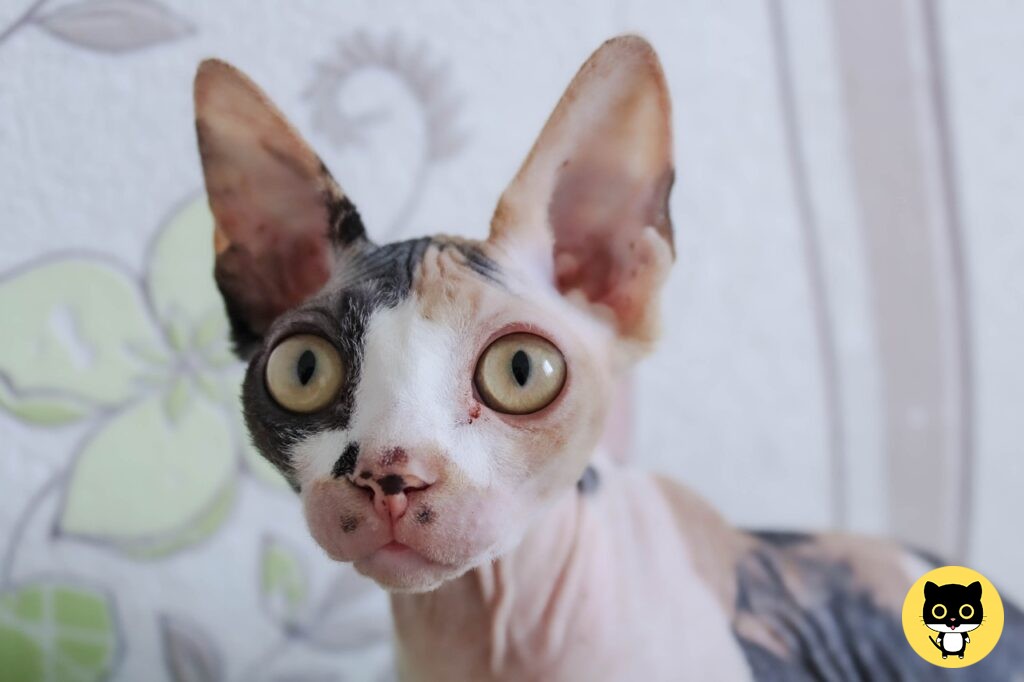
The Peterbald is best understood as an involved companion rather than as a novelty hairless cat. Developed in St. Petersburg in 1994 from Don Sphynx and Oriental Shorthair foundation stock, it is its own Russian breed with a distinctive long-lined shape and unusually broad coat possibilities. Some Peterbalds are nearly naked; others have a suede-like, flocked, brush or ordinary straight coat. That variation matters every day, because the amount of visible hair is not a reliable shortcut to the amount of care involved.
Quick Facts
| Quick fact | Peterbald |
|---|---|
| Type | Recognized pedigree breed; championship/full recognition includes TICA and FIFe. |
| Adult size | Medium-sized, elegant and muscular. |
| Coat | Ranges from hairless through fine down or altered brush/velvet-like coats to straight coat. |
| Typical activity | Highly active, athletic and playful. |
| Estimated lifespan | No sufficiently reliable breed-specific lifespan range was established in the current evidence. |
Identity and recognition
The Peterbald is a distinct breed, not simply a hairless Oriental Shorthair or a different coat expression of the Sphynx. It is eligible for championship competition in TICA, and FIFe places it among its fully recognised Category 4 breeds. CFA’s current recognised-breeds list does not include the Peterbald. WCF publishes a Peterbald standard, but publication of a standard by itself does not establish the same current recognition status as championship eligibility or full recognition elsewhere.
These labels are worth checking when registration or showing matters. “Recognised,” “registered,” “listed in a standard” and “eligible to compete” are related but not interchangeable terms. A breeder should be able to explain which registry records the parents and kittens, what documentation accompanies the sale and whether the cat’s particular coat is eligible for showing.
The breed’s history explains much of its appearance and personality. The Oriental influence is visible in the long, lean outline, large ears and wedge-shaped head, while the hairlessness and coat variation reflect its other foundation stock. The result is a cat with its own breed identity, even when an individual Peterbald resembles another long-bodied or hairless breed.
Appearance, size and coat
A Peterbald has a medium-sized, muscular body that is long, lean and somewhat tubular rather than bulky. Its head forms a long wedge, its ears are very large, and its eyes are almond-shaped. Long legs end in small oval feet, and the tail is long and whip-like. Approximate adult weights are 5–7 pounds for females and 7–10 pounds for males, although proportions and condition are more informative than a target number alone.
The coat can be naked, suede-like, flocked, brush or straight. A naked cat may have little more than a fine covering, while a straight-coated Peterbald can look much more conventionally furred. Straight-coated cats may still be registered or used in breeding, but they are excluded from the TICA show ring. Coat texture can also change during the first two years and, in some cats, for several years afterward.
This late change creates a practical buying issue. A kitten that appears almost hairless may not retain that exact texture, and a kitten with a soft covering may develop a different adult coat. Ask to see photographs or meet adult relatives when possible, and treat the actual kitten’s future coat as something to estimate rather than guarantee.
Peterbalds can occur in a broad range of colors and patterns. Eye-color rules depend on the registry and color category: TICA treats eye color as independent of coat color, while WCF specifies bright green eyes and intense blue eyes for colourpoints. If showing or registering a particular color is important, confirm the applicable standard rather than relying on a general breed description. The current breed standard and published WCF standard illustrate why details can differ.
Temperament and daily companionship
A Peterbald generally brings an active social presence into the home. Breed descriptions portray these cats as affectionate, curious, intelligent, playful, energetic and often vocal. Many are interested in what their people are doing and may seek regular conversation, play and physical proximity rather than spending most of the day unnoticed.
That sociability can be rewarding, but it is not the same as universal tolerance for being carried, restrained or handled whenever a person chooses. A friendly cat may still dislike forced grooming, prolonged holding or rough attention from children. Meeting an adult and asking how that individual responds to touch, visitors and routine care gives a more useful picture than relying on the word “affectionate.”
Young or especially active Peterbalds benefit from interactive play, sturdy scratching surfaces and safe opportunities to climb and observe. Puzzle feeding, rotating toys and short play sessions can help direct energy into activities the household can support. A secure apartment can work as well as a larger home if it offers engagement, vertical space and reliable temperature control; there is no simple floor-area rule that determines suitability.
Compatibility with children, cats and dogs is often described positively, but introductions and household management remain decisive. A new cat needs an escape route, separate food and toileting resources, supervised early contact and time to adjust. The other animal’s behavior matters at least as much as the Peterbald’s breed reputation. Sociality with people or familiar pets should not be treated as evidence that a particular cat is safe with birds, rodents, reptiles or fish.
Some individual caregivers describe comfortable car travel or quick adaptation to new environments, while also noting that visitor responses can be shaped by previous experiences. Such stories make adaptability plausible for some cats, not guaranteed for all. They also suggest a useful question for breeders and adopters: what has this cat already experienced, and how does it respond when a situation changes?
Coat-dependent care
The most important care decision follows the individual coat. A straight, brush or more substantial coat may need a fine-toothed comb about weekly, with extra attention if loose hair or tangles accumulate. A light-feeling coat can still leave hair around the home, so people choosing a Peterbald to avoid visible shedding may be surprised by a coated individual’s routine.
Hairless and sparsely coated cats shift the work from brushing to skin management. Some caregivers notice visible oil, eye discharge or a need for regular cleaning, while others particularly value the unusual feel of the coat and the closeness it encourages. These experiences are compatible: the same lack of fur can make skin maintenance more noticeable while also being part of the cat’s appeal.
Hairless varieties may need individualized gentle cleaning or bathing. Guidance commonly suggests bathing about every other week for hairless cats, but over-washing can irritate the skin or encourage a cycle of excess oil and cleaning. The right schedule depends on the cat’s skin, environment and response. Use products cautiously and ask a veterinarian to guide choices for exposed or irritated skin.
Warm resting areas are important for hairless and sparsely coated Peterbalds. They should also be protected from prolonged direct sun, with indoor or closely supervised management being the prudent approach. Exposed skin is not a reason to improvise with human products; discuss any sunscreen or skin preparation with a veterinarian. Low visible hair also does not make the breed reliably hypoallergenic. All cats produce allergens, and allergy-sensitive households should spend time with the individual cat before committing. The American College of Allergy, Asthma & Immunology’s explanation of pet allergies provides useful general context.
Routine care still includes veterinary examinations, dental attention, ear checks, nail care and observation of the skin. Feeding should follow life stage, body condition and veterinary advice rather than hairlessness alone. Some guidance notes that hairless cats may have higher energy demands, but that does not justify feeding every Peterbald the same amount.
Health and lifespan
No well-defined Peterbald-specific disease profile or breed-specific screening protocol is established in the reviewed guidance. That is useful information, but it is not a health guarantee. The absence of a recognised Peterbald disease list does not show that an individual cat is free of inherited, acquired or ordinary feline illness, and it should not encourage buyers to borrow dramatic health claims from related breeds without evidence.
Preventive care and family-history questions therefore matter. Before buying, request veterinary records, pedigree information and whatever health history the breeder can provide for parents and close relatives. Ask directly about recurring dental, skin, respiratory, digestive or other problems in that particular line, rather than asking only whether the breed is “healthy.” A responsible answer should distinguish known history from assumptions.
TICA gives an estimated life expectancy of 12–15 or more years. This is a planning estimate, not a measured Peterbald population life table. A caregiver should plan for a long commitment while recognising that lifespan depends on the individual cat, preventive care, genetics, environment and illnesses that cannot be predicted from breed membership alone.
Cost and availability
Peterbalds are uncommon, so availability varies by region and may involve a wait or import arrangements. Current North American breeder availability exists, but regional supply, waiting times and transport requirements are not measured consistently. A buyer should verify the breeder’s identity, registry documentation, veterinary records, pedigree and total transport cost rather than treating an online listing as proof of a straightforward purchase.
A 2026 U.S. breeder-purchase estimate places Peterbalds at about US$1,700 and up, with some reported prices reaching US$4,000. These are asking or secondary-source purchase estimates, not verified completed-sale data, and they should not be mistaken for a universal price. Adoption fees and recurring costs for food, veterinary care, grooming supplies, skin care, insurance or travel are separate and cannot be responsibly inferred from the purchase figure. The dated cost example is useful mainly as a budgeting reference.
Is a Peterbald a good fit?
A Peterbald may suit a caregiver who wants an interactive, talkative and visually unusual companion, has time for daily engagement and is comfortable adapting care to the cat’s coat. It can also suit an apartment household when the home is secure, warm, enriched and organised around the cat’s need for play, climbing and retreat.
The breed is less suitable for someone seeking a quiet, highly independent cat or assuming that a hairless appearance means less work. A hairless individual may require deliberate skin, warmth and sun management; a coated individual may need combing and may leave visible hair. Likewise, an affectionate reputation cannot promise that every cat will enjoy handling, travel, children or extended social contact.
Before committing, assess four things together: the adult coat tendencies in the family, the actual cat’s response to people and handling, allergy reactions in the household, and the breeder’s records and account of recurring family health problems. That process is more reliable than shopping for the label “hairless” or relying on a broad temperament promise.
What owners and caregivers say
Owners and caregivers describe Peterbald relationships as highly involved. One caregiver portrays a people-oriented cat with considerable affection and personality, while another impression compares the experience to having “two cats” because of the attention and activity required. These accounts fit the breed’s described social intensity, but they are individual experiences rather than a measure of how every Peterbald behaves.
Travel and change can also vary with history. A caregiver reported comfortable car travel and adjustment to new settings, yet explained that the cat’s response to visitors was shaped by what it had previously experienced. This makes adaptability a possibility rather than a promise. A well-socialised adult may be confident in unfamiliar situations, while another Peterbald may need slower introductions and more control over distance.
The coat produces the clearest contrast in household experience. Hairless-cat caregivers have mentioned visible oil, eye discharge and cleaning demands, while others value the unusual texture and the close companionship that can accompany a cat needing warmth and attention. Neither side cancels the other. The practical lesson is to ask what the individual cat’s skin and eyes are like, how often it currently receives care, and whether that routine fits the household.
For the right caregiver, the Peterbald’s intensity is part of the reward: this is often a cat to live with actively rather than simply admire. The best match is not determined by hairlessness alone, but by whether the household welcomes frequent participation and can provide patient, coat-specific care while respecting the cat’s boundaries.
Selected sources
TICA Peterbald breed information and standard; FIFe Peterbald breed information; CFA recognised breeds; UC Davis Veterinary Genetics Laboratory breed information.
 English