
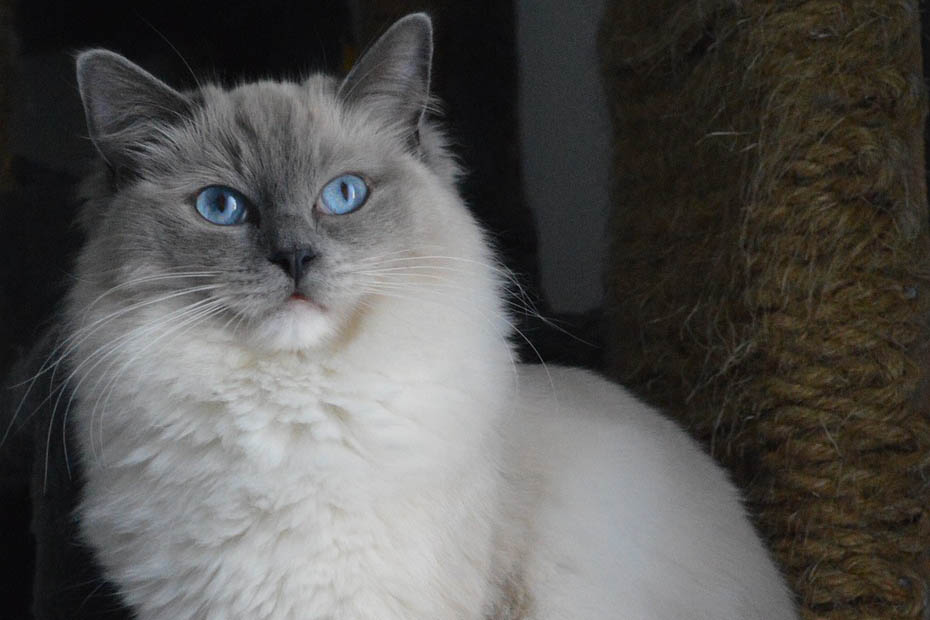
The Ragdoll is best understood as a large, slow-maturing companion cat whose appeal comes from the combination of striking appearance and close social relationships. It is not, however, a guarantee of a floppy lap cat, a maintenance-free coat or a hypoallergenic household. The useful question is whether your home can accommodate a substantial, people-oriented cat with an individual personality, regular grooming needs and a few important health questions.
Quick Facts
| Type | Large, slow-maturing pedigreed companion cat |
|---|---|
| Adult size | Approx. 10–15 lb (4.5–6.8 kg) for females and 15–20 lb (6.8–9.1 kg) for males; body condition matters more than a target number |
| Coat | Moderately long or semi-long, silky or plush, with abundant guard hairs and little or minimal woolly undercoat |
| Eyes | Blue and generally oval in the standard breed type |
| Maturity | Coat color develops over roughly two to three years; full size and weight may take about four years |
| Typical household fit | Homes wanting an interactive, socially present cat and willing to provide grooming, play and sturdy equipment |
Identity and recognition
Ragdoll is a distinct pedigreed breed recognized by major international cat organizations. FIFe lists it as RAG in Category 1 and records recognition from 1991. CFA and TICA also recognize the breed. Recognition matters because a blue-eyed, pointed cat that resembles a Ragdoll is not automatically a pedigreed Ragdoll: pedigree, registration and the specific rules of the named organization determine eligibility. The FIFe breed standard and other registry standards also differ in some details of accepted colors and patterns.
The breed’s history is closely tied to the development of a recognizable pedigreed type rather than to a single temperament promise. Today, its identity rests on a large rectangular body, a semi-long silky coat, blue eyes and pointed coloration, along with a reputation for sociability. Those features describe a breed direction, not a mechanical set of behaviors. A Ragdoll can be devoted without enjoying every form of handling, and a calm adult can have been a lively, demanding kitten.
Appearance, size and coat
A Ragdoll has a substantial, balanced silhouette rather than a delicate one. The body is large, muscular and rectangular, with medium-to-heavy bone, moderately long legs and a long tail. The head forms a modified wedge, the ears are wide-set, and the large oval eyes contribute much of the breed’s characteristic expression. Adult males are commonly larger than females, but the published weight ranges are expectations, not instructions to make a cat as heavy as possible. A sound body condition is more important than reaching the upper end of a breed description.
Slow development is part of living with this breed. A young Ragdoll may look unfinished for some time, and the eventual depth of color and body size may not be apparent in kittenhood. Coat color typically develops over approximately two to three years, while full size and weight can take about four years. This extended maturity makes an adult’s structure and temperament easier to assess than a kitten’s future qualities.
The coat feels silky or plush and is moderately long to semi-longhaired. Breed standards describe abundant guard hairs with little or minimal woolly undercoat, a structure that may make the coat feel less dense than a heavily woolly longhair. That does not mean the home will be hair-free. A light-feeling coat can still shed visibly, leave hair on clothing and furniture, and form tangles if loose hair is not removed.
Color and pattern provide much of the breed’s visual variety. Recognized pattern terms include colorpoint, mitted and bicolor; some standards and breed materials also use van. Seal, blue, chocolate, lilac, red and cream are established color terms, while TICA also lists cinnamon and fawn. Lynx and tortie describe pattern or color modifiers, not separate breeds. Standard Ragdolls have blue eyes, and the pointed pattern is associated with blue eyes. Eye color and appearance alone, though, cannot establish pedigree.
Temperament and daily companionship
Social closeness is one of the breed’s most attractive tendencies. Many Ragdolls like to follow their caregivers, greet them, sleep nearby or settle in the same room. This kind of companionship can suit someone who wants a cat that is present throughout the day without necessarily demanding constant physical contact.
Being socially attached is not the same as wanting to sit on a lap. Some Ragdolls prefer to lie beside a person, accompany them from room to room or rest at the foot of the bed rather than be carried. Others enjoy more direct contact. The practical way to evaluate this distinction is to meet an adult whenever possible and ask specific questions about pickup, restraint, visitors, grooming and changes in routine.
Activity also changes with age. Adults are often relaxed and moderately active, but kittens and young adults can be energetic, playful and surprisingly persistent. Interactive toys, climbing opportunities and games such as fetch can help direct that energy. A calm adult temperament should not be interpreted as permission to under-enrich the environment.
A Ragdoll can work well in a family or a multi-pet home when the introductions are managed rather than rushed. Children need supervision and instruction in gentle handling. Cats and cat-safe dogs should be introduced gradually, with separate resources and places where the Ragdoll can retreat. Small or vulnerable pets should remain physically separated; a friendly reputation does not remove a cat’s predatory instincts or make unsupervised access safe.
Care and the practical workload
Regular combing is the central coat routine. Weekly brushing or combing is a useful starting point, but the right interval depends on the individual coat, season and the cat’s tolerance. A cat that releases a great deal of loose hair or develops friction points around the legs, chest, armpits or hindquarters may need more frequent attention. Short, calm sessions are often easier than waiting until a large mat requires prolonged handling.
Owners describe a wide range of shedding experiences. Some find regular combing keeps the coat manageable; others report heavy hair on floors, clothing and even food, seasonal increases in shedding, or mats when grooming slips. These experiences are compatible with the breed’s coat structure: a coat with little woolly undercoat may be comparatively easy to comb while still releasing a conspicuous amount of hair. If visible hair is a serious concern, meet the individual cat and discuss the parents’ coats rather than relying on the word “silky.”
Handling tolerance should be built, not assumed. A Ragdoll may accept brushing, nail care and routine examination, while another resists being picked up or permits contact only when it initiates the interaction. Reward-based handling, gradual desensitization and respect for escape signals make grooming safer for both cat and caregiver. The breed’s size also means that a struggling adult can be difficult to restrain safely.
Daily life should include play, scratching surfaces, resting places and social interaction. Heavy-duty scratching posts, stable cat trees and secure shelves are especially important for a large cat; lightweight equipment can wobble, tip or discourage use. Weight monitoring deserves attention because a large frame can make gradual weight gain difficult to notice. Portion control, routine weighing and active play are more useful than judging size by appearance alone.
There is no established hypoallergenic Ragdoll status. Fel d 1 exposure cannot be predicted reliably from coat length, coat texture or visible shedding. Someone with allergies should spend time with the actual cat and consider medical advice before committing, while recognizing that an individual trial does not guarantee future tolerance.
Health, screening and longevity
The most important breed-specific acquisition question concerns hypertrophic cardiomyopathy, or HCM. Research has identified the MYBPC3 R820W variant in Ragdolls and associated it with the disease. A prospective breeder should be able to discuss parentage, test results, veterinary records, family cardiac history and the cardiac evaluation used in the breeding program. A genetic result is valuable, but a negative result is not a lifelong guarantee that a cat will never develop HCM or another heart condition. Genetic testing is one part of screening, not a complete cardiac clearance.
Routine veterinary care should also keep an eye on body condition, teeth and gums, digestion and skin. UK primary-care data recorded periodontal and dental disease, diarrhoea, enteropathy, obesity and skin disorders among diagnoses in Ragdolls. Those findings do not predict that an individual cat will develop each condition, but they give caregivers practical areas to monitor. Changes in appetite, stool, weight, grooming, skin or activity deserve veterinary attention rather than being dismissed as breed quirks.
Longevity is an estimate, not a promise. TICA describes many Ragdolls as living into their mid- or high teens. A 2025 UK VetCompass study reported a median age at death of 12.85 years among 133 Ragdolls in its study population. The two figures answer different questions and should not be treated as a guaranteed lifespan for a particular cat. Health screening, preventive care, body condition, environment and ordinary individual variation all matter.
Buying, adoption and availability
Price depends heavily on region, pedigree, registration, breeding practices, age, reproductive status and what health care is included. As a dated U.S.-oriented example, a breeder guide published in 2026 gives an asking-price range of approximately US$1,800–$2,500 for a pet-quality kitten from a TICA-registered breeder who performs health testing. This is an asking-price example, not a universal market price or a guarantee of quality. A lower price may reflect age or circumstances, while a higher price does not by itself prove better breeding.
Availability and adoption fees need to be checked locally. Rescue organizations, breeders and registry listings change over time, and there is no defensible universal figure for current availability, recurring annual costs or legal requirements. A careful buyer should verify the breeder’s identity, contract, vaccination and veterinary records, registration claims, return policy and the opportunity to see the kitten’s living conditions. Asking for the named registry and the actual pedigree is more informative than relying on appearance or an unverified “Ragdoll-type” label.
The strongest fit is a caregiver who wants a socially engaged cat but is comfortable with individual variation. A Ragdoll can be a rewarding indoor companion for families, couples or single-person homes that provide stable routines, interactive play, safe vertical space and regular coat care. It is a less suitable choice for someone seeking a guaranteed lap cat, a cat that needs little interaction, equipment designed for smaller breeds or a coat that will not noticeably shed.
What owners and caregivers say
Owners and caregivers describe relationships in which the cat’s closeness is unmistakable even when lap sitting is not. One owner describes a loving Ragdoll that prefers being beside the person rather than on the person’s lap. That distinction is useful: the breed’s social reputation may show up as following, greeting and shared-room companionship rather than passive acceptance of being held.
Handling stories vary in the same way. Some cats tolerate grooming, nail care and routine contact; others resist pickup or accept affection only on their own terms. For a household with children, this variation makes adult temperament and handling history especially important. A gentle breed reputation should support thoughtful supervision, not replace it.
Coat experiences are similarly mixed. Some caregivers report hair on clothing, floors and food, daily brushing, frequent vacuuming and mats after grooming is neglected. Others find shedding manageable with regular combing, while some notice a seasonal increase and others see a very different pattern in an individual cat. The practical synthesis is straightforward: plan for a real grooming and cleaning routine, then use the actual cat’s coat to adjust it.
The Ragdoll’s best qualities are therefore more substantial than the effortless stereotype. It is a distinctive, large and often affectionate companion whose presence can be deeply rewarding. The responsible decision is to value sociability without demanding compliance, appreciate the coat without assuming low shedding, and investigate cardiac health without treating one test as a guarantee. Meet the individual, ask precise questions and prepare the home for the adult cat it will become.
 English