
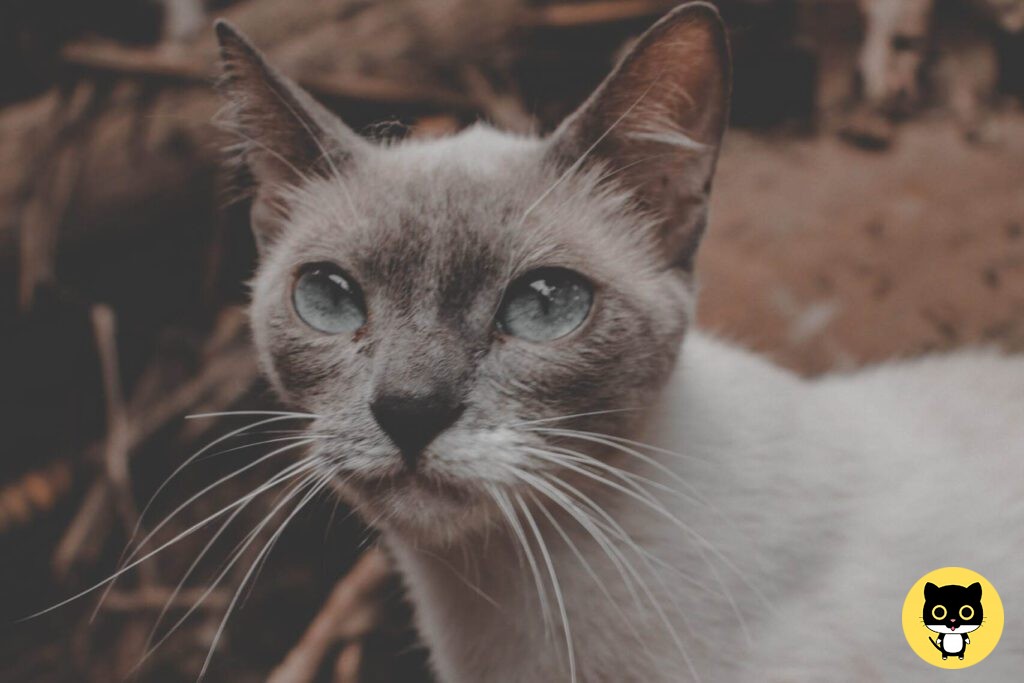
Sam Sawet is a traditional Thai cat type with cultural importance, but the name does not currently provide the same practical certainty as a modern, internationally standardized breed. For a prospective caregiver, that distinction matters. The cat may have a recognizable place in Thai cat literature and tradition while still lacking a dependable breed profile for adult size, temperament, health, price or lifespan.
Quick Facts
| Quick fact | What it means for a caregiver |
|---|---|
| Traditional identity | Auspicious Thai cat type associated with the name แซมเศวต (Sam Sawet) |
| Traditional appearance | Short, fine coat with black and white hairs mixed together, often creating a gray impression; yellow or golden eyes |
| Modern registry status | Not separately listed in the current public breed materials of CFA, TICA or FIFe |
| Temperament | No established breed-wide temperament profile; assess the individual cat |
| Health and lifespan | No validated Sam Sawet-specific disease profile or population lifespan estimate |
| Availability | Historically limited and difficult to verify; current inventory and import routes are not independently established |
What Sam Sawet means
Sam Sawet is best understood as a traditional Thai type rather than automatically as a modern pedigree breed. Thai literature places it among auspicious cat types, and the name is associated with the distinctive idea of dark hairs interspersed with pale ones. The type therefore has a cultural and historical identity even though its present-day documentation may be limited.
That identity should not be confused with registration status. The current public breed lists and standards of CFA, TICA and FIFe do not list Sam Sawet as a separately recognized breed. A reference to Maew Boran, Thai cats generally or a preservation project does not by itself establish that an individual cat is registered as Sam Sawet.
The practical consequence is simple: the label should begin a conversation, not end one. A seller’s description, a gray-looking coat or a registration document from an unfamiliar organization cannot independently prove historical identity, pedigree or recognition by a major registry. Ask what the organization is, what its registration means and whether its records document this particular cat’s parents and ancestry.
History, relationships and look-alikes
Sam Sawet belongs to the wider story of Thai cats, but shared geography does not make every Thai-associated cat the same type. It should be kept distinct from the Korat or Si-Sawat, the Thai or Wichienmaat, the Siamese and the Khao Manee. These cats may overlap in historical setting or in some visual descriptions, yet their standards, recognition systems and health information should not be transferred to Sam Sawet without direct evidence.
The strongest traditional description gives Sam Sawet a short, fine coat in which black hairs are mixed with white hairs. Rather than producing a solid blue-gray or uniformly silver coat, this mixture can create a gray or softened dark impression when viewed from a distance. Traditional descriptions also refer to yellow, golden or “firefly-like” eyes and a slender, refined body.
Modern descriptions sometimes use terms such as blue-gray, ticked, silver-tipped or uniformly gray. Those terms are not automatically interchangeable with the traditional black-and-white mixed-hair description. Coat terminology can change the apparent identity of the cat, so a photograph or casual color description is not enough to establish that an individual is Sam Sawet.
No reliable standard establishes an adult height, weight range, maturation timetable or formal tail specification. A caregiver should judge the cat in front of them: age, sex, body condition, frame and muscle development are more useful than a guessed breed chart. A slender-looking young cat may still change considerably as it matures, while an adult’s health and condition can affect its apparent shape.
Living with a Sam Sawet
The short coat should make routine grooming relatively manageable compared with a long coat. Gentle combing can remove loose hair, help a caregiver notice skin changes and provide a calm opportunity to handle the cat. It does not establish a fixed grooming calendar, however. Shedding, seasonal coat change, skin sensitivity and the tendency to develop tangles have not been reliably standardized for Sam Sawet.
A fine or silky coat can still leave hair around the home. This is especially important for someone choosing the cat because they expect minimal shedding. Allergy-sensitive households should not treat short hair as evidence of low allergen exposure or hypoallergenic suitability. Spend time with the individual cat, consider appropriate medical advice and make the decision based on the household’s actual response.
Temperament is the least predictable part of the Sam Sawet label. There is no established breed-wide evidence defining activity level, vocalization, trainability, curiosity, handling tolerance or compatibility with children, dogs, cats or small pets. That does not make the cat unknowable; it means that observation is more informative than a promise attached to the name.
Meeting an adult is particularly valuable. Watch how the cat responds to a new person, whether it seeks contact or prefers distance, how it reacts to gentle handling and whether it can retreat without being pursued. Ask how it behaves during play, at feeding time and when household activity increases. A kitten’s future personality cannot be guaranteed from its coat or traditional classification.
Ordinary feline enrichment is a sound starting point. Provide daily opportunities for interactive play, scratching, hiding, climbing or using safe vertical space. Keep food, water, litter boxes and resting places predictable, and allow the cat to control the amount of contact it receives. These provisions are not special Sam Sawet requirements; they are flexible safeguards that help accommodate individual variation.
Health and everyday care
No Sam Sawet-specific inherited disease predisposition, population health profile, mandatory genetic panel or validated lifespan estimate has been established. Health claims associated with the Korat, Siamese, Thai, Russian Blue or other cats should not be imported simply because a Sam Sawet may look gray, come from Thailand or share part of the region’s history.
Good care therefore looks like responsible care for any cat. Feed a complete diet suited to the cat’s life stage, monitor body condition rather than relying only on appetite and arrange preventive veterinary examinations. Vaccination, parasite control, dental care, identification and safe housing should be planned with a veterinarian who knows the cat’s age, lifestyle and local risks.
Controlled outdoor access is safer than unsupervised roaming. Indoor housing should include places to hide, comfortable resting areas, scratching surfaces and enough separation between essential resources to reduce conflict. A cat’s health outcome will be shaped by its individual genetics, preventive care, environment and illnesses over time, so there is no responsible fixed number of years to promise for Sam Sawet.
Before taking ownership, request veterinary examination records, vaccination and parasite information, identification details and any available family-health records. If a pedigree is claimed, ask for the parents’ names, the issuing organization, the meaning of its registration and written proof connecting the records to the cat. Registration alone does not demonstrate major-registry recognition or guarantee health.
Price, rarity and availability
There is no reliable, verifiable Sam Sawet kitten or adult price example that can be stated with all of the necessary context: currency, region, date and whether the figure was an asking price, completed sale or adoption fee. A seller’s number should therefore be treated as an individual market claim rather than a normal Sam Sawet price.
Rarity can make an asking price sound more authoritative than it is. A high figure may reflect import costs, preservation work, transport, documentation or simply a seller’s judgment; it does not prove authenticity or quality. Before paying a rarity premium, verify the cat’s identity claim, inspect the records and confirm the legal and veterinary requirements for transfer or import in the relevant jurisdictions.
Historical reports describe very limited documented availability, and Thai preservation and media accounts have focused on maintaining a small number of cats believed to fit the traditional type. There is no independently verified current inventory, population count or standard import pathway. “Rare,” “available” and “authentic” are separate claims that each require checking.
Is a Sam Sawet the right cat for you?
Sam Sawet may suit someone who values Thai cat history, is comfortable with incomplete breed infrastructure and is willing to assess an individual cat carefully. The appeal is not limited to appearance: the type carries cultural meaning and represents an effort to preserve a traditional description that may otherwise become blurred by modern labels.
It is less suitable for someone who needs predictable adult size, a guaranteed personality, a recognized pedigree, a documented health screening program or a dependable price and availability guide. Those expectations belong more naturally to a thoroughly established modern breed with a stable standard and a larger documented population.
The most reliable decision method is practical rather than romantic. Confirm what the seller means by Sam Sawet, compare the cat’s appearance with the traditional description, examine the records, meet the individual and observe its response to people and handling. Then budget for ordinary lifelong cat care without assuming that rarity brings superior health, unusual longevity or special behavior.
What owners and caregivers say
Caregivers describe rewarding but individual relationships with cats believed to fit the Sam Sawet type. One Thai caregiver describes a cat with black hairs mixed with white, a strong attachment to people, sustained lap sitting and a desire for warmth and attention. That cat also benefited from daily play and gentle regular brushing. The account gives a vivid picture of one affectionate, socially engaged cat, but it does not establish a temperament rule for the type.
An owner who found a black-looking cat described it as unafraid of people while remaining unsure whether it was truly Sam Sawet. That uncertainty is important. A cat can look plausible and behave in an appealing way without its historical identity being clear. In practice, the question “Is this a friendly cat?” may be easier to answer than “Can this cat be authenticated as Sam Sawet?”
Thai preservation and media reports also place attention on the work and expense involved in maintaining a very small number of cats believed to represent the traditional type. Those efforts say more about rarity, identification and cultural preservation than about a consistent personality pattern.
Taken together, these experiences suggest a balanced approach. A Sam Sawet may be an affectionate lap cat, an independent companion or something in between. The best caregiver is not the person who expects the label to predict everything, but the person prepared to verify the history, notice the individual and provide a stable, enriched and well-supervised life.
Further reading
The Thailand Foundation overview of auspicious Thai cats provides cultural and appearance context. The National Library of Thailand material and the Library of Congress record for Thai cat literature offer additional historical background.
 English