
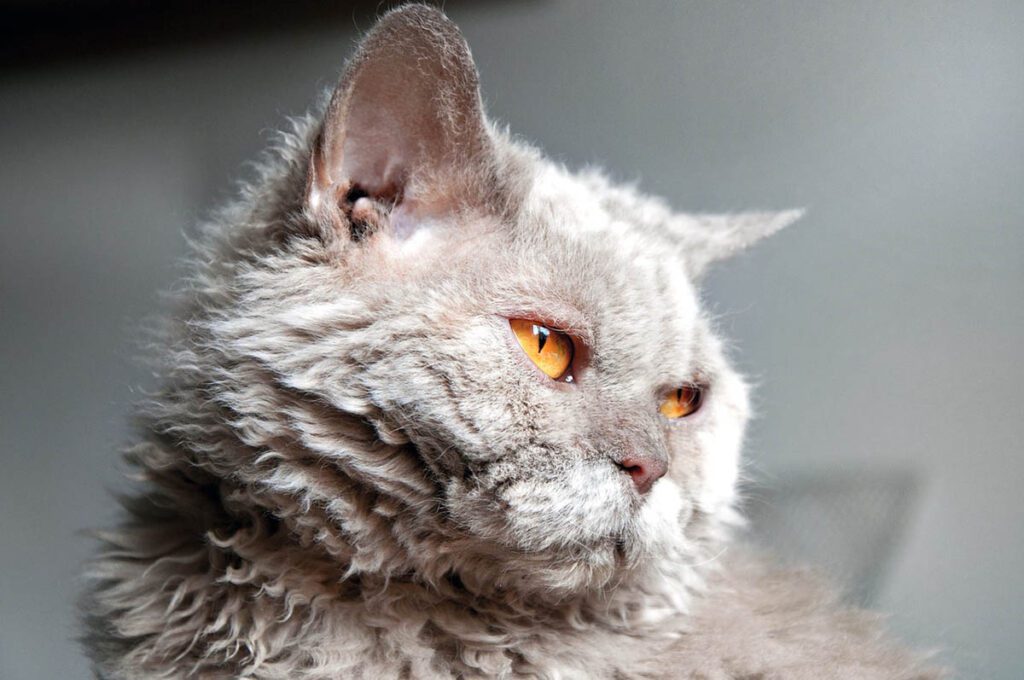
Selkirk Rex: the curly-coated companion with an individual agenda
The Selkirk Rex is a pedigree cat for people who are drawn to a substantial, plush-coated companion rather than a delicate-looking novelty. It comes in both shorthair and longhair forms, and its defining feature is a coat in which the guard, down and awn hairs may all develop waves or curls. The breed can be strikingly teddy-bear-like, but its practical appeal rests on more than appearance: it combines a solid physical presence with a generally gentle, socially engaged temperament.
Recognition is well established, although the details depend on the registry. The Cat Fanciers’ Association and The International Cat Association accept the Selkirk Rex for championship competition. FIFe lists the longhair as SRL and the shorthair as SRS, both as fully recognized Category 3 breeds. Registration rules and permissible colors are not identical across organizations, so someone buying for showing or breeding should check the rules of the registry they intend to use rather than assume that one standard applies everywhere.
| Breed | Selkirk Rex |
|---|---|
| Coat forms | Shorthair and longhair |
| Typical build | Medium to large, heavy-boned, muscular and semi-cobby |
| Adult male example | Approximately 12–15 lb (5.4–6.8 kg); females are generally smaller |
| Estimated lifespan | About 10–15+ years, as a broad estimate rather than a guarantee |
| Best preparation | Plan for social companionship, enrichment and grooming suited to the individual coat |
A substantial cat beneath the curls
The Selkirk Rex has a broad, rounded head, full cheeks, round eyes and medium-sized rounded ears. Its body is muscular and heavy-boned, with a semi-cobby outline rather than a fine or elongated one. A substantial tail tapers toward the tip. Adult males are often described at roughly 12–15 pounds, while females are generally smaller; there is no comparable formal female weight range in the information used here, so individual frame and condition matter more than a target number.
The coat is dense, soft and plush in either length. Curls may be especially noticeable around the neck, belly and tail, while longhair coats are expected to form loose, random curls rather than tight, dreadlocked structures. The visual effect can range from a gently rippled coat to a much more obvious curly texture. That variation is part of the breed’s character, not evidence that one-looking coat is necessarily more correct or healthier than another.
Color and eye possibilities are broad, but showing and registration details differ. TICA’s standard broadly accepts colors and patterns, whereas CFA rules exclude some colors, including cinnamon and fawn. Eye-color requirements also depend on the registry and the coat pattern; blue or odd eyes may be restricted in particular combinations. A prospective exhibitor should compare the relevant registration rules and breed standard before choosing a kitten for a specific show or breeding plan.
The coat is a developing feature, not a fixed kitten costume
A kitten’s early curls do not reliably predict the finished adult coat. Curl and texture can change around eight to ten months and may continue developing until roughly two years. Genotype, age, hormones, climate and season can all affect how the coat looks. One caregiver also described curls becoming less pronounced after a kitten groomed itself frequently, a useful reminder that photographs taken at one age may not represent the cat’s later appearance.
This makes an adult or older relative especially informative. A breeder should be able to discuss how the family’s coats developed over time, not simply show a particularly curly newborn. Meeting an adult from the line can also reveal texture, density and the amount of maintenance required between grooming sessions.
The Selkirk Rex sheds. Curly or light-feeling hair may be less immediately obvious on furniture, but it does not disappear, and fine hairs can still become airborne around the home. The breed should not be described as hypoallergenic: all cats produce allergens, and a curly coat does not establish lower household allergen exposure. Anyone with allergies should spend time with the individual cat, ideally in the environment where the cat lives, before committing.
Grooming follows the individual coat
Grooming can be straightforward, but it is not identical for every Selkirk Rex. Guidance ranges from less frequent combing for manageable coats to combing a couple of times each week, and those descriptions are compatible once coat length, density, tangling and loose hair are considered. A short, open coat may need relatively little intervention; a long, dense, greasy or tangle-prone coat may turn grooming into a regular cooperative-care routine.
Gentle combing and careful separation with the fingers can help preserve the curl rather than pull it straight. The important goal is not to impose a rigid schedule but to prevent knots, monitor the skin and learn what the cat will tolerate. Check areas where friction and density create trouble, including the neck, belly, behind the legs and around the tail. If bathing is needed, the cat’s tolerance matters as much as the product or technique.
Caregivers report a wide range of coat experiences: manageable brushing, noticeable shedding, greasiness, tangling and occasional bathing. These differences are a reason to ask specific questions before adoption. How often does this cat need combing? Does the coat become oily? Has the cat accepted nail trimming, combing or bathing? What happens when a small knot is found? Such answers are more useful than calling the breed either “low maintenance” or “high maintenance.”
Companionship without a guaranteed lap habit
The Selkirk Rex is generally portrayed as gentle, people-oriented, playful and socially involved without being intensely driven. That combination can suit a household wanting a cat that participates in daily life while still having periods of quiet independence. A caregiver described an affectionate cat that remained attached to the household but was also content to play alone or watch birds from a window.
Social does not necessarily mean lap-seeking, pickup-tolerant or pleased by prolonged handling. Companionship may mean following a person from room to room, choosing to rest nearby, greeting the household or requesting contact on the cat’s own terms. The same cat may be affectionate yet dislike being restrained. Anyone specifically seeking a constant lap cat should meet an adult and observe how that cat initiates and ends contact.
Playfulness and independence also belong together. A Selkirk Rex may enjoy interactive play and attention but still need the ability to retreat, watch the outside world and occupy itself. Provide daily play, scratching surfaces, comfortable resting places, safe vertical options and window access where appropriate. A secure indoor apartment can work just as a house can; the relevant question is whether the home offers enough space, choice and engagement, not what type of dwelling it is.
This temperament is likely to suit a caregiver who wants an involved household companion and can respect individual boundaries. It is a less certain match for someone looking for a decorative, effortless cat whose curls guarantee a particular personality. If children or other animals are present, introductions should be gradual and supervised, with escape routes and separate resources available while relationships develop.
Health, ancestry and responsible acquisition
Health decisions should begin with the individual pedigree rather than with a breed-wide assumption. Breeder guidance discusses screening for polycystic kidney disease, hip dysplasia and hypertrophic cardiomyopathy, but the available information does not establish Selkirk-specific prevalence for these conditions or a universal testing panel. Those screening topics are therefore reasons to ask informed questions, not proof that every Selkirk Rex carries a particular risk.
The breed’s ancestry and permitted outcrosses make family history especially useful. Ask for the pedigree, registration records, veterinary history and relevant genetic-test documentation. A responsible breeder should also explain the health of close relatives, any known issues in the line and the socialization the kitten has received. Records show what has been examined; they cannot promise that a kitten will remain healthy throughout life.
Early handling information is valuable for reasons beyond health. Ask how the kitten responds to combing, nail care, being briefly examined and ordinary household activity. A kitten that has experienced calm grooming may still develop different preferences as it matures, but this history gives the caregiver a better starting point. The coat and temperament should be assessed together, because a cat that needs frequent maintenance must be able to learn a workable routine with its people.
Availability may require patience. The Selkirk Rex is described as relatively rare, and a caregiver may need to contact breeders beyond the immediate area or check rescue organizations separately. There is no reliable regional count or wait-time measure to predict how quickly one will be found. Rescue availability and breeder availability should also be treated as different searches rather than assumed to follow the same pattern.
A published guide gives a rough estimate of $800–$2,500 for a kitten from a reputable breeder, but that figure lacks a traceable region, currency basis, sale sample and clear distinction between asking and completed-sale prices. It should not be treated as a universal Selkirk Rex price. Obtain current quotations from breeders in the relevant country or region, and keep those prices separate from rescue or adoption fees; no defensible regional adoption-fee example is established here.
Life expectancy is commonly estimated at about 10–15 or more years. This is a broad expectation, not a population survival table or a promise for an individual cat. The sensible financial and emotional decision is to prepare for ordinary lifelong cat care, routine veterinary attention and the possibility of age-related needs well beyond the kitten stage.
What owners and caregivers say
Owners and caregivers describe rewarding relationships, but not one uniform Selkirk Rex personality. Affection may coexist with self-directed play, window watching and a preference for choosing when to engage. That is not a conflict: an involved companion can still be independent for parts of the day. The practical question is whether the caregiver wants shared presence and voluntary contact, or is specifically seeking a cat that will tolerate constant carrying and reliably settle on a lap.
The coat produces a similarly mixed everyday experience. Some caregivers find brushing manageable, while others deal with substantial shedding, fine hairs that are difficult to see, greasiness, tangles or occasional baths. These reports concern particular cats, so they should not be converted into a fixed breed-wide schedule. They do support a clear preparation: expect hair, budget time for grooming and judge the cat’s actual coat rather than assuming that curls mean less work.
A good match is therefore a caregiver who values the Selkirk Rex’s distinctive texture and substantial presence, can provide ordinary enrichment and lifelong care, and is willing to adapt grooming to the cat in front of them. Before committing, meet an adult where possible, watch its response to handling, ask how the coat behaves between grooming sessions and review the family’s records. The breed can be an engaging, affectionate household companion, but its curls do not replace the work of matching an individual cat to an individual home.
Selected sources
Recognition and standards: FIFe breed information, CFA Selkirk Rex information, and TICA Selkirk Rex information.
Coat genetics and development: UC Davis Veterinary Genetics Laboratory coat test information. Allergy context: American College of Allergy, Asthma & Immunology guidance on pet allergies.
 English