
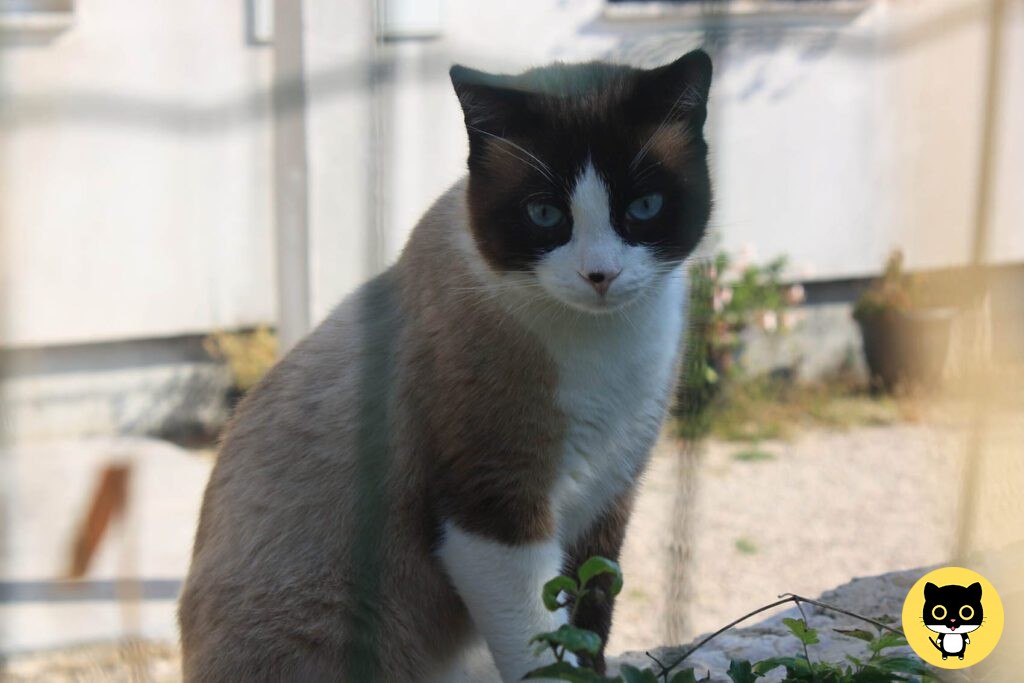
The Snowshoe is best understood as an engaged companion rather than a predictable personality package. This pointed, blue-eyed cat may follow people from room to room, demand a game, comment on household events or settle nearby while someone works. Yet the same breed can include a quieter cat, a cat that dislikes being carried, or one that retreats when unfamiliar visitors arrive. The useful question is not simply whether Snowshoes are friendly; it is whether you want a cat that may participate actively in household life, while accepting that each individual chooses how that participation looks.
Quick Facts
| Type | Pointed shorthair breed with white feet and blue eyes |
|---|---|
| Adult reference size | Females approximately 7–10 lb (3.2–4.5 kg); males approximately 9–12 lb (4.1–5.4 kg) |
| Coat | Short, smooth and close-lying; usually a light grooming commitment, but not hair-free |
| Typical activity | Active, curious and athletic, with individual variation |
| Estimated longevity | About 15–20+ years as a reported estimate, not a guarantee |
| Recognition | Accepted as a championship breed by TICA in 1994; recognized by FIFe since 2004 |
What the Snowshoe is—and what establishes its identity
The Snowshoe is a registry-defined breed developed in the United States from Siamese-related cats crossed with bicolor American Shorthairs or domestic cats. Its name refers to the characteristic white feet, while its overall appearance combines pointed coloring with a moderate, athletic build. TICA lists it as a championship breed accepted in 1994, and FIFe records recognition from 2004. It is not listed among the breeds on the CFA breeds page checked in October 2026. Readers can compare the TICA breed description and FIFe breed page for those recognition positions.
Appearance alone cannot prove that a cat is a Snowshoe. Pointed coloring, blue eyes and white feet can occur in nonpedigreed domestic cats and in cats from other breed backgrounds. A rescue cat with the Snowshoe look may be a wonderful companion, but documented registration or ancestry is needed when pedigree identity matters. This distinction also prevents appearance, price and health expectations from being treated as if they were the same thing.
Appearance, color and the developing pattern
The intended Snowshoe body is firm, muscular and moderately elongated rather than heavy or cobby. The head is a modified wedge, the ears are medium to medium-large, and the paws are oval. The approximate adult reference ranges are 7–10 pounds for females and 9–12 pounds for males, although healthy individuals will not all occupy the middle of those ranges. Body condition and proportion matter more than reaching a particular number.
The coat is short, smooth and close to the body, generally with no evident undercoat in the cited breed material. Long, plush or woolly coats are not the intended type. The coat’s light feel makes grooming straightforward, but it does not make the home hair-free: a short-haired cat can still shed loose hair onto furniture and clothing.
Pointed coloring, blue eyes and four white feet provide the visual identity most people associate with the breed. Seal and blue points are commonly described, while chocolate and lilac points are less common. The white on the face and feet varies in amount and shape. Some standards place particular value on an inverted-V facial marking, but real cats may show less symmetrical or less sharply defined white.
Kittens begin life white and develop their points during the following weeks. Point color, body color and the contrast of the white areas can continue changing for up to about two years, especially in dilute colors. A kitten’s early appearance is therefore not always its finished adult pattern.
Living with a social, active cat
Activity is one of the most practical parts of Snowshoe ownership. These cats are described as athletic, curious and trainable, with possible enthusiasm for chasing toys, climbing, retrieving, leash walking, water play or agility-style activities. Not every Snowshoe will enjoy every one of these pursuits, but a home should be ready for more than occasional passive entertainment.
Daily interactive play, sturdy scratching surfaces, elevated resting places and puzzle or reward-based activities give that energy somewhere useful to go. Wand toys, toy rotation and short training sessions can be more effective than leaving a large collection of toys untouched. A Snowshoe who receives little interaction may seek stimulation by opening doors, investigating cupboards, waking people or creating games of its own. That is not necessarily misbehavior; it may be a sign that the environment is not offering enough appropriate work.
Social attachment often appears as proximity rather than constant cuddling. A Snowshoe may follow a familiar person, sleep beside them, supervise household tasks or seek conversation without wanting to sit on a lap. Handling tolerance is a separate quality. A cat may love its person and still object to being picked up, restrained for nail trimming or touched by a stranger.
Vocal behavior also varies. Some Snowshoes are quiet, while others talk frequently or make persistent requests. The breed descriptions characterize vocal individuals as generally soft and melodic, but a prospective caregiver should not assume that every cat will be either silent or conversational. If nighttime noise would be a serious problem, meeting the individual cat—or asking a breeder or foster caregiver specific questions about its daily vocal habits—is more useful than relying on the breed name.
Home suitability and relationships with people and animals
An apartment can suit a Snowshoe when it provides vertical territory, scratching areas, safe retreat spaces, regular play and dependable social contact. A large house is not automatically a better environment if it offers little interaction or stimulation. The meaningful measure is whether the cat can exercise, observe, withdraw and engage with people on its own terms.
Children can be a reasonable match when adults supervise interactions and teach respectful handling. The cat needs an escape route that children cannot block, and the family needs to understand that following a child or playing nearby is not permission to be grabbed. A Snowshoe that dislikes restraint should not be pressured into cuddling to satisfy a child’s expectations.
Other cats and dogs require an individual assessment rather than a breed-wide promise. Some caregivers describe Snowshoes that love dogs; others describe cats that dislike other cats or could not be integrated successfully with resident senior cats. These differences may reflect age, previous experience, introduction methods and individual temperament. Separate rooms at the beginning, gradual scent and visual exchanges, duplicate food and water stations, multiple litter boxes and escape spaces give introductions a better chance.
Reported chasing and hunting behavior also matters when a home includes birds, rodents, rabbits or other vulnerable small animals. Secure separation is prudent, even if the Snowshoe seems affectionate toward people. Outdoor interest is not a reason to allow free roaming. An enclosed area, supervised outing or leash arrangement is safer when the individual cat accepts it.
Allergies deserve similarly realistic planning. Short hair does not make a Snowshoe hypoallergenic. Fel d 1 exposure is not reliably predicted by coat length or visible shedding, so someone with significant allergies should spend time with the particular cat and seek medical advice before committing.
Grooming and everyday care
A Snowshoe’s coat usually creates a relatively light grooming routine. Weekly brushing is a reasonable starting point, using a soft brush to lift loose hair and help a caregiver notice changes in the skin. Some cats will need less frequent grooming; others shed more noticeably at particular times of year. The coat’s low tendency to mat does not eliminate the value of handling practice, especially if the cat will need veterinary examination or nail care.
There is no distinctive Snowshoe diet or special routine for bathing, eyes, ears or skin that needs to be assumed for every cat. Feed a complete diet appropriate to the cat’s life stage, monitor body condition rather than relying only on food labels, and provide ordinary dental care, parasite prevention, nail care and veterinary examinations. An active cat can still gain weight if food intake exceeds its actual exercise, particularly as it ages.
Training works best when it is short, predictable and reward-based. Teaching a cat to enter a carrier, accept brief paw handling or walk through a harness should happen gradually, before those skills become urgent. A Snowshoe may be highly trainable and still have firm preferences about what it will tolerate.
Health, records and responsible acquisition
No single, definitive Snowshoe disease profile is established by the available breed material. That makes a restrained health approach more useful than a dramatic list of inherited disorders. Routine preventive care, attention to weight and dental health, and prompt veterinary advice when behavior or physical condition changes are appropriate for every Snowshoe.
Breeding records still deserve careful attention. The breeding policy and health information discusses PRA and PKD testing in the context of breeding decisions, historical ancestry and breeding lines; it does not establish those conditions as a diagnosis for every Snowshoe. References to HCM in the same context concern British Shorthair outcrosses rather than a demonstrated universal Snowshoe predisposition. A buyer should ask what testing is relevant to the particular parents and line, rather than treating every test as mandatory for every cat. Cardiac screening should be guided by family history and veterinary advice.
Before buying a registered kitten, request registration and pedigree records, the parents’ and close relatives’ health history, vaccination and veterinary records, and relevant PRA or PKD testing information. A responsible breeder should be willing to explain what is known, what has been tested and what remains uncertain. For an adult or rescue cat, medical records and a direct assessment of behavior may be more informative than an assumed breed profile.
Longevity, cost and availability
A reported Snowshoe longevity estimate is 15–20 or more years. That figure is useful for planning a long relationship, but it is not a population median or a promise for an individual cat. A caregiver should plan for changing food, activity, dental and veterinary needs over a potentially extended lifetime, including the possibility of emergency expenses.
In U.S. market-guide examples checked in September and October 2026, breeder asking prices were approximately $2,000–$4,000 or more in one guide and $2,000–$3,500 in another. These are dated asking ranges, not audited completed-sale prices; location, pedigree, breeder practices, age, color and included care can all change the amount. The figures should not be read as proof that a higher-priced cat is healthier or more affectionate.
U.S. shelter and rescue examples checked in 2026 ranged from approximately $50–$150 through one adoption service and $50–$300 in another consumer guide. Adoption fees are not breeder prices and may include sterilization, vaccines, microchipping or preventive treatment. A shelter cat with Snowshoe-like coloring may not have documented pedigree, but that affects identity records rather than the cat’s ability to become a rewarding companion.
One U.S. consumer estimate placed recurring food, litter and routine-care costs at about $50–$150 per month in September 2026. That estimate varies substantially with location, food and litter choices, insurance and veterinary practice, and it does not adequately represent emergencies. It is better used as a starting budget than as a dependable monthly ceiling.
Registered kittens can be difficult to find in some regions. The member-breeder search may help locate registered breeders, while shelters and rescues may offer cats with the characteristic appearance more readily. Anyone seeking pedigree should verify the documentation before paying a breed-specific price.
Is a Snowshoe right for you?
A Snowshoe may suit a caregiver who wants an interactive cat, enjoys play and communication, and is prepared to build an enriched indoor environment. The breed can be a good fit for someone who appreciates a companion that may follow them, learn routines, investigate the home and remain close without necessarily becoming a lap cat.
It may be a poor match for someone seeking a reliably quiet, highly independent or consistently cuddly cat. The breed label cannot guarantee tolerance of visitors, dogs, other cats, nail trimming or being carried. An adult meeting is particularly valuable: it allows a prospective caregiver to observe sociability, stranger response, handling tolerance, activity level and lap preference directly.
What owners and caregivers say
Owners and caregivers describe Snowshoes as rewarding precisely because they can feel involved in family life. People report cats that follow them everywhere, sleep nearby and make their presence known through frequent conversation. One kitten caregiver described especially active nighttime talking, while another owner described two cats as affectionate, clingy and vocal. For a person who wants a cat that notices household routines and seeks interaction, those qualities can be delightful.
Closeness does not always mean physical compliance. Caregivers describe cats that stay beside their people but dislike laps, being picked up or having their claws trimmed. That contrast is important: a Snowshoe may be deeply attached while still requiring consent-based handling and patient training. Someone imagining a cat that welcomes prolonged restraint should ask about that specific behavior rather than equating affection with touch tolerance.
Confidence around strangers ranges just as widely. Some caregivers describe hiding, sensitivity to doorbells or fear of unfamiliar situations; others report cats that readily greet visitors. A quieter older cat may spend much of the day resting, while another individual may require repeated play sessions. These are compatible experiences, not evidence that one side has misunderstood the breed. They show why age, history and the individual relationship matter.
Relationships with other animals can also be decisive. One caregiver described a very people-loving Snowshoe that could not be integrated successfully with senior cats. Another reported a cat that loved dogs, while a different owner described a Snowshoe that disliked other cats. These stories make gradual introductions and realistic household matching more important than assuming universal compatibility.
Individual quirks can be especially memorable. One caregiver described a Snowshoe named Ezzie that traveled well, opened doors, played and showed affection. That is a charming illustration of one cat’s abilities, not a promise that Snowshoes commonly travel easily or learn to open doors.
The clearest practical conclusion is “engaged but not predictable.” Prepare for activity, social interest and intelligence, then leave room for a particular cat to be quieter, more cautious, less tactile or more selective about companions. When the home supplies enrichment and safe retreat, and the caregiver evaluates the actual cat rather than buying an appearance or a promise, the Snowshoe’s varied ways of participating in family life can become one of its greatest strengths.
 English