
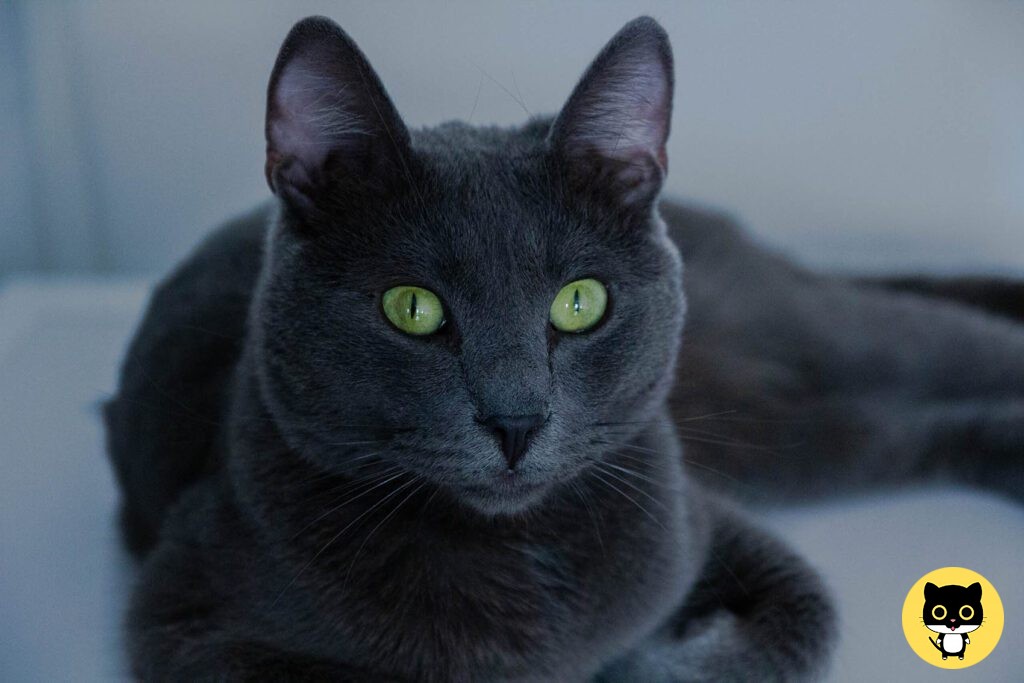
The Russian Blue is best understood as a cat of selective closeness: often observant, playful and deeply connected to familiar people, but not necessarily eager to be handled by everyone or in every situation. That distinction matters more than the simple label “affectionate.” A Russian Blue may follow a caregiver from room to room, sleep nearby, initiate play or converse vocally while still declining a lap or retreating when visitors arrive.
Quick Facts
| Typical type | Moderate-sized, long and graceful, fine-boned but muscular |
|---|---|
| Coat | Short, dense, plush double coat in blue with a silver sheen in the commonly recognized standard |
| Eyes | Vivid green in mature cats; younger cats may pass through yellow or transitional shades |
| Grooming | Usually modest, though the dense coat can leave visible hair |
| Reported lifespan | Broad estimates range from 10–20 years; other references give approximately 12–15 years |
| Best suited to | A predictable household that can provide play, vertical space, retreat areas and respectful handling |
Identity, recognition and related names
The Russian Blue is a distinct pedigreed breed rather than a description for any gray cat. A solid blue-gray coat may look similar, but appearance alone cannot establish pedigree. For a documented Russian Blue, registration and lineage records matter as much as the visual impression.
Recognition is not completely uniform across organizations. The CFA, TICA and FIFe standards describe the Russian Blue as a blue, shorthaired breed. The GCCF uses the broader name Russian and recognizes Blue, Black and White varieties. WCF lists the Nebelung separately as the longhaired Russian Blue. These differences are classification choices, not evidence that every gray, black or white cat belongs to the same pedigreed breed.
The breed’s relationship with the Nebelung is therefore worth clarifying. The Nebelung shares a Russian Blue connection but is treated as a separate longhaired breed in some classification systems. A longhaired cat with a Russian Blue-like color should not automatically be represented as a Russian Blue, and a domestic shorthair with a blue coat is not pedigreed simply because it has the right color.
For prospective buyers, the practical test is documentation: ask to see registration and pedigree records, veterinary records, parasite-control information, a written contract and the breeder’s return provisions. A responsible breeder should also explain how kittens have been socialized and share relevant family health information.
Appearance: elegant lines and a remarkably dense coat
The Russian Blue has a moderate, graceful build that can look delicate without being fragile. The body is long, the legs are long, the tail tapers, and the head is typically medium-sized with a modified wedge shape and large ears. Beneath that elegant outline is a muscular cat capable of climbing, sprinting and vigorous play.
Weight varies with sex, frame, age and condition. Published adult reference figures span roughly 7–13 pounds (3.2–5.9 kg) in one veterinary guide and 8–15 pounds (3.6–6.8 kg) in another breed reference. Those numbers are broad orientation points, not targets. A healthy body condition is more meaningful than trying to make a cat fit a breed-weight range, and dependable sex-specific ranges are not established.
The coat is short but not flat or insubstantial. Its fine, dense double layer feels plush, and silver-tipped guard hairs can give the blue coat its characteristic shimmering appearance. The coat may feel light in the hand while still putting hair on clothing, furniture and floors. “Shorthaired” reduces grooming work; it does not mean no shedding.
In the commonly used Russian Blue standard, mature eyes are vivid green or emerald green. Kittens and adolescents may have yellow or changing eye color before the adult shade develops. Coat color, eye intensity and overall finish can continue to mature, so a young kitten should not be judged against the final appearance of an adult.
The Russian Blue is not reliably hypoallergenic. Allergy-sensitive caregivers should spend time with the specific cat and, where possible, with the adults in its home before committing. Coat color, short hair and a polished appearance do not predict whether a person will react to that individual.
Temperament and everyday relationships
Curiosity is central to life with a Russian Blue. These cats are commonly described as observant, playful and interested in what their people are doing. A caregiver may find a cat watching from a high shelf, investigating a new object, joining a game or following household activity from a comfortable distance.
Attachment may be expressed through proximity rather than constant touch. A Russian Blue can rub against a person, sleep at the foot of the bed, follow someone through the house or settle nearby without wanting to be picked up. This is not lesser affection; it is a different social language. A household that notices voluntary contact is likely to build a better relationship than one that measures love by lap time alone.
Strangers and sudden changes can bring out the more cautious side of the breed. A cat may hide, hiss, growl or retreat from an unfamiliar hand after moving home. That response should not automatically be interpreted as aggression. Quiet refuge, predictable routines and the freedom to approach at the cat’s own pace can make a substantial difference. Sudden changes in behavior in an established cat still deserve veterinary attention.
Individual variation is unusually important when assessing fit. Some Russian Blues are comfortable being carried, highly vocal and eager to sleep on a lap. Others share space happily but avoid unexpected touch. Some settle within days; others require weeks or months to feel secure. A slow start after adoption can reflect relocation stress, previous socialization or temperament rather than a failed bond.
Positive training can be a rewarding outlet. Short, treat-based sessions may teach behaviors such as coming when called, jumping through a hoop or offering a paw. These examples support the use of patient, reward-based interaction, not a promise that every Russian Blue will perform tricks or a claim that the breed has a universal intelligence ranking.
Home life, children and other animals
An apartment can suit a Russian Blue if it offers territory rather than merely floor space. A tall cat tree, secure shelving, window perches, hiding places and daily interactive play can turn a smaller home into a sufficiently rich environment. A large house is not automatically better if it is noisy, unpredictable or leaves the cat nowhere to withdraw.
Daily play helps channel chasing, climbing and problem-solving behavior. Wand toys, food puzzles, rotating toys and brief training sessions are useful choices. Because the breed may have an enthusiastic appetite as well as an active mind, food puzzles should be included within a measured daily ration rather than added freely to it.
Children can live successfully with a Russian Blue when they are taught to wait for the cat to approach, avoid chasing and stop handling when the cat signals discomfort. Supervision is particularly important with young children. A child who wants a cat that tolerates being carried or hugged at any moment may be disappointed unless the individual cat has clearly shown that preference.
A calm, cat-safe dog may be compatible, and some Russian Blues form strong relationships with other cats. Neither outcome is guaranteed by the breed name. Introductions should be gradual, with separate resources and escape routes. Birds, rodents, reptiles and other vulnerable small pets require secure separation because a gentle household companion may still respond strongly to movement and hunting-style play.
Grooming and routine care
Grooming is usually straightforward. Breed-care guidance ranges from combing two or three times a month to once or twice a week. The right schedule depends on the individual cat’s loose hair, undercoat and tendency to form tangles. A quick, calm session is often more useful than an elaborate routine imposed on a cat that dislikes restraint.
Regular handling practice should include paws, ears, mouth and the carrier, but it should remain gradual and reward-based. The purpose is not to force submission; it is to make necessary care familiar. A cat that learns that brief handling predicts food or another pleasant experience may cooperate more readily over time.
Food management deserves attention. Large appetites can contribute to excess weight if portions and activity are not monitored. Feed a complete diet appropriate to the cat’s life stage, measure or otherwise control portions, and use body condition rather than a fixed breed amount to guide adjustments with veterinary help.
Dental care is ordinary but important feline care. Brushing where tolerated, veterinary dental assessment and attention to changes in eating or mouth comfort are sensible parts of preventive care. A 2024 case-control study recorded tooth resorption in 10.0% of its Russian Blue subgroup, but that finding does not establish a Russian Blue predisposition. It is better treated as a reason to take dental health seriously, not as proof of a breed disorder.
Health and longevity
No confirmed Russian Blue-specific inherited disease syndrome is established in the reviewed breed material. That is reassuring in a limited sense, not a guarantee of exceptional health. Russian Blues can still develop the ordinary problems of domestic cats, and preventive veterinary care remains essential.
Routine examinations, vaccination, parasite prevention, body-condition monitoring and dental assessment provide the practical foundation. Changes in appetite, weight, thirst, toileting, mobility, grooming, breathing or social behavior should be considered as health information rather than dismissed as personality.
Reported longevity estimates vary considerably. TICA gives a broad range of 10–20 years, while GCCF and VCA references give approximately 12–15 years; some sources mention individuals reaching 16 years or more. These are planning estimates rather than population life-expectancy measurements. Genetics, nutrition, preventive care, environment and chance all influence an individual cat’s lifespan.
Availability and purchase cost
Finding a pedigreed Russian Blue may take patience. Demand can exceed breeder supply, and some U.S. catteries use waiting lists or deposits. Contacting several established breeders, considering an adult rehome and being willing to wait are safer strategies than choosing the first gray kitten advertised online.
Dated U.S. asking-price examples checked in 2026 included US$2,500 from Velva Cattery, US$3,450 for a Royal Blues kitten, and US$2,200–3,000 for a household-pet male listed in Brookline, Massachusetts. These are listing prices, not completed-sale averages. The price may reflect differences in registration, breeding rights, transport, vaccinations, socialization and contract terms. Examples can be checked through the Velva Cattery listing, Royal Blues purchasing information and the Brookline listing.
A 2026 U.S. cost guide placed shelter or breed-rescue adoption at approximately US$75–200, but that is a general guide rather than a verified Russian Blue rescue-fee schedule. A shelter cat with a blue-gray coat may be a wonderful companion while being a domestic shorthair or mix without pedigree documentation. Those are different claims and should be kept separate.
Before paying a deposit, ask what is included and what happens if circumstances change. Registration and pedigree records, veterinary and parasite-control records, family health history, a written contract, return provisions and details of kitten socialization are all useful. The reviewed sources do not establish a mandatory Russian Blue-specific genetic testing panel, so a breeder’s claims about testing should be explained precisely rather than accepted as a breed-wide requirement.
Is a Russian Blue a good match?
A Russian Blue may suit a caregiver who values an intelligent, visually striking companion and enjoys relationship-building that does not always take the form of cuddling. The breed can be a good choice for an apartment, a family with respectful children or a home with another carefully introduced cat when the household provides play, vertical territory, retreat spaces and steady routines.
It may be a poor match for someone who needs a guaranteed lap cat, a completely silent housemate, an allergy-safe pet or an animal that adapts instantly to visitors and relocation. The more useful question is not whether Russian Blues are affectionate, quiet or easy. It is whether the household can accept a cat that may want to participate closely in family life while retaining firm preferences about touch, strangers and change.
Meeting an adult is particularly valuable. An in-person interaction can reveal lap preference, handling tolerance, vocalization, response to unfamiliar people and adjustment style far more reliably than a breed description. For a kitten, ask how the breeder has introduced it to people, household sounds, handling, carriers and other animals, while remembering that early behavior is not a guarantee of the adult personality.
What owners and caregivers say
Owners and caregivers describe Russian Blues as cats whose bonds can be strong even when physical contact is selective. One household included a female who stayed close to people but avoided laps and an approaching hand unless she was sleepy, while a male kitten in the same home was affectionate almost immediately after a long journey. The contrast makes the practical point clearly: even cats sharing a breed label can have very different ideas about closeness.
Adjustment after adoption also ranges widely. Some cats settle within days; others hide, hiss or retreat from hands after a move. One adopter described a frightened beginning followed by gradually increasing trust over weeks or months, with a quiet refuge and predictable routine helping the cat approach voluntarily. Another caregiver said an adult adopted Russian Blue took about a year before sleeping near the caregiver’s feet, eventually becoming affectionate and briefly friendly with visitors.
Affection may look like lap sleeping, asking to be carried, following a person, learning tricks or maintaining a lively conversation. It may instead look like sharing a room, rubbing against someone, appearing for bedtime or accepting a short snuggle while avoiding laps and unexpected handling. These experiences are compatible rather than contradictory: the common thread may be engagement on the cat’s terms, although that should not be treated as a rule for every individual.
Relationships with other cats show the same range. Some caregivers describe close feline companionship, while others emphasize slow introductions and the need to let each cat adjust at its own pace. The best preparation is therefore not a promise about the breed but a household plan: provide escape routes, introduce animals gradually, watch body language and allow trust to develop without force.
Selected sources
Recognition and standards can be checked through the CFA Russian Blue breed profile, TICA breed profile, GCCF Russian breed information and the FIFe breed regulations. Veterinary care guidance is available from Cornell Feline Health Center and VCA’s Russian Blue reference.
Owner stories mentioned above come from individual accounts, including examples about personality differences, adjustment and social relationships at this account of contrasting personalities, a frightened kitten after rehoming and an adult cat’s gradual adjustment. Individual stories illustrate possibilities, not the frequency of any one temperament.
 English