
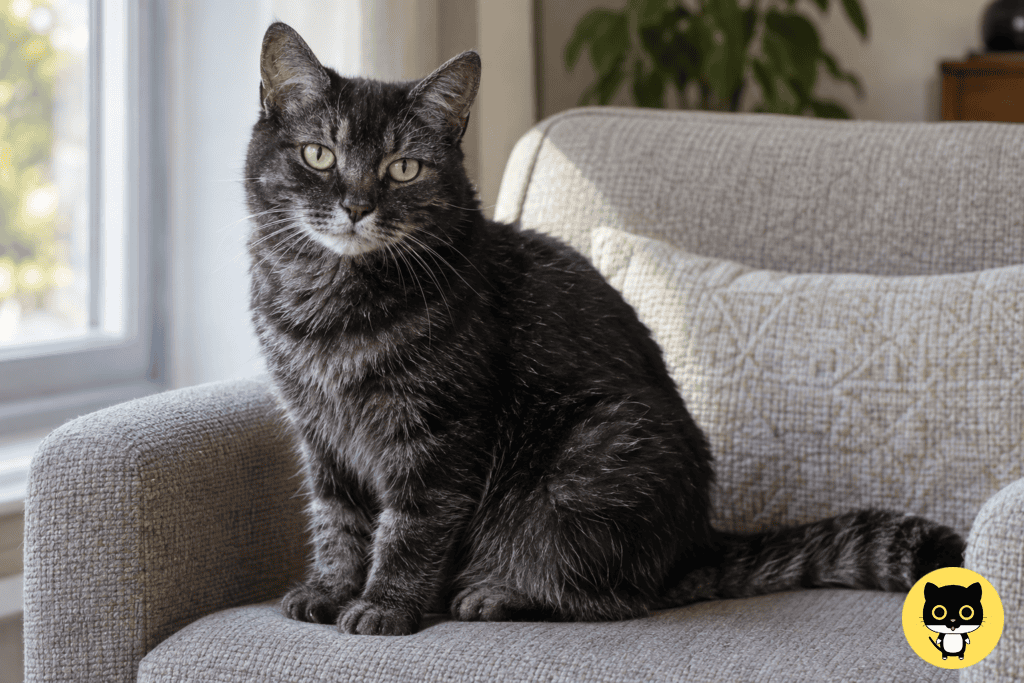
The Transylvanian is an emerging pedigree cat built around the naturally occurring Carpati, or Karpati, appearance associated with Romania. Its identity therefore has two parts: a distinctive coat pattern and a documented breeding programme. A free-ranging, rescue or farm cat with similar colouring may look remarkably close, but appearance alone cannot establish that it is a pedigree Transylvanian. For anyone considering purchase, pedigree records and registration are more meaningful than the coat by itself.
Quick Facts
| Breed name | Transylvanian |
|---|---|
| Foundation | Breeding programme associated with the naturally occurring Carpati/Karpati phenotype |
| Size and build | Medium-sized, medium-length, muscular without being heavy |
| Accepted coat expressions | Black Carpati and Blue Carpati |
| Coat length | Short; long hair is disqualifying under the published standard |
| Eye colour | Yellow to hazel preferred; a complete independently verified coat-specific rule is not established |
| Availability | Limited and international, generally arranged through individual enquiry |
| Breed-specific lifespan | No population-based estimate is available |
This distinction matters because the breed is still developing institutionally as well as genetically. The programme’s published material describes the Carpati foundation and an effort to preserve it through planned breeding, while the underlying genetic cause and inheritance pattern remain under investigation. The unusual appearance is real, but it should encourage careful verification rather than create an assumption that every similar-looking cat belongs to the breed.
Recognition and what a buyer is actually acquiring
Recognition currently depends on the organization and the date of the record being checked. The reviewed WCF EMS document lists Transylvanian as TRA-non and provisionally recognized. The breed project reports a full-recognition decision dated August 23, 2026, but that announcement does not remove the need to confirm the current position directly with the relevant registry. GCCF material lists the breed name and show eligibility, while that is not the same as full championship recognition.
For a companion buyer, this may seem like administrative detail, but it can affect what the purchase includes. A cat bought for companionship is not making the same promise as a cat bought with breeding rights, show eligibility or a pedigree accepted by a particular registry. Before paying a deposit, ask which organization will register the cat, whether the parents and litter are registered, what status applies in the destination country and whether the written contract reflects those claims.
The programme’s developing genetic work adds another reason to separate identity from appearance. Tests that exclude known feline variants can be useful pieces of health information, but they do not prove that a cat is a Transylvanian, establish the Carpati mutation, or guarantee that the cat is free from inherited disease. A credible breeder should be able to explain the laboratory used, what each test can and cannot detect, and how the results have influenced the mating plan.
Appearance: a compact athletic cat with a changing coat
The Transylvanian standard describes a medium-sized cat with a medium-length outline, relatively slender bone and a muscular but not bulky body. The legs are relatively high, the paws are compact and oval, and the tail tapers at medium length. This suggests an athletic, balanced cat rather than either a delicate fine-boned type or a heavy-bodied one.
The head is a modified wedge, with medium-sized upright ears that broaden at the base. The eyes are oval and slightly oblique. Yellow to hazel eyes are preferred in the published standard, but a complete independently verified rule assigning particular eye colours to each coat category is not available. A prospective owner should therefore be cautious about confident claims that a certain eye colour is guaranteed by a particular Carpati expression.
The defining coat effect is the Carpati pattern. Black Carpati has a dark base, while Blue Carpati has the corresponding diluted blue-grey base. Pale salt-and-pepper hairs soften and interrupt the darker colour, with stronger contrast commonly described around the nose, ear rims, paws, mask and tail. A small white locket on the chest or belly is permitted. Long hair is disqualifying under the published standard.
The coat may not look fully settled in kittenhood. Young cats can appear much paler, with the contrast developing progressively as they mature. This is useful to know when viewing photographs of kittens: a pale-looking youngster is not necessarily going to retain that first impression as an adult. Ask to see photographs of parents and older offspring, and treat an adult coat as the better guide to the finished expression.
The short coat should usually be simpler to manage than a longhaired coat, but “short-haired” does not mean “hair-free.” A soft, dense undercoat, coarser guard hairs and a slight lift can still produce loose hair around the home, particularly during seasonal shedding. No breed-specific brushing schedule has been established, so grooming should follow the individual cat’s shedding, tangling and tolerance. A comb used often enough to remove loose hair without turning grooming into a struggle is more useful than a fixed promise about weekly maintenance.
Temperament and the meaning of “people-oriented”
The breeding programme selects for gentle, trusting and human-oriented behaviour, and breeder descriptions portray the cats as calm, playful and interested in people. That is an encouraging starting point for a household seeking an engaged companion. It supports planning for daily social contact, interactive play, scratching areas, elevated resting places and the ability to choose between joining the household and retreating from it.
Those descriptions do not answer every question a household needs answered. A people-oriented cat may follow someone from room to room, settle nearby, seek play or enjoy brief contact without being a lap cat. The available information does not establish reliable breed-wide patterns for lap preference, being picked up, vocalization, climbing, hunting intensity, independence or response to stress.
Meeting the actual cat is therefore especially valuable. Ask how it responds to grooming, transport, visitors, unfamiliar rooms and time alone. For a kitten, ask what the breeder has observed rather than relying only on a general description of the breed. For an adult, direct observation can reveal whether “human-centred” means close physical contact, shared-room companionship or a more independent relationship.
Some cats from the programme have reportedly become family or therapy cats, and individual owners have described them as rewarding companions. One imported male, Heinrich GreyHeart, was described by his breeder as balanced and deeply human-centred after his first year with his United States owner. Lili GreyHeart was reported to have tolerated the journey from Europe to the United States and made friends quickly after arrival. These are useful examples of what an individual Transylvanian may be like, but they cannot predict how every cat will handle travel, handling or unfamiliar people.
Living with a Transylvanian
A Transylvanian is likely to do best in a home that offers social contact without requiring constant physical affection. Provide more than a food bowl and a bed: include daily play, stable resting places, sturdy scratching surfaces and room to move away from noise or attention. These are sensible provisions for a potentially people-oriented cat, not evidence of an exceptional enrichment requirement unique to the breed.
Compatibility with other cats or animals should be assessed one relationship at a time. Reports of friendliness with other cats and animals are encouraging, but they do not establish dependable compatibility with children, dogs or small pets. Introduce animals gradually, begin with separate resources and living areas, and provide escape routes that prevent one animal from being cornered.
Birds, rodents, rabbits and other vulnerable animals require secure physical separation even if the cat seems gentle. A friendly temperament does not remove predatory behaviour, and early socialization cannot guarantee that a particular cat will ignore a small animal. Families with young children should likewise supervise contact and teach the child to leave the cat alone while it is eating, sleeping, hiding or trying to escape interaction.
Indoor living or carefully controlled outdoor access is the safer default. Harnesses, enclosed outdoor spaces and supervised exploration can provide stimulation without exposing a relatively uncommon cat to traffic, theft, infectious disease or accidental breeding. If a cat is intended for outdoor access, discuss identification, neutering or breeding status, vaccination and local hazards with the veterinarian.
Care and veterinary considerations
Routine cat care is the appropriate starting point. Feed a complete diet suited to the cat’s life stage, monitor body condition rather than relying only on appetite, keep water available and maintain regular veterinary examinations. No special Transylvanian requirement for bathing, dental care, skin care, nutrition or climate management has been verified.
Dental care still matters even without a breed-specific dental warning. Introduce tooth brushing gradually if the cat accepts it, and ask the veterinarian to examine the mouth during routine visits. Similarly, do not interpret a short coat as protection from skin problems or assume that a cat with striking eyes needs unusual eye care. Observe the individual and investigate changes such as persistent discharge, itching, weight change, poor appetite or altered behaviour.
No breed-specific disease predisposition, prevalence estimate or validated inherited syndrome has been established for the Transylvanian. Individual genetic screening is not proof that the breed is disease-free, and the Carpati genetic variant remains under investigation. This is not a reason to expect illness; it is a reason to avoid marketing claims that promise a special health advantage or a complete genetic guarantee.
No population-based Transylvanian lifespan estimate is available. Individual cats may reach ordinary feline ages, but that general expectation should not be presented as a measured breed-specific figure. Preventive care, weight control, dental attention, safe housing and prompt treatment remain more useful to a caregiver than an unsupported number.
Buying, availability and cost
Availability is limited and international. Documented breeding activity or placements have involved Romania, Hungary, Canada and the United States, and current placement is handled through individual enquiries rather than a continuously stocked public inventory. A buyer may therefore face a waiting period, international transport, import paperwork and the need to verify that the pedigree follows the cat across borders.
No defensible public purchase-price range, completed-sale dataset or breed-specific adoption fee was available as of October 2, 2026. The project indicates that prices are discussed individually according to the cat, destination, status, documentation and transport. That means an advertised figure should never be repeated without identifying its currency, region, date and basis—asking price, completed sale or adoption fee.
Before committing money, request the pedigree and registration records, veterinary history, vaccination and parasite records, family health information and the laboratory reports for every DNA test. Ask what the results mean, what they do not mean and how they affect the planned mating. The contract should state the cat’s registration status, breeding or show rights, health terms, payment arrangements and return policy.
International acquisition requires a separate practical check. Confirm the destination country’s import rules, microchip and vaccination requirements, health certificates, quarantine provisions, carrier requirements and total transport costs before paying a deposit. A low-looking kitten price can become a very different final cost once transport, paperwork, veterinary preparation and exchange rates are included.
Who is this breed suitable for?
The Transylvanian may suit someone who appreciates an uncommon appearance but wants the everyday routine of a short-haired cat rather than an elaborate grooming project. It may also appeal to a caregiver who enjoys an interactive relationship and is willing to provide regular contact, play and environmental choice without demanding that the cat be constantly available for handling.
It is less suitable for someone who wants certainty from the breed label alone. The developing recognition picture, limited availability, unresolved genetics and lack of a breed-specific longevity estimate make documentation and realistic expectations essential. A buyer who wants show eligibility or breeding rights should verify current registry rules directly; a companion-only buyer can place more weight on the actual cat’s social history, but still needs a reliable pedigree and contract.
The most useful decision is not whether every Transylvanian will be calm, cuddly or easy with other animals. The evidence does not support those promises. The more practical conclusion is that the breed offers a plausible direction—distinctive coat, short-hair care and a breeding goal centred on gentle human relationships—while the individual cat remains the best guide to handling tolerance, sociability and household fit.
What owners and caregivers say
Owners and caregivers are likely to find the Transylvanian rewarding when they value an engaged relationship more than a fixed personality type. Reports from the breeding programme describe family and therapy placements, and particular cats have been said to adjust well to new homes and international travel. These experiences make the breed’s people-oriented aim tangible, but they should be read as examples rather than guarantees.
An owner considering one should ask what companionship looks like in the specific cat: Does it seek a lap, follow people, settle close by, initiate play or prefer to be admired without much handling? How does it respond to grooming, visitors, transport and quiet periods alone? Those answers are more useful than assuming that a striking appearance comes with a fully predictable temperament.
The Transylvanian is best approached with curiosity and verification. Its coat can make it immediately memorable, while its emerging status means that pedigree, current registry standing, health documentation and transport arrangements deserve unusually careful attention. For a caregiver comfortable with ordinary cat care and a little more responsibility around checking what is established, it can be an intriguing and potentially affectionate companion—provided the individual cat, rather than the name alone, earns the final vote.
 English